
400,000 Chitungwiza Residents Trapped In A Living Nightmare Of Human Waste
The adage “water is life” is slowly losing its relevance for nearly 400 000 residents of Chitungwiza, a bedroom town located about 25 kilometres southeast of Harare’s central business district, where water shortages and bursting sewage pipes have become a grim reality.
Zimbabwe National Statistics Agency (ZimStat’s) 2022 population and housing census preliminary results show that Chitungwiza is the third largest populated urban council after Harare and Bulawayo, with 371 244 inhabitants.
Current projections by the World Population Review say between 419 611 and 420 000 inhabitants now live in Harare’s dormitory town.
It is for these inhabitants that each time municipal water returns after days or even weeks of enduring dry taps, it sparks disaster.
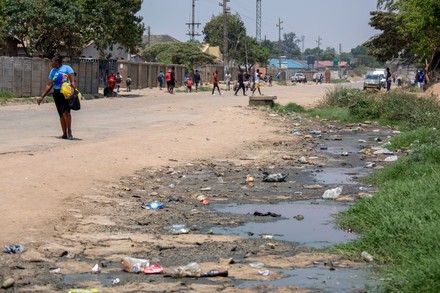
Instead of bringing joy to residents, who sometimes go for long without running water, the returning supply of the precious liquid is followed by streams of raw sewage flowing onto streets, yards and homes, posing a serious health hazard to residents who include children and the elderly.
For residents, this incongruity is agonising as they are caught in a difficult situation, torn between two undesirable options.
Beaulla Meki (40) said living without running water is a problem on its own but its presence raises serious health concerns as well.
“We need water for our day-to-day survival but every time municipal water comes, we have to take turns as a family cleaning up the foul-smelling sewage around our home to make the place habitable,” said Meki, a resident of Zengeza 1, in Chitungwiza.
The Rufaro Road area in the same suburb has earned monikers such as “Water Works, Limpopo, Rufaro River” due to the ever-flowing raw sewage along its length and breadth, providing a conducive breeding ground for water-borne diseases that include cholera, typhoid and dysentery.
Over the years, Chitungwiza has been hit by recurring outbreaks of deadly diarrheal diseases, which have seen the town losing precious lives.
When a catastrophic cholera wave swept through the country in 2008 to 2009, more than 4 000 people, including children, succumbed to the water-borne disease, with Chitungwiza being the initial epicentre.
ZimStat’s Human Settlement and Environmental Health Statistics Report of 2023 showed that in 2023 Chitungwiza recorded a total of 4 280 diarrhoeal diseases and conditions with diarrhoea accounting for 4 256 cases while dysentery and cholera registered two and 21 cases respectively.
Of the 4 256 diarrhoea cases, 2 250 were children aged below five years and the remainder were those aged five and above, underscoring the fact that young children are vulnerable to intestinal diseases.
The same report revealed that Chitungwiza recorded one cholera fatality and one typhoid case in 2023.
Reports also indicate that between October 2023 and January 2024 cholera claimed five lives in the sprawling dormitory town.
Cholera is caused by consuming food or water contaminated with the bacterium vibrio cholerae.
One Ndlovu (69), who has lived in Zengeza 3 Extension since 1994 when the area was still being developed, fears waking up one day drenched in raw sewage.
The Zimbabwe Old People Association (Zopa) member said each time municipal water is reconnected, his ensuite lavatory gurgles and swells, threatening to overflow as the ageing pipes strain under pressure.
“I live in constant fear that one day I will wake up to a house flooded with raw sewage,” Ndlovu said.
“Each time municipal water is restored, my ensuite lavatory rises to alarming levels, releasing a choking stench.
“And, spending the entire night inhaling the foul stench is unbearable, especially to someone of my age.
“Personally, I implore those at the helm of Chitungwiza Municipality and government to urgently address the matter.’
Turning to children, Ndlovu said he constantly battles to keep his three-year-old grandson and his friends from playing near the pool of unprocessed sewage that has formed in front of his house.
“Naturally, children love playing with water but they cannot separate clean from dirty water,” said a concerned Ndlovu.
“When I am around, I stop them from playing near sewage but they sometimes sneak off and use the contaminated water in their games.”
When this publication visited Zengeza 3 Extension recently, streams of raw sewage could be seen gushing from several homes near Ndlovu’s residence, painting a grim picture of the worsening sanitation crisis.
Despite all this, life has to go on.
In their efforts to get rid of flooding in their yards, residents have improvised drains that snake through their homes, directing the raw effluent onto the streets, where it disrupts the smooth flow of human and vehicular traffic as they try to manoeuvre past the mess.
At times, residents are forced to take risky ways past the filth.
They use precarious stepping stones, dotted across streams and pools of raw sewage, to navigate from one end to the other.
But, young children and senior citizens, who are most vulnerable to poor sanitation environments, often find it difficult to walk past the shaky stones.
As a result, they may end up trudging through raw sewage.
At other points, roads have become impassable, forcing residents to find alternative routes.
For the residents of Chitungwiza, this is not a temporary phenomenon but daily exposure to raw sewage.
Adding to the irony is the fact that residents who spoke to this paper said they have ceased to consume municipal water directly or indirectly, citing quality concerns.
They said they use the council water for laundry, flashing toilets, general house cleaning among others.
However, there are growing fears that those alternative sources such as boreholes and shallow wells deemed safe could also be contaminated through percolation.
Chitungwiza Municipality spokesperson Tafadzwa Kachiko said the recurrent sewer bursts were caused by a combination of factors which included aged sewer infrastructure, scarcity of conventional municipality water as well as improper disposal of solid waste into sewer lines.
“The recurrent sewage bursts in areas such as Zengeza, St Mary’s, CA and Unit M are largely a result of aged sewer infrastructure, scarcity of conventional municipality water, and improper disposal of solid waste into sewer lines.
“Residents often experience sewer bursts when water supply is restored because some lines would have been clogged with foreign materials such as sand, sanitary pads, diapers, and even kitchen utensils,” Kachiko said.
He said the Chitungwiza’s sewer system was designed for a smaller population hence the current demand exceeds its capacity.
“In the long-term, we have embarked on comprehensive rehabilitation projects, including the Zengeza Outfall sewer rehabilitation and targeted upgrades in St Mary’s, Unit M and other affected areas,” Kachiko said
“These projects being implemented in phases due to resource limitation, are aimed at modernising the network and expanding its capacity to meet the growing demand.”
Chitungwiza and Manyame Residents Association (Camera) director Marvelous Kumalo said the raw sewage overflows have engulfed the whole town, and this has far-reaching consequences to residents.
“This is a problem that covers the entirety of the town,” Khumalo said.
“We have sewage hotspots in St Mary’s such as the CA area, Rufaro Road area and the Chigovanyika area.
“We have the same problem in Seke’s Unit D, Unit B and Unit M areas.
“The sewage crisis has affected our daily lives, remember the recurrent cholera situation in Chitungwiza and other water-borne diseases.
“In terms of health, it has negatively affected the town.”
He said they have raised these concerns with the Chitungwiza Municipality, but they always cite lack of resources for taking out major uplifts relating to sewer infrastructure.
“We have seen positive attempts by the municipality and other partner organisations attending to these raw sewage overflows and sewage pipe bursting, but in our view, these projects produce limited results or solutions as far as the overflows are concerned because these are just stop-gap measures,” Khumalo said.
“What is needed is a complete overhaul of the sewer system so that we don’t do the ad-hoc approach to attending to sewer bursts.
“We are continuing to call on the municipality and the central government to resolve this crisis by setting aside adequate resources to increase the volume of piping infrastructure.”
Community Working Group on Health (CWGH) executive director Itai Rusike said the 2008-2009 cholera outbreak served as a grim reminder of Zimbabwe’s urgent need to invest in reliable water and sanitation infrastructure.
“Local authorities have a very clear mandate on water, sanitation and hygiene (Watsan),” Rusike said.
“The cholera outbreak of 2008-2009 was a marker of the need for investment in water and sanitation infrastructure.
“The historical cholera outbreak of 2008-2009 started in Unit O, Seke, Chitungwiza due to water starvation and yet city authorities, as are the rest of urban areas, have not yet improved on execution of their Watsan mandate.
“Zimbabweans still suffer and die from preventable diseases which in other countries were last seen more than 100 years ago because of effective prevention using Watsan, organised urbanisation, safe food and nutrition systems, and good enabled personal and food hygiene.”
Recent reports have said council is working on rehabilitating Chitungwiza’s sewer system, following a meeting with central government Chitungwiza Municipality officials.
However, residents remain sceptical, arguing several other projects in the past yielded nothing.
“Personally, I have completely lost trust in council and government overtures.
“There have been several projects in the past, including one in 2016 and yet another which was funded by the African development bank – through Zimfund – but they did not produce any tangible results.
“We suspect these are ploys to siphon money through seemingly positive project proposals,” said 35-year-old Onias Tumbare who resides close to Rufaro Road in Zengeza 1.
Despite Chitungwiza’s growth, the ongoing raw sewage overflows are not beyond redemption.
There is an urgent need to upgrade the entire sewage system, coping with the ballooning population.
Continous education and behaviour change campaigns – run in local media, community platforms and schools – will also go a long way in discouraging residents from dumping foreign objects into sewer lines, making illegal connections as well as warning against acts of vandalism. Standard