
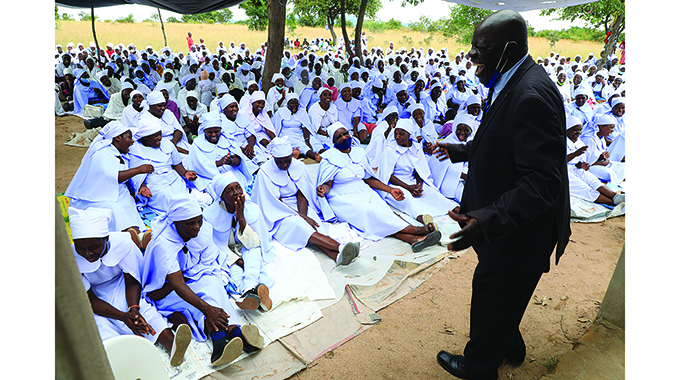
Supreme Court ends Mugodhi Church succession battle, upholds appointment of bishop
THE Supreme Court has dismissed an appeal by Mugodhi Apostolic Faith Church and Washington Mugodhi (pictured) bringing to an end a protracted leadership dispute and confirming that the church is governed by a written constitution under which succession to the office of bishop is not hereditary.
In a judgment handed down recently, a bench comprising Deputy Chief Justice Elizabeth Gwaunza and Justices Lavender Makoni and Hlekani Mwayera upheld a High Court ruling that Aaron Munodawafa is the substantive Bishop of the Mugodhi Apostolic Faith Church, while Washington Mugodhi’s claim to the position was unlawful.
“The appeal be and is hereby dismissed with costs,” the Supreme Court ruled, with full reasons released subsequently.
The dispute arose in 2019 following the illness and later death of Bishop Tawedu Mugodhi, who had led the church until his passing that year. Shortly before his death, Bishop Mugodhi convened a meeting of senior church leaders and announced that his son, Washington Mugodhi, then a pastor, had been appointed senior vice bishop.
That announcement triggered sharp divisions within the church, with one faction insisting that leadership succession was governed by a long-standing written constitution based on seniority, while the opposing camp argued that the church had no constitution and that the bishop was free to appoint his successor in line with unwritten traditions.
The leadership impasse quickly escalated into a series of court battles, including urgent applications to interdict rival factions from accessing church shrines and properties, and a declaratory application seeking clarity on who lawfully held the office of bishop.
Tracing the origins of the church, the Supreme Court noted that the Mugodhi Apostolic Faith Church was founded in 1949 following a breakaway from the Apostolic Faith Mission after disagreements over polygamy. From its inception, the court found, the church operated as a universitas governed by a constitution, with leadership appointments regulated by seniority rather than lineage.
“The former Bishops of the church were former vice bishops who only ascended to the position of Bishop by having been the most senior vice bishop of the church per the church constitution,” said the Supreme Court.
The court outlined a consistent succession history in which bishops who led the church after its founding , including Lameck Chakuvinga, Bishop Chikwena and Bishop Mutandiro Mubvuwiwa, were not members of the Mugodhi family, reinforcing the finding that succession was not hereditary.
After Bishop Tawedu Mugodhi’s death, a National General Conference held on 2 February 2020 resolved that the office of bishop had fallen vacant. In line with the constitution, the senior vice bishop at the time, Aaron Munodawafa, was appointed substantive bishop, while Tonnie Sigauke was elevated to senior vice bishop.
Washington Mugodhi challenged those resolutions, arguing that the church had no valid constitution and that his late father had appointed him in terms of unwritten church canons. He further sought court orders barring rival leaders from accessing church shrines.
The High Court rejected those arguments, finding that the church had adopted a constitution as far back as 1952, which had been amended over time, and that Bishop Tawedu Mugodhi himself had repeatedly acknowledged its existence. The High Court declared Munodawafa the lawful bishop and interdicted Washington Mugodhi from holding himself out as such.
On appeal, the Supreme Court found no basis to interfere with those findings. The court held that Washington Mugodhi had failed to lead any evidence to disprove the existence of a constitution and could not “approbate and reprobate” by relying on the constitution when it suited him and disavowing it when it did not.
“The second appellant cannot be allowed to rely on the constitution as and when it is favourable to him and when it is not in his favour make a complete turn around and claim that the church has no constitution,” the court said.
The apex court further ruled that allegations of fraud surrounding the church’s 1952 constitution had been raised for the first time on appeal and could not be entertained.
Having confirmed that succession was constitutionally regulated, the court held that Munodawafa, as the most senior vice bishop at the time of the vacancy, was the only person eligible to be appointed bishop.
“The second appellant’s appointment based on inheritance has no basis on which to stand on,” the court said, declaring his claim “null and void”.
The ruling decisively closes a years-long leadership struggle that had fractured the Mugodhi Apostolic Faith Church and entrenched the principle that church governance, even in religious bodies, remains subject to their own constitutions and the rule of law.