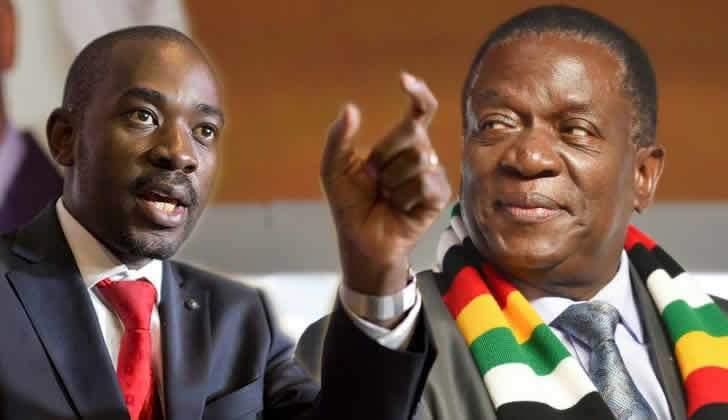
Chamisa challenges Mnangagwa to subject proposed constitutional changes to referendum
Opposition politician Nelson Chamisa has taken President Emmerson Mnangagwa to task over what he describes as sweeping constitutional changes being pursued without consulting the people of Zimbabwe, as required by the constitution.
His remarks come amid growing debate over Constitutional Amendment Bill No. 3, which has stirred controversy across the political divide.
Addressing journalists in Harare on Thursday, Justice Minister Ziyambi Ziyambi said the proposed armendments do not require a referendum, effectively ruling out a direct vote by citizens on the alterations to the country’s supreme law.
Among the proposed amendments is a provision to extend Mnangagwa’s term of office from 2028 to 2030, thereby altering the current five-year presidential term to seven years.
In addition, another significant proposal seeks to remove the right of ordinary citizens to directly elect the President, restricting that power to Parliament instead.
Legal analysts have argued that such far-reaching changes require a referendum. Notably, senior Zanu PF figures, including Patrick Chinamasa, have previously acknowledged that certain constitutional amendments of this magnitude would ordinarily demand approval through a national plebiscite.
Against this backdrop, Chamisa who contested Mnangagwa in the heavily disputed 2018 and 2023 elections has emerged as a vocal critic of the proposed reforms. Widely viewed as the principal political rival affected by the changes, he has challenged the President to subject the amendments to a referendum if he is confident of public support.
Writing on social media recently, Chamisa questioned Mnangagwa’s self-description as a constitutionalist, arguing that a genuine defender of constitutionalism should not shy away from the will of the people.
“Dear Mr ‘Listening President’…A true and proper constitutionalist must not be afraid of proper elections or at all costs seek to avoid the people.
“Why are you so scared of people of Zimbabwe if you claim you are supported? Has the time not come for you to persuade the persuaders not to persuade you not to murder the ‘constitution’?” Chamisa said.
Section 328 of Zimbabwe’s Constitution is widely interpreted as both explicit and instructive in requiring a referendum for amendments that affect presidential term limits and other entrenched provisions.
Meanwhile, Zanu PF is relying on its parliamentary majority to steer the controversial bill through the legislature. Critics, including opposition figures and civic groups, have described the proposed amendments as a “mutilation” of the constitution.
Mnangagwa’s loyalists, including self-exiled Professor Jonathan Moyo, have sought to defend the changes, arguing that they amount not to a term extension but to an adjustment of electoral cycles – a position that has drawn scepticism from several legal scholars within Zimbabwe and beyond.
At the same time, a group of war veterans has approached the Constitutional Court, arguing that the President is acting unlawfully by pursuing sweeping constitutional changes without consulting the electorate.
The matter is yet to be heard. *_-Bulawayo24_*