
The trending US-Iran war explained [FULL DETAILS]
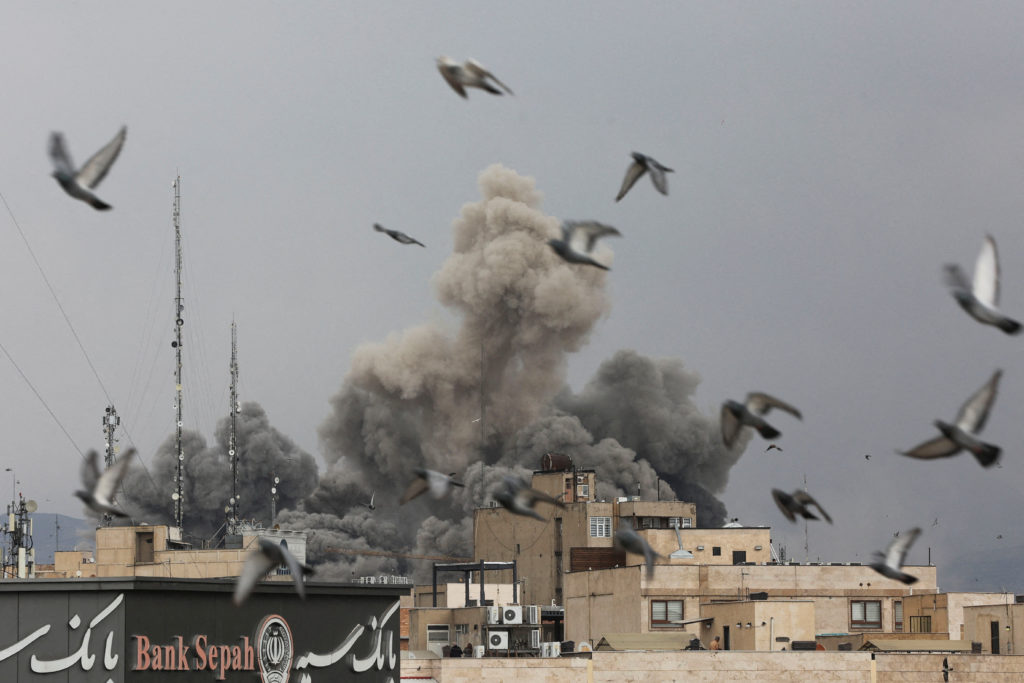
The United States and Israel launched coordinated military operations against the Iranian regime on February 28, 2026. The action, focused on the regime’s nuclear facilities, military infrastructure, and leadership, followed a conclusion reached in Washington and Jerusalem that diplomacy had been exhausted, and that a nuclear-armed Iran posed an unacceptable security threat to America, Israel and America’s Arab allies, and the world. Here is what you need to know.
*What Happened?*:
U.S. President Donald Trump confirmed that the United States launched strikes against the Iranian regime, saying “the United States military began major combat operations in Iran” to “defend the American people by eliminating imminent threats from the Iranian regime,” and reiterating that Tehran “can never have a nuclear weapon.” The U.S. said the operation, called Epic Fury, was carried out alongside Israel’s campaign Roaring Lion, with Prime Minister Benjamin Netanyahu saying Israel acted to remove “the existential threat posed by the terrorist regime in Iran” and thanking Trump for his “historic leadership.”
Iranian media reported explosions in Tehran and other sites tied to intelligence, defense, and nuclear programs.
*What is AJC Saying?*:
American Jewish Committee stands with the United States and Israel as they undertake targeted military action to stop the Iranian regime’s global terror campaign. The world will be a safer place when the threat of the Iranian regime’s illicit nuclear and missile programs, along with Iran’s Islamic Revolutionary Guard Corps, is dismantled once and for all. We hope today’s military action is a decisive step toward fulfilling that vital mission. Read the full AJC statement here.
*How Has Iran Responded?*:
Iran has launched waves of ballistic missiles and drones at Israeli population centers and Arab Gulf states that host U.S. forces, including Kuwait, Qatar, the United Arab Emirates, Bahrain, Saudi Arabia, and Jordan. Israeli officials say Iran has fired roughly 170 ballistic missiles toward Israel and other targets across the region.
Iranian strikes have targeted locations linked to U.S. forces, including facilities associated with the United States Fifth Fleet in Bahrain, as well as bases in Qatar, Kuwait, and Iraq. Explosions have also been reported near military facilities in the region as air defenses intercepted incoming missiles and drones.
As of this writing, 12 Israelis have been killed in Iranian missile attacks. This includes nine people in the city of Beit Shemesh near Jerusalem on March 1, when a direct ballistic missile strike destroyed a synagogue and damaged nearby buildings.
Three U.S. service members were also killed during operations connected to the conflict, with several others wounded.
Iran’s attacks have also struck civilian areas across the Gulf. In Abu Dhabi, debris from intercepted missiles and drones killed one civilian and caused fires at port facilities. In Dubai, strikes damaged areas near Palm Jumeirah and injured several civilians. Across the UAE, authorities report three people killed and at least 58 wounded since the attacks began.
Additional strikes or interceptions have damaged buildings in Manama and targeted infrastructure near Kuwait International Airport. Iranian drones also struck the port of Port of Duqm, while explosions were reported near Erbil International Airport.
Iran’s Islamic Revolutionary Guards Corps has also disrupted traffic through the Strait of Hormuz, saying that traffic through the vital shipping lane was “not allowed.”
The Iran-backed Hezbollah terror group in Lebanon declared solidarity with Iran but stopped short of committing to join the fighting. Hamas also condemned the “Zionist-American hostility on the Islamic Republic” and called for “unity in the Muslim world,” but has not launched any attacks on Israeli forces.
AJC posted on X, “Today, Bahrain, Jordan, Kuwait, Qatar, Saudi Arabia, and the UAE were all attacked by the Iranian regime. These six countries, together with other Arab partners and allies, uniformly condemned the attacks as a flagrant violation of their national sovereignty and an unacceptable escalation that threatens the security and stability of the region. This aggression is also a stark reminder of the shared threats facing both Israel and the Arab world, and of the need for deeper regional cooperation. Our thoughts are with the people of the Middle East. May this period of upheaval give way to a more stable, secure, and integrated future.
*What Are the U.S. and Israel Communicating to the Iranian People?*:
While the U.S. and Israel have targeted the Iranian regime’s leadership, both President Trump and Prime Minister Netanyahu have indicated that it is up to the Iranian people to change their government. In his video address, Trump called on Iranians to “take over your government” once the strikes conclude, saying “the hour of your freedom is at hand.” Netanyahu said the joint operation would “create the conditions for the brave Iranian people to take their fate into their own hands.”
*Which Iranian Regime Leaders Have Been Killed?*:
The joint U.S.–Israel operation has targeted senior Iranian officials responsible for overseeing Iran’s nuclear program, ballistic missile development, support for terrorist proxies, and the regime’s repression of domestic protests.
Iranian state media, along with U.S. and Israeli officials, confirmed that Khamenei — Iran’s Supreme Leader since 1989 — was killed in strikes on Tehran. Satellite imagery shows extensive destruction at his compound following the attack, which Israeli officials said targeted a meeting of senior Iranian security leaders.
According to the Israel Defense Forces, the opening phase of the operation included coordinated strikes on several locations in Tehran where top military and regime officials had gathered.
Among the senior figures reported killed are:
> Abdolrahim Mousavi, Iran’s army chief of staff.
> Aziz Nasirzadeh, Iran’s defense minister.
> Mohammad Pakpour, head of Iran’s elite military force responsible for regional proxy operations.
> Ali Shamkhani, a senior adviser to the Supreme Leader and former secretary of Iran’s Supreme National Security Council.
> Mohammad Shirazi, head of the Supreme Leader’s military bureau.
> Hossein Jabal Amelian, head of the Organization of Defensive Innovation and Research (SPND), is linked to advanced weapons development.
> Saleh Asadi, head of the intelligence directorate of the Khatam al-Anbiya emergency command.
> Reza Mozaffari-Nia, former head of SPND and former deputy defense minister.
Israeli officials said the strikes targeted a high-level security meeting involving figures responsible for directing Iran’s strategic military programs, including missile and drone operations.
Following the death of Khamenei, Iranian authorities reportedly established a temporary leadership council — including President Masoud Pezeshkian, judiciary chief Gholamhossein Mohseni Ejei, and cleric Alireza Arafi — to oversee the transition until a new supreme leader is chosen by the Assembly of Experts. The upheaval marks the most significant leadership crisis in the Islamic Republic since the Iranian Revolution.
*Who Was Iran’s Supreme Leader Ayatollah Ali Khamenei, and Why Was He a Threat to the World?*:
Ali Khamenei, 86, has served as Iran’s Supreme Leader since 1989, succeeding the Islamic Republic’s founder, Ruhollah Khomeini. As Supreme Leader, he held ultimate authority over Iran’s military, judiciary, and key political institutions while serving as the regime’s highest religious authority. A mid-ranking cleric without the senior religious credentials of his predecessor, Iran amended its constitution to allow Khamenei’s appointment.
Under Khamenei, Iran expanded its regional power through the backing of terrorist proxy groups, including Hezbollah, Hamas, and the Houthis. The United States and several Western governments designate Iran as the world’s leading state sponsor of terrorism, while Tehran has continued advancing its nuclear program and long-range missile capabilities.
At home, Khamenei’s rule was marked by harsh repression, especially of protest movements over the years, including the 2009 Green Protests, 2022 Women, Life, and Freedom Protests, and most recently the protests in January 2026. Authorities have repeatedly imposed internet shutdowns during nationwide protests, and human rights groups report that security forces have killed tens ofthousands of demonstrators during successive crackdowns.
Khamenei has long engaged in spreading antisemitism, including Holocaust denial. His hostility toward Israel has been explicit. He called the Jewish state a “cancerous tumor” and “rabid dog,” promoted conspiracy theories about “Zionist” influence in Western politics, and circulated messaging invoking the Nazi phrase “Final Solution” in reference to Israel. For decades, opposition to Israel and the United States had been central to his rule.
*How Did We Get Here?*:
For decades, the Iranian regime has pursued nuclear weapons, long-range ballistic missiles, and a global network of terrorist proxies — including Hezbollah, Hamas, Iraqi militias, and the Houthis — openly threatening Israel, destabilizing the region, and targeting the United States and countries throughout the world, including supporting Russia in its war on Ukraine through tens of thousands of suicide drones.
The 2015 Iran nuclear deal, known as the Joint Comprehensive Plan of Action (JCPOA), slowed parts of Iran’s nuclear program but left its missile arsenal and terror network intact, and after the U.S. withdrew from the JCPOA in 2018, Tehran accelerated its violations.
Iran also played a role in supporting Hamas’ October 7, 2023, massacre and abduction of Israelis — the deadliest day for Jews since the Holocaust — followed by direct Iranian missile and drone attacks on Israel in April and October 2024.
Diplomacy regarding the Iranian regime’s illicit nuclear weapons program collapsed in early 2025 when Supreme Leader Ali Khamenei rejected nuclear talks as Iran enriched uranium to 60% and restricted inspections by the International Atomic Energy Agency (IAEA). After the IAEA censured Tehran, the regime announced another hardened enrichment facility, with an IAEA report indicating Iran was much closer to a nuclear weapon than previously believed. In response, Israel launched Operation Rising Lion in June 2025, followed days later by U.S. strikes on Fordow, Natanz, and Isfahan. It’s important to note that in June of 2025, the U.S. asked Iran to give up its nuclear weapons program, and it refused to do so.
At the same time, Iran faced a growing internal crisis: protests spread across all 31 provinces amid economic collapse and a plunging currency, and human rights groups reported that security forces killed more than 6,000 demonstrators and arrested tens of thousands in a sweeping crackdown.
Amid a major U.S. military buildup in the Middle East, the U.S. and Iran held multiple rounds of indirect nuclear talks, mediated by Oman, toward a deal that could prevent Iran from acquiring nuclear‑weapon‑usable material. President Trump stated that he preferred a diplomatic solution but remained skeptical, insisting that “Iran cannot have nuclear weapons” and warning that military options remain if Tehran failed to accept the verifiable, long‑term elimination of its program.