
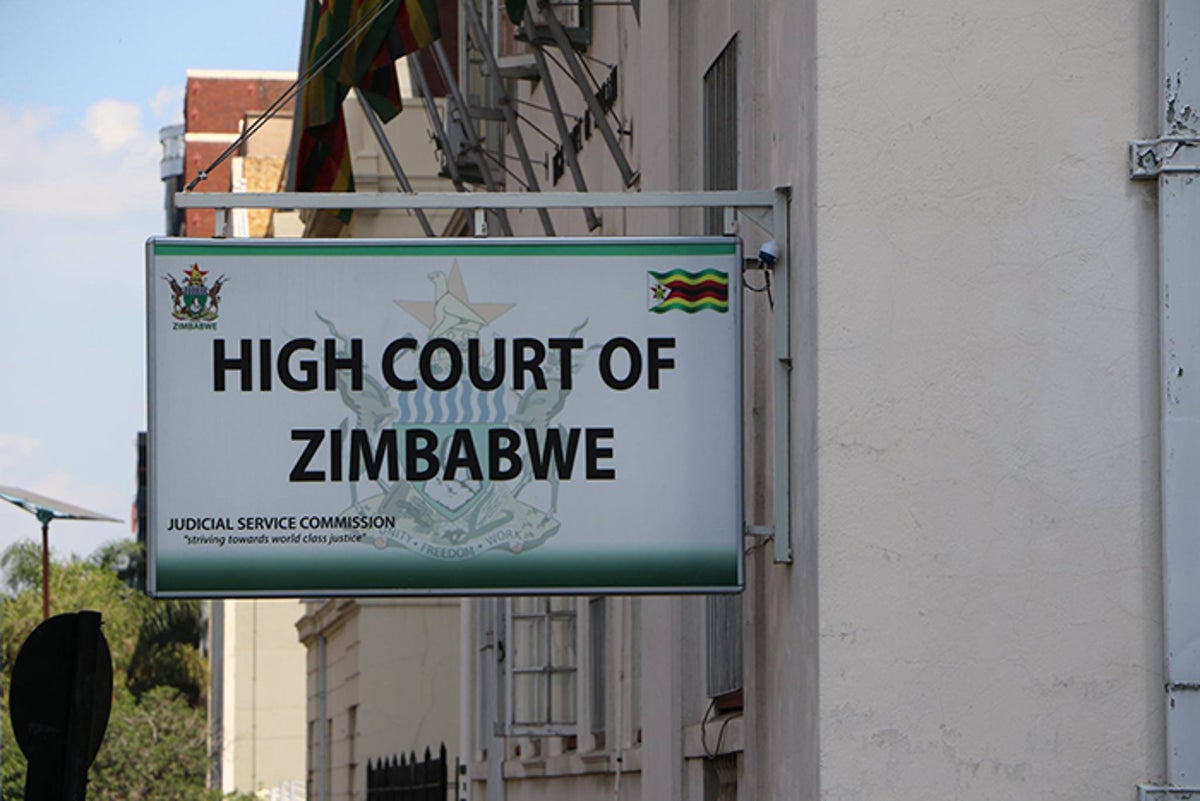
High Court chides magistrate for mishandling case involving mentally ill accused person*
THE High Court has sharply criticised the conduct of a Bulawayo magistrate in a criminal insult case involving a mentally ill accused person, ruling that although the final verdict was correct, the proceedings were riddled with serious legal and procedural errors.
In a detailed criminal review judgment, Justice Munamato Mutevedzi withheld his certificate of confirmation after finding that the magistrate fundamentally misunderstood the law governing mental disorder defences and special verdicts, despite ultimately acquitting the accused on the basis of insanity.
“The verdict that the accused was not guilty because of insanity cannot be debated,” Mutevedzi said.
“It is how it was arrived at that caused my strife.”
The case involved Tamisayi Brian Mapako, who was charged with criminal insult under section 95(1)(a) of the Criminal Law (Codification and Reform) Act after allegedly harassing a woman at Fidelity House in Bulawayo between May and June 2024. The court heard that Mapako persistently accosted the complainant, wrote letters demanding sexual intercourse, proposed what he called “a threesome romp,” and later sent what the judge described as “terrifying letters” referring to a looming “holocaust” and “sacrifices.”
“It was at that point that the complainant really panicked [and] decided to report the matter to the police,” court heard.
On Mapako’s initial court appearance, the magistrate ordered a mental examination under the Mental Health Act after concerns were raised about his mental state. Two medical practitioners later certified that he was mentally disordered and unfit to stand trial, leading to his committal to Mlondolozi Psychiatric Unit for treatment in July 2024.
Fifteen months later, Mapako was returned to court after doctors deemed him fit to stand trial, and the Prosecutor-General authorised his prosecution. During trial, he admitted sending the letters but claimed he was “love-stricken” and did not appreciate the wrongfulness of his conduct.
Mutevedzi found that this explanation should have alerted the court to a defence of mental disorder at the time of the offence, not ignorance of the law. “Far from being mistake or ignorance of the law, the accused was simply pleading that he was mentally disordered or intellectually handicapped at the time that he committed the crime,” he said.
Instead, the magistrate mischaracterised the defence, embarked on what the judge described as an irrelevant legal exposition, and then inconsistently concluded that Mapako committed the offence but lacked the requisite criminal intent due to mental illness.
“This court is convinced beyond reasonable doubt that the accused committed the offence,” the magistrate had ruled, before adding that Mapako “lacked the requisite mens rea when he committed this offence.”
Mutevedzi said this betrayed a “serious misunderstanding” of the law, particularly the distinction between a normal acquittal and a special verdict of not guilty by reason of insanity.
“Needless to emphasize, the special verdict of not guilty by reason of insanity means exactly that. The accused is found not guilty,” he said. “He or she cannot be sentenced to any punishment.”
Yet after returning the special verdict, the magistrate proceeded to conduct a pre-sentencing inquiry and allowed a victim impact statement, actions Mutevedzi said only made sense if the court mistakenly believed it had convicted the accused.
“I am forced to think that the trial court indeed thought that it had convicted the accused,” he said.
The judge also faulted the prosecution for its handling of the case, noting that the State itself appeared to accept that Mapako was mentally disordered at the time of the offence. “Where a prosecutor is of agreement that the person was mentally disordered at the time of the commission of the crime, the right course is for the state and the accused to proceed by way of a statement of agreed facts,” he said.
Medical evidence placed before the court showed that Mapako had a long history of schizophrenia, having been treated at Ingutsheni Central Hospital on at least 12 occasions since 1999. A psychiatrist, Dr Elena Poskotchinova, reported that he was psychotic, delusional, and “dangerous to society,” but fit to stand trial at the time of prosecution.
“There is a reasonable possibility that at the time of the alleged crime the accused was suffering from mental disorder Chronic Schizophrenia,” the psychiatrist stated, adding that he “should not be held legally responsible for his action.”
Mutevedzi concluded that although the proceedings were deeply flawed, setting aside the outcome would serve no practical purpose because the same verdict would likely be reached again.
“In the end I cannot do anything other than to withhold my certificate as I hereby do,” the judge ruled.
The judgment serves as a pointed warning to lower courts on the proper application of mental health laws and the handling of accused persons suffering from serious mental illness. _*NewZimbabwe*_