
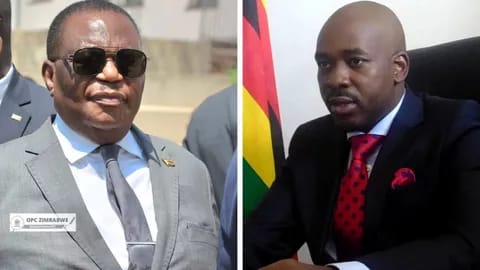
A Chamisa-Chiwenga alliance and the politics of the unthinkable in Zimbabwe
At first glance the idea feels like oil and water. Yet politics is not chemistry. It is arithmetic, interests and survival.
By Gabriel Manyati
Zimbabwean politics has always had a talent for the dramatic, but every so often a hypothetical emerges that forces even hardened observers to pause.
One such scenario is a political understanding between Nelson Chamisa, the youthful face of opposition renewal, and Constantino Chiwenga, the retired general turned Vice President who embodies the state’s coercive backbone.
At first glance the idea feels like oil and water. Yet politics is not chemistry. It is arithmetic, interests and survival.
The immediate reaction among many Zimbabweans would be disbelief. Chamisa built his political identity as the antithesis of the military-influenced politics that crystallised around the 2017 transition.
His rhetoric has leaned on democratic renewal, generational change and civilian authority. Chiwenga, by contrast, is inseparable from the security establishment and from ZANU PF’s liberation war ethos.
One speaks the language of citizens. The other speaks the language of command. On paper, their political DNA clashes.
And yet history teaches that political actors do not always choose allies based on shared poetry. They choose them based on shared necessity.
Across Africa and beyond, former rivals have closed ranks when their interests briefly converged. Unity governments, transitional pacts and elite bargains often arise not from affection but from pressure.
The question is not whether Chamisa and Chiwenga like each other. The question is whether circumstances could ever make cooperation rational.
Feasibility starts with incentives. What would each man gain? For Chamisa, the main obstacle to power has never been popularity alone. It has been the structure of power, particularly the security sector’s role in political outcomes.
Any pathway that softens resistance from that quarter would, in theory, lower the cost of political transition.
For Chiwenga, the calculation would be different. His influence is tied to his standing within ZANU PF and the military-linked elite. If his position there were weakened by factional battles, an external political understanding could become a hedge against isolation.
Still, feasibility is not the same as likelihood. The political costs would be enormous. Chamisa’s support base includes citizens deeply suspicious of military involvement in civilian politics.
Many would view any alignment with a former army commander as betrayal. Opposition politics in Zimbabwe has long drawn moral energy from resisting militarised governance. To dilute that stance would risk fracturing his base, especially among urban voters and civil society actors.
Chiwenga would face his own backlash. ZANU PF remains a party where loyalty and internal hierarchy matter. Any overt cooperation with the most visible opposition figure would be read as treachery by rivals.
It could trigger pushback from within the party and the state. In a system where internal dynamics are as decisive as national elections, that is not a small risk.
So under what circumstances could the idea move from fantasy to plausibility? The first would be a severe internal rupture within ZANU PF that leaves key actors searching for new alignments.
Zimbabwean politics is no stranger to factional contests. If such a contest produced stalemate or threatened elite security, unconventional coalitions could enter the realm of possibility.
The second circumstance would be a national crisis that demands a broad-based stabilising arrangement. Deep economic collapse, prolonged unrest or a legitimacy crisis after a disputed election could create pressure for an elite pact.
In such moments, the language of national interest often becomes a bridge between unlikely partners. A transitional authority framed as temporary and reform-oriented could provide political cover.
Yet another circumstance would involve guarantees. Elite politics runs on assurances about safety, assets and future relevance.
If key players believed that cooperation reduced personal and political risk, doors that look firmly shut can quietly open. This is the unromantic side of politics, but it is real.
The broader implications of a Chamisa-Chiwenga understanding would be profound. On the positive side, it could lower the temperature of winner-takes -all politics.
If elements of the security establishment felt represented in a new arrangement, the risk of confrontation during transitions might decrease. It could also, in theory, open space for gradual reforms if both sides saw stability as mutually beneficial.
But there is a darker possibility. Such an alliance could dilute democratic accountability if it became an elite pact that sidelines citizens.
Zimbabweans have repeatedly shown that they want meaningful change, not merely rearrangements among powerful men. A deal that looks like power sharing without reform could deepen public cynicism. Stability without legitimacy is fragile.
There is also the question of narrative. Chamisa has cultivated the image of a new political generation. Aligning with a figure rooted in the old guard risks blurring that message.
Chiwenga, similarly, draws authority from liberation war credentials and state structures. Partnering with a charismatic opposition leader could confuse his traditional base. Politics is not only about numbers. It is about story, and stories must make sense to supporters.
Perhaps the most realistic assessment is this. A formal, public alliance between Chamisa and Chiwenga is unlikely under normal conditions.
Their constituencies, histories and incentives pull in different directions. However, politics often operates in grey zones. Tacit understandings, indirect signals and limited issue-based cooperation are more plausible than a grand coalition announced at a rally.
Zimbabwe’s political future will probably not be decided by one dramatic handshake between rivals.
It will be shaped by institutions, economic realities, regional pressures and citizen agency. Still, exploring such hypotheticals is useful. It reminds us that politics is fluid and that today’s impossibility can become tomorrow’s headline when interests shift.
In the end, the Chamisa-Chiwenga scenario is less a prediction than a lens. It forces us as Zimbabweans to think about how power really works in our country.
It asks whether change comes only through elections, only through elites or through a complex dance between the two. And it underlines a simple truth. In politics, there are permanent interests but few permanent enemies.
We would do well to watch not only what politicians say about each other, but also what circumstances might one day push them into the same room. That is often where the future quietly begins.