
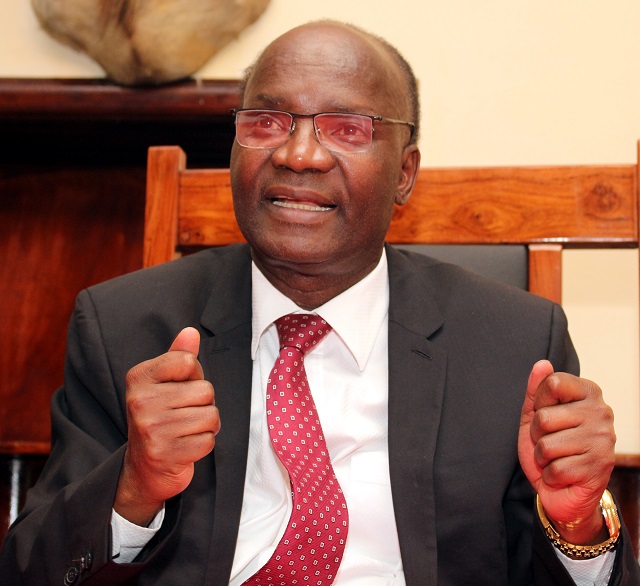
I can understand this coming from a first-year law student — Constitutional lawyer Mavedzenge rips Jonathan Moyo for insisting Mnangagwa should extend stay without referendum
Exiled former minister Jonathan Moyo was on Thursday left seething in anger and frustration after Constitutional lawyer Justice Mavedzenge likened his grasp of constitutional issues to that of a first-year student of law and expressed disappointment with his level of reasoning.
Moyo is advocating for President Emmerson Mnangagwa to extend his stay in power without going through a referendum, beyond the constitutionally stipulated five years, as was recently gazetted in the controversial Constitutional Amendment No. 3 Bill.
His argument is that Mnangagwa is not extending his term but rather lengthening it.
The two were panellists on a Twitter Space (X) hosted by CITE ZW.
Mavedzenge based his argument on Section 91(2), Section 95(2) and a Constitutional Court judgement in Marx Mupungu vs. Justice Minister, which declared any changes to terrn limits must be taken through a referendum.
Moyo maintained that the Constitutional Court, in passing judgment, was simply suggesting and not passing a binding ruling.
“Yesterday, the Attorney General’s (AG) office published what I consider to be a mischievous and misleading flier which said the only term limit for the President is on Section 95,” said Mavedzenge.
“I can understand when persons without basic legal knowledge fail to make a connection between Section 91(2) and 95 but I struggle to understand how a whole AG’s office can miss this.
“It has left me with two questions and I am sure those are the questions that other Zimbabweans have; Is the AG afraid of telling the President the truth that the term limit provision is primarily Section 95(2) as per the Constitutional Court’s decision or is the AG complicit in these sinister plans to subvert the Constitution?
“Part of what has been said about the Marx Mupungu vs. Justice Minister is to mislead the people, the owners of the Constitution, not me, not Zanu PF or any of the politicians.
“One of the arguments I have heard against this decision is that what the court said is obiter dictum, none binding.”
Obiter dictum are comments or observations included in a judge’s ruling that are not essential to the decision, and as a result not legally binding on other courts. It simply means a suggestion.
Added Mavedzenge: “The court drew a distinction between age limit provisions on one hand and term limit provisions on the other hand.
“Age limit provisions are those clauses in the Constitution which limit the oldest age at which one can occupy an office, while term limit provisions are clauses which limit the length of time one can occupy an office.
“The court did not just make a passing comment or mere suggestion when it identified section 95(2), it made a binding ruling which simply says you can change age limit provisions but you cannot touch term limit provisions without seeking the approval of Zimbabweans and that distinction was essential.
“In fact, the whole argument in that court application was centred around the distinction between age limits and term limits and the decision of the court turned on that distinction and in explaining that distinction the court had to demonstrate what term limits and age limits are; and then someone wakes up from somewhere and says the court was just making suggestions.”
A faction within the ruling Zanu PF party does not just want Mnangagwa to hang on till 2030; it is in support of changing how Presidents have been voted for in Zimbabwe since independence.
The amendments proposed in the Constitutional Amendment No. 3 Bill will extend his term by two years to achieve the 2030 agenda, while also permanently extending Parliamentary terms to seven years.
Sections 91 and 95 of the Constitution, which dictate two five-year terms are being ignored, just as Section 328 (7) which declares that amendment to a term-limit provision with the effect of extending the length of time that a person may hold public office must not benefit the incumbent.
“I can understand if this is coming from a first-year student of law because usually we do not go that deep in explaining to then legal concepts, but I worry when I hear that coming from someone at the level of a minister or a former minister who has dealt with the law,” he added, to Moyo’s explosion.
Moyo took an hour, ranting and laying into Mavedzenge for his submissions which he said were disrespectful and reflected an inflated opinion of lawyers.
Exiled since 2017, having fled from Mnangagwa at the height of the 2017 coup, Moyo’s support of the same Zanu PF faction that wanted him dead has raised eyebrows.
Moyo argued Mavedzenge had yet to highlight what the Mnangagwa regime had so far done to undermine the Zimbabwean Constitution. He accused him and those calling for a referendum of jumping the gun and argued they should be patient as Parliament does its job.
“You are saying there must be a referendum. There should not be a referendum because you say so? There should be one because the Constitution says so. The constitution is clear about which cases require a referendum,” said Moyo.
“The legal making exercise in Parliament only started on Tuesday with the counting of the 90 days during which you, me and other people should engage, debate and so forth and then parliament will be seized.
“Even before MPs start their work, you are preempting that exercise, you are reaching queer analytical arguments, to cast aspersions.
“What is it that has been done right now in relation to this which is not following the constitution. Is it wrong for cabinet to come up with a bill? Is it violating any particular law for cabinet to give that bill to the Speaker, to gazette it.
“Is the Speaker not gazetted the bill? You are making poisonous arguments, unsupported by any law.” *_-NewZimbabwe_*