
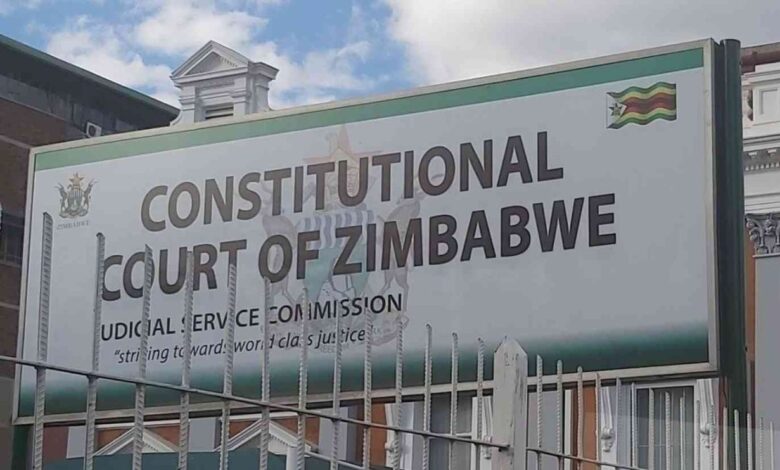
ConCourt Rejects Ibhetshu LikaZulu’s Withdrawal Of Court Challenge Against ZANU-PF’s 2030 Agenda
The Zimbabwe Constitutional Court has reportedly rejected the sudden withdrawal by local pressure group Ibhetshu LikaZulu and its secretary-general, Mbuso Fuzwayo, of their application to stop the Constitutional Amendment Bill Number 3 process.
Fuzwayo announced the decision to withdraw the case on Monday, 9 March 2026, citing an “unrelenting smear campaign” targeting him and the pressure group.
According to a senior Harare constitutional lawyer cited by The NewsHawks, the withdrawal was turned down over issues related to legal costs. The lawyer was quoted as saying:
“I have just checked the 𝐢𝐞𝐜𝐦𝐬 𝐬𝐲𝐬𝐭𝐞𝐦 looking for a different case, and then I realised that Case N0. CCZ10/26 (Ibhetshu LikaZulu & Mbuso Fuzwayo vs President Emmerson Mnangagwa, ZANU-PF, Ziyambi Ziyambi, Jacob Mudenda & Virginia Mabiza) withdrawal has been rejected.
“It was rejected on account of the legal costs issue. But ask other lawyers, they will explain to you how the system works.”
A Zimbabwean constitutional lawyer based in Johannesburg, South Africa, explained to The NewsHawks in detail how cases like this are handled. Said the lawyer:
“Withdrawing a Constitutional Court case is not always a simple, absolute right, particularly when it involves important constitutional issues and matters of public interest or when significant proceedings have already occurred, as in this case, because the court had already granted the applicants direct access after a serious consideration of the initial application for permission to file.
“While an applicant may request to withdraw a case, the court retains discretion to proceed, particularly regarding legal cost implications or to prevent abuse of process, as seen in various matters, including the Jacob Zuma litigation cases in South Africa.
“Once a matter is before the ConCourt, the court may deny a withdrawal if it strongly believes a judgment is necessary for legal certainty or if the case has already proceeded too far.
“So, the important issues at stake here in this case include costs, judicial discretion, procedural rules and abuse of court process.”
The ConCourt can continue to hear a case even if the applicant wants to withdraw, particularly when it involves public interest or serious legal issues. The lawyer added:
“Firstly, simply withdrawing does not necessarily escape liability for costs. The court may still order the applicant to pay the legal costs of other parties, as shown in recent rulings regarding Zuma’s applications. The same applies in this case.
“Secondly, the court may continue to hear a case even if the original applicant wishes to withdraw, especially if the matter concerns public interest or serious legal questions.
“Thirdly, procedural rules. The process requires formal procedures, such as filing a notice of withdrawal, which may require permission of the court or the Chief Justice.
“Fourthly, there is abuse of the court process. If a withdrawal is seen as a tactical manoeuvre, which it is in this case, the court may impose conditions or reject it.
“In the case of former president Zuma, multiple attempts to rescind or appeal orders, for instance, regarding his contempt of court sentence, were dismissed by the ConCourt rather than simply withdrawn.
“Fifthly, put differently, withdrawing a case from the ConCourt is not always ‘at will’ or ‘automatic’, particularly if the case raises important constitutional issues.
“While a party can request withdrawal, the court controls its docket and may refuse to stop proceedings if it believes it is in the public interest to decide the matter.
“In short, while an applicant can ask to withdraw a case, it is not always a simple, guaranteed, or unilateral action in constitutional matters. It’s up to the court to decide.”