
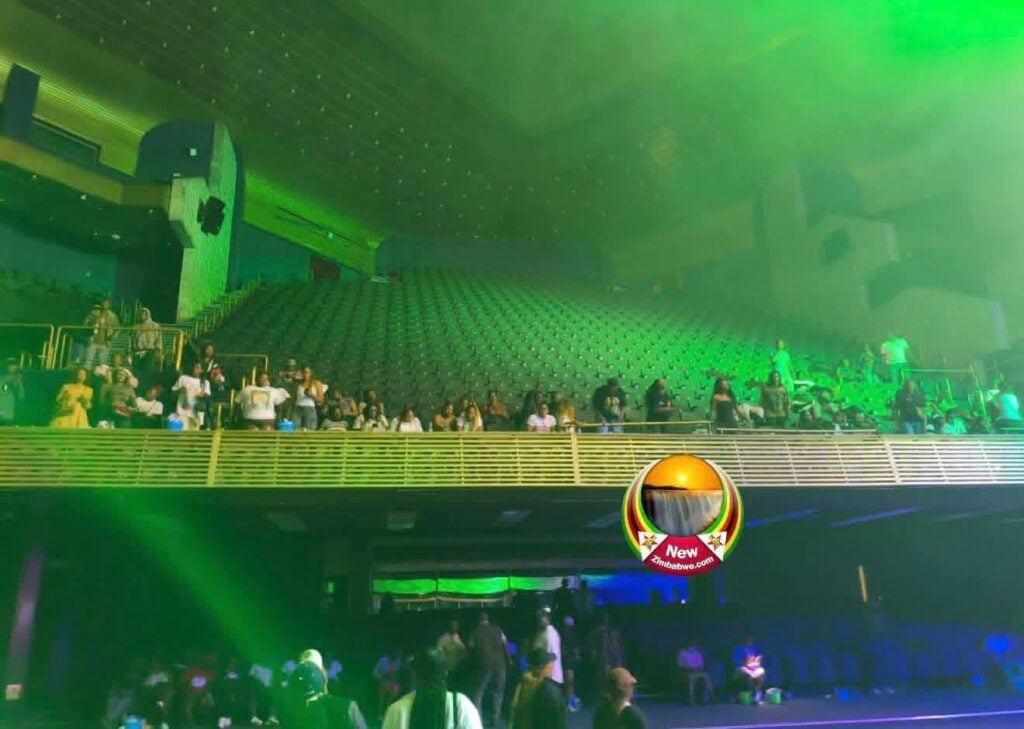
How and why Jah Prayzah’s HICC show flopped
Several converging factors explain the underwhelming turnout at Jah Prayzah’s weekend show at the Harare International Conference Centre (HICC), with poor planning, shifting audience dynamics, political perceptions, and strong competition all playing a role.
At face value, Jah Prayzah remains one of Zimbabwe’s biggest musical exports. However, the disappointing attendance at HICC exposed deeper structural and reputational challenges that go beyond a single event.
One of the key issues was strategic miscalculation. The artist appeared to rely heavily on the momentum of his previous HICC performance in November, where the crowd’s overwhelming response — particularly to the song Ruzhowa — created a perception of sustained peak popularity. That moment, while significant, may have led to an overestimation of guaranteed turnout without adequately reassessing current market conditions.
Closely linked to this is a growing disconnect with his core fan base. In recent years, Jah Prayzah has increasingly gravitated towards elite venues and premium pricing models, with tickets reportedly reaching around US$100. This shift has alienated sections of his traditional audience — many of whom supported him from his early days performing in high-density suburbs, growth points, and small towns.
Historically, artists such as Alick Macheso and the late great Oliver Mtukudzi maintained their relevance by consistently performing across all social spaces, including marginalised communities. That approach fostered loyalty and a sense of connection that transcended class divides — something critics argue Jah Prayzah has gradually abandoned.
Another sensitive but significant factor is his perceived association with Zanu PF. Over the years, the artist has performed at state-linked events and has been publicly associated with figures aligned to the ruling establishment. His reported links to businessman Wicknell Chivayo — who is widely viewed as politically connected — have further reinforced this perception.
In a politically polarised environment like Zimbabwe, such associations can shape public sentiment. For some sections of the population, especially younger and urban audiences, this has created the impression that Jah Prayzah is aligned with elite or establishment interests, including the controversial “Vision 2030” narrative. Whether accurate or not, perceptionin the entertainment industry often translates directly into consumer behaviour.
Timing also worked against the HICC show. Held during the Easter holiday, a period when many Zimbabweans travel, attend church gatherings, or spend time with family, the event struggled to compete with seasonal patterns of movement and reduced urban activity.
Compounding these challenges was direct competition from the Ama2K Festival in Belgravia, which drew massive crowds, particularly among Gen Z audiences. Unlike the HICC show, Ama2K was strategically timed to coincide with school holidays and was tailored specifically to youth culture.
With a line-up featuring trending acts such as Nutty O and Ruger, and a well-executed programme that started on time and maintained momentum throughout, the festival offered a compelling alternative. It was not just a concert — it was an experience aligned with current consumption trends driven by social media and youth identity.
This contrast highlighted a broader shift in the entertainment landscape: star power alone is no longer sufficient. Audiences are increasingly drawn to relevance, accessibility, and overall event experience.
There are also indications of audience fatigue. Some critics argue that fans now expect fresh content, innovative performances, and strong supporting acts rather than relying on established hits. In a difficult economic environment, disposable income is limited, forcing consumers to be more selective about which events they attend.
Taken together, these factors suggest that the HICC flop was not simply a rejection of Jah Prayzah as an artist, but rather the result of poor event positioning, weak promotional strategy, political perception challenges, and changing audience expectations.
The episode offers a critical lesson for both artists and promoters: success in Zimbabwe’s evolving entertainment industry requires constant reinvention, careful audience engagement, and strategic neutrality in a politically sensitive environment.
Looking ahead, a more grounded approach — reconnecting with grassroots audiences, diversifying performance locations, and aligning shows with audience behaviour patterns — may be key to rebuilding momentum.
As it stands, the HICC show serves as a reminder that even the biggest brands are not immune to missteps.
Disclaimer: Dr Garikai Chaunza (PhD) is a Postdoctoral Fellow at Rhodes University’s School of Journalism and Media Studies. He writes in his personal capacity, and the views expressed are his own. *_-ZimEye_*

