
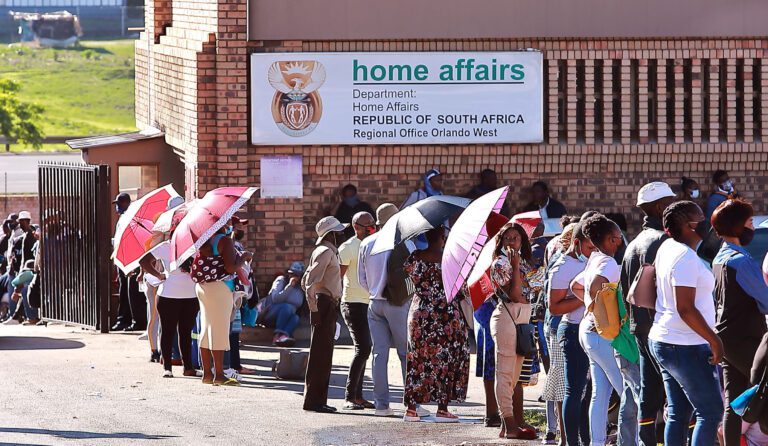
SA permit holders decry unfair association with undocumented migrants and criminality
ZEP holder identified as Sandy has appealed to the South African government to assess permit holders individually rather than treating them as a collective immigration problem.
“Look into cases individually, do not group us. We have lived, contributed and still contribute faithfully to this country,” she said.
This came put amid reports that the South Africa’s Department of Home Affairs says the number of Zimbabwe Exemption Permit (ZEP) holders currently in the country is likely significantly lower than the officially recorded 178 000, with authorities now conducting an audit to determine how many permit holders remain after deaths, migration and movement into other visa categories.
This was revealed during public consultations on the future of the Zimbabwe Exemption Permit (ZEP) and Lesotho Exemption Permit (LEP) systems, where government officials, migrants representatives and civil society groups debated the future of the special immigration dispensations.
Sandy said she had lived in South Africa for more than 20 years and had worked as a community leader assisting fellow Zimbabweans navigate immigration processes.
“As a ZEP holder I’m grateful for the opportunity that I was given. There are a lot of challenges that we have faced.,” she said.
She claimed some Zimbabweans who attempted to comply with government instructions to migrate into mainstream visa categories had not received responses to their applications.
“Majority of the people that I have assisted with their application since 2021 to follow what the minister had said, that we need to migrate to mainstream visas, never received any responses,” Sandy claimed.
“They have done the waivers but never received any responses, which took forever.”
As a result, many found themselves trapped between official extension directives and institutions refusing to recognise them.
“You find that your account is blocked when you are travelling at the border,” she said.
“The Home Affairs people who are working at the border will actually disregard any documentation you have and they will tell you, ‘No, we want you to have a sticker in your permit.’”
She said the contradiction between ministerial directives and frontline enforcement had created widespread confusion.
“The banks will disregard that order. The police are disregarding that order. Even the schools are always demanding that,” she said.
Sandy rejected suggestions that ZEP holders had become a burden on South Africa, saying many had contributed significantly through work, taxes and small businesses.
“We have contributed a lot to the economy in our employment, in the small businesses that we have opened. A lot of people have employed South Africans, not only do they employ Zimbabweans, or other foreign nations, but they have employed South Africans in those small businesses,” she said.
At the same time, she said permit holders often found themselves unfairly associated with undocumented migrants and criminality.
“We are viewed as the villains in this whole issue,” she stated.
Sandy also pushed back against claims that Zimbabweans alone were responsible for document fraud.
“The people who are causing all these fraudulent documents to be happening are people who are working within the department,” she alleged.
“A Home Affairs employee comes to you and says, ‘I can do these documents for you, just pay me so much.’”
She argued that corruption inside state institutions was enabling fraudulent documentation networks.
“This is not a foreign national who is doing this. This is another South African who is pocketing money” she said.
Secretary of the African Diaspora Forum and chairperson of the Zimbabwe Community in South Africa, Ngqabutho Nicholas Mabhena, also argued that the public debate often confused documented ZEP holders with undocumented Zimbabwean migrants.
“In the absence of proper data or proper recording, we believe that you have more Zimbabweans in South Africa than the holders of the Zimbabwe exemption permits,” Mabhena said.
“As Zimbabweans keep coming, while we agree that the number of ZEP holders has gone down, undocumented Zimbabweans are actually more than the holders of the Zimbabwe exemption permits.”
Mabhena urged authorities and the public to separate the two categories.
“Maybe if we were to separate the holders of the Zimbabwe exemption permits and the undocumented Zimbabweans,” he said.
The consultations also cast light around the legal status of children born to ZEP holders in South Africa.
The Home Affairs official explained children born to temporary permit holders generally inherited the immigration status of their parents rather than automatic South African citizenship.
“When a person gives birth to a child, that child will follow the status of their parents,” Mavuso said.
“If someone is a permanent resident from Botswana, for example, the child will follow the status of the parent.”
He said the same principle applied to Zimbabwean permit holders.
“Now, if you have a ZEP, which is a temporary administrative permit to allow legal status in the country, and then give birth to a child in South Africa… that child will be registered as a Zimbabwean,” Mavuso said.
“The question would be, what legal document would they have? Because they need to follow the status of their parents.”
Mavuso noted there had been cases where South African fathers registered children born to Zimbabwean mothers, particularly in border areas such as Limpopo’s Vhembe district.
“We have seen cases in the Vhembe area where there are a lot of fathers who are South African who are registering children with Zimbabwean mothers. It’s a trend that we are following and we do not know whether it has anything to do with trying to give status to those particular children,” he said.
Speaking during the Eastern Cape consultations webinar on Wednesday, South Africa’s Department of Home Affairs spokesperson and Deputy Director-General for Operations, Thulani Mavuso, said the department still had detailed records of ZEP holders but acknowledged the actual number of people remaining under the dispensation had likely declined substantially.
“We have the details, we have the emails and we have all the details of the ZEP holders,” Mavuso said.
“Remember when you have applied, those who have applied for waivers, the details, we have the information.”
Mavuso explained that the figure of 178 000 referred to permit holders who were formally approved under the exemption programme over time, but said the department now needed to establish how many remained active within the system.
“We are saying those that we approved under ZEP were 178 000. But we have to deduct those who have left, those who have died, those who have moved to other categories, he said adding, “That number is being audited.”
The audit comes amid growing contestation around the actual size of the Zimbabwean population living in South Africa legally, as the debates around migration, unemployment and documentation continue to intensify in the neighbouring country.
The ZEP system traces its roots to the original Dispensation of Zimbabweans Project (DZP), introduced as a temporary administrative mechanism to regularise the stay of Zimbabweans who had entered South Africa during periods of severe economic and political instability in Zimbabwe.
Mavuso said one of the key reasons the special dispensation was initially introduced was because many Zimbabweans had obtained South African identity documents fraudulently.
“And they were asked to surrender those documents so that they can be given some form of amnesty and then be allowed on the special exemption,” he said.
Mavuso said authorities were still uncovering fraudulent documentation linked to that period.
“We still discover a number of those who still hold fraudulent documents,” he said.
“What happened at the time is that ID numbers would be created without birth records.”
He said the department continued investigating and removing fraudulent identities from the national population register.
The Home Affairs official also provided broader context on South Africa’s immigration and asylum system, saying many migration frameworks established after apartheid had not anticipated the scale of movement that would follow.
“When the 1998 Refugee Legislation was created, South Africa at the time projected that they expected to receive no more than 3 000 applications for asylum a year,” he said.
“Because the region was stable, there were no political issues around whether there were wars in the region.”
However, Mavuso said the reality quickly changed as in the first year when the legislation came into operation, the department “received more than 11 000,” applications for asylum.
He added that South Africa’s asylum system had increasingly been abused, pointing to a recent Constitutional Court ruling that supported the department’s long-standing concerns.
“The issue of the abuse of the asylum regime, it is there, as the Concourt ruled in our favour (on Tuesday),” he said.
“If you look at the number of applications that get approved, it is about five percent in the region. 95 percent gets rejected.”
According to Mavuso, visa waiver systems initially designed to promote regional trade and tourism were later used by some migrants as pathways for long-term stay.
“Government at the time projected and made decisions around visa waivers for the region for ease of movement of people for trade and tourism,” he said.
“But it turned out to be utilised for long-term stay and in an illegal way.”
It was in that context, he said, that the special Zimbabwean dispensation was introduced.
“This issue of special dispensation was introduced as a temporary administrative exemption,” Mavuso said.
“It was not created to be a pathway to automatic and permanent residence or citizenship.”
He stressed that this distinction remained central to the current policy debate.
“The idea was all those that are now left must apply for a waiver so that they can apply for a mainstream visa under the immigration legislation and move away from this temporary exemption,” he explained.
The department’s consultations are therefore intended to gather public submissions before recommendations are presented to the Minister of Home Affairs.
“What we are doing as bureaucrats in this process is to solicit those particular inputs so that we can then be able to go back to the minister and say, based on the consultations we have had, these are the views that are emerging,” Mavuso said.
“From our side, this is the advice that we are giving.”
While the South African government insists the dispensation was always temporary, many ZEP holders argue that years of living, working and raising families in South Africa have created realities that cannot easily be resolved through administrative directives.
A ZEP holder identified as Sandy appealed to the government to assess permit holders individually rather than treating them as a collective immigration problem.
“Look into cases individually, do not group us. We have lived, contributed and still contribute faithfully to this country,” she said.
Sandy said she had lived in South Africa for more than 20 years and had worked as a community leader assisting fellow Zimbabweans navigate immigration processes.