
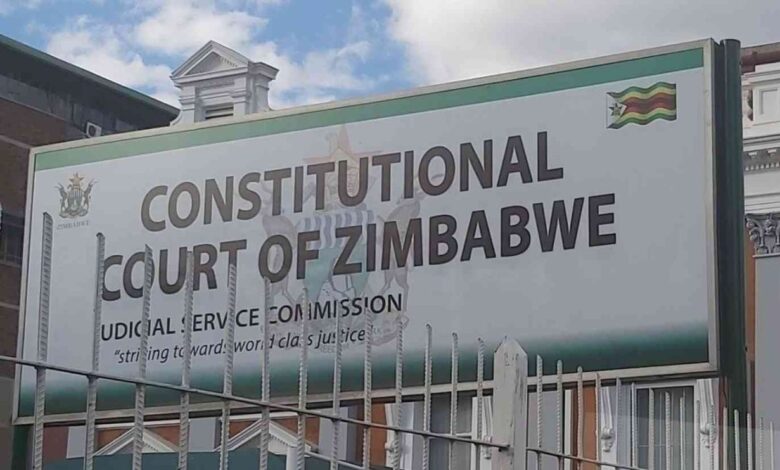
Constitutional Amendment No. 3 faces fivefold test at ConCourt
Constitutional lawyer Professor Lovemore Madhuku has provided an update on the legal battle against the Constitution of Zimbabwe Amendment (No. 3) Act, saying five cases are now before the Constitutional Court, with more expected to follow.
The Act (CAA3) has become one of the most controversial constitutional reforms in recent years.
Among its key provisions are the extension of presidential and parliamentary terms from five to seven years and changes to the method of electing the President.
The law abolishes Zimbabwe’s system of direct presidential elections, replacing it with an indirect electoral process in which Members of Parliament and Senators will jointly elect the president.
It also provides for the election of the President by Parliament and extends the term of office from five to seven years.
Addressing the media in Harare on Monday, Madhuku said that five cases currently before the apex court are contesting that framework on different, but overlapping grounds.
He said the first matter, brought by a group of war veterans including Nkomo and Gurira, was heard on 22 September.
Madhuku, who is representing the applicants alongside advocates Lewis Uriri and Tawanda Zhuwarara, said the team approached the court seeking direct access to challenge the contentious provision that allows Parliament, rather than a direct public vote, to elect the President.
Madhuku said the argument is straightforward.
“You cannot take away the right of Zimbabweans to elect their president directly without a referendum. It’s very straightforward,” he said.
“You can’t just wake up like what CAB 3 did and say for all these years you’ve been voting for your president, now you’re no longer going to vote for the president, the president will be elected in parliament.”
He said that the legal team argued that the amendment violates the Bill of Rights and that removing the direct presidential vote requires approval through a public referendum.
The war veterans are challenging CAA3 on constitutional grounds, including changes affecting the election of the President and the length of presidential and parliamentary terms.
The Constitutional Court heard arguments and reserved judgement. Madhuku said the bench had appreciated the importance of the matter and that a ruling is expected “very, very soon”.
He expressed hope that the court will allow the war veterans to proceed to the full Constitutional Court to join the other cases.
Madhuku said the remaining four cases all deal with aspects of Amendment No. 3 but approach it from different angles. All four have now been removed from the roll, a development he described as a procedural step rather than a dismissal.
The second case was filed by the MDC led by Douglas Mwonzora. It raises the same referendum question – that the right to directly elect a President has been taken away without consulting the people. It had been set down for 23 September. Madhuku confirmed his team is also involved in that matter.
The third case is a well-known application brought by former opposition MP Prince Dubeko Sibanda. This matter had previously been taken to court but was deemed not ripe for hearing at the time.
According to Madhuku, Sibanda’s argument rests on Section 328, Subsection 7 of the Constitution, which provides that amendments relating to term limits cannot benefit incumbents.
“You cannot have the president benefiting, because the constitution is very clear in Section 328, Subsection 7, that if you do amendments of that nature, the incumbents must not benefit,” Madhuku said. That case had been set down for 30 September but has been taken off the roll.
The fourth is an omnibus application in which lawyer Tendai Biti is representing another group of war veterans. Madhuku described it as the most comprehensive of the challenges, as it takes on all issues – not just the referendum question, but also the procedures followed to enact the amendments and the question of incumbency. It had been set down for 7 October and has also been removed from the roll.
The fifth and final case is being brought by a National Constitutional Assembly (NCA) member. It deals with a procedural irregularity, alleging that provisions which were not gazetted were later amended when the Bill was in Parliament.
“A number of provisions that they just decided to amend when they were in Parliament” were never included in the gazetted Bill, Madhuku said.
Madhuku said the four cases that are yet to be heard are hung together and will likely be managed as a consolidated group.
“They are together as four cases. They now have not been set down. The court removed them from the roll; you might have read that. We believe that that is simply a procedural step. They want to bring, I think, the parties together to a discussion, possibly a case management, where they determine when these matters will be heard,” he said.
He added that the previous staggered diary – with one case set for this week, another for next week and another for the following week – was not tight and that a case management process would provide clearer timelines.
“We expect that in the course of this week” there will be direction on how the matters will proceed, Madhuku said. *_-Pindula_*