
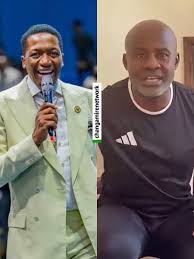
Temba Mliswa and Eubert Angel feud exposes Zanu PF Succession Wars as analyst warns of national fallout
Political analyst Dr Sibangilizwe Moyo has warned that growing tensions within Zanu PF, exposed by the public confrontation between former Norton MP Temba Mliswa and Prophet Uebert Angel over Vice-President Constantino Chiwenga, could have serious consequences for Zimbabwe’s political stability, economy and public institutions.
In an analysis titled “Friendly Fire Without the Accident: When Zanu PF’s Internal Battles Become Zimbabwe’s National Liability,” Moyo argues that the disagreement between Mliswa and Angel is more than a personal exchange, as it reflects deeper tensions surrounding political influence, loyalty and succession within the ruling party.
He is careful to distinguish the two individuals involved in the confrontation, noting that Chiwenga is the subject of their disagreement rather than a direct participant in the public exchange.
Moyo says the controversy exposes the growing tendency for Zanu PF’s internal political battles to spill into the public domain through religious sermons, social media exchanges and competing declarations of loyalty.
He argues that although political parties naturally experience internal disagreements, the problem arises when such disputes become so intense that they create uncertainty about the country’s leadership and future direction.
*Questions over Angel’s religious platform*
Moyo acknowledges that Mliswa raises a legitimate concern about religious platforms being used for political positioning, arguing that churches should not become sanctuaries for protecting particular political personalities from scrutiny.
However, he also challenges Mliswa’s consistency, pointing out that the former legislator equally uses public platforms to advance his own political arguments.
He says both Angel and Mliswa must be judged by the substance of their arguments rather than the personalities they support or criticise.
*Chiwenga at the centre of succession speculation*
The analyst observes that Vice-President Chiwenga has increasingly become a significant reference point in discussions about Zanu PF’s future leadership.
To some, he represents a possible alternative centre of political authority, while others view him as a potential future leadership option or a symbol of constitutional continuity.
Moyo cautions against confusing political speculation with constitutional certainty, noting that the Vice-President’s constitutional position, Zanu PF’s internal leadership arrangements and presidential succession procedures are separate matters.
Nevertheless, he says competition over political influence, networks and organisational support continues to fuel uncertainty within the ruling establishment.
*Warning over economic consequences and corruption*
Moyo warns that prolonged political infighting could undermine investor confidence, discourage businesses from expanding and delay investment decisions as companies become uncertain about Zimbabwe’s political and policy direction.
He argues that political stability is essential for economic recovery and that the country cannot promote itself as an attractive investment destination while its political environment generates persistent uncertainty.
He further warns that internal power struggles could distract those responsible for protecting public resources, monitoring state-owned enterprises, scrutinising public contracts and investigating corruption.
According to Moyo, individuals involved in corruption and the looting of public resources could exploit periods of political distraction and weakened oversight to advance their interests.
He stresses that corruption is not necessarily caused by factional politics, but warns that political uncertainty can create opportunities for those seeking to benefit from weakened accountability.
*State institutions must not become casualties*
The analyst insists that Zanu PF must distinguish between the interests of the ruling party and those of the state.
He says institutions such as the judiciary, police, civil service, financial regulators and public enterprises belong to the people of Zimbabwe and should not become instruments of factional battles.
Moyo calls for stronger institutional independence, transparent procurement processes, professional public administration and impartial investigations into corruption, regardless of the political status of those implicated.
He also warns that institutional capture could cause more lasting damage than the public political confrontations dominating headlines.
*‘Zimbabwe should not pay for elite power struggles’*
Moyo says ordinary citizens ultimately bear the consequences of political instability through lost investment, limited employment opportunities, weakened public services and growing uncertainty about the country’s future.
He argues that unemployed graduates, pensioners, farmers, workers and small-business owners are more concerned about economic opportunities and stable governance than which political personality wins an internal political battle.
He concludes that Zanu PF must demonstrate that it can manage leadership competition and succession questions without compromising national institutions or public confidence.
Moyo’s central warning is that while the ruling party may survive factional disputes and succession battles, Zimbabwe should not be expected to absorb the economic and institutional damage arising from them.
“The ultimate test of political leadership is not how effectively one defeats an internal rival; it is whether, in the pursuit of power, one remembers that there is a country to govern,” Moyo writes. *_-Nehanda Radio_*


