
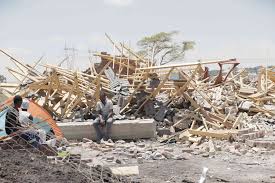
WHO IS RESPONSIBLE: Councils demolish, government directs as thousands of Zimbabweans face losing homes
The ongoing demolition of houses and informal structures across Zimbabwe has exposed a growing dispute over responsibility between local authorities and central Government, with thousands of families facing the loss of their homes and life savings.
In an opinion article, Dr Masimba Mavaza argues that while local authorities physically execute demolitions, central Government provides the policy direction through its nationwide clean-up campaigns, leaving ordinary residents caught between the two institutions.
The controversy came into sharp focus on August 14, 2026, when bulldozers and municipal police descended on St Martins Extension at around 5am, demolishing houses and leaving residents distressed.
Among those affected was 28-year-old Methro Masunga, who was reportedly awakened by the sound of bulldozers and shouting as municipal officers moved in to destroy residential structures.
Mavaza identifies local authorities as the institutions directly responsible for carrying out demolitions through their municipal police, town planning and legal departments.
In Harare, the City Council has defended its actions as enforcement of planning regulations against structures allegedly built without proper approvals or on unauthorised land.
However, the Harare Residents’ Trust director, Precious Shumba, accused council departments of directing demolitions in St Martins Extension despite a High Court order protecting certain residents.
Council records reportedly indicate that more than 5,000 houses are facing demolition under 37 outstanding High Court orders, while a separate council task force has inspected 22,255 sites to identify structures on prohibited or unauthorised land.
Other local authorities have also conducted demolitions, including Chitungwiza Municipality, which reportedly destroyed about 500 informal stalls at Makoni Business Centre, while Chipinge Rural District Council demolished more than 100 structures under Operation Chenesa/Hlanzeka.
However, Mavaza argues that responsibility cannot be placed entirely on councils, pointing to the role played by central Government in driving the nationwide clean-up campaign.
The Ministry of Local Government and Public Works, led by Minister Daniel Garwe, has overseen a zero-tolerance drive aimed at restoring order in urban areas, with the campaign spreading to Harare, Chitungwiza, Bulawayo, Mutare, Kariba, Beitbridge and Plumtree.
In June 2026, Garwe reportedly told a Zanu PF meeting that he had been authorised to carry out demolitions under an operation dubbed Operation Unoziva Kwawakabva, also known as Operation Dzokera Kumba Kwako.
Despite this, the Minister has repeatedly distanced Government from direct responsibility, maintaining that demolitions are carried out by local authorities in accordance with court orders.
On November 12, Garwe reiterated that Government had no policy directing the destruction of people’s homes, adding that authorities had attempted to delay some demolitions while exploring possible solutions.
In a significant development, Government on November 9 ordered all authorities to STOP home demolitions, directing them to prioritise the regularisation of informal settlements and the prosecution of illegal land barons.
The directive followed warnings from the Zimbabwe Human Rights Commission that demolitions were worsening the country’s urban housing crisis and threatening families who had acquired residential stands through informal arrangements.
Mavaza draws comparisons between the current demolitions and the controversial 2005 Operation Murambatsvina, during which approximately 700,000 people reportedly lost their homes, livelihoods or both.
However, he notes that the two operations differ in execution. While Murambatsvina was directly organised and implemented by central Government, the current demolitions are largely being carried out by local authorities, often relying on court orders and operating within a broader Government-driven clean-up campaign.
The article also raises serious constitutional and legal concerns, particularly under Section 74 of the Constitution, which prohibits arbitrary eviction from homes or demolition of homes without a court order issued after considering all relevant circumstances.
In St Martins Extension, residents have also cited a High Court consent order issued on October 29, 2025, by Justice Happias Zhou, which protected named applicants from demolition without a valid court order.
While residents accuse council officials of disregarding the order, the council maintains that the demolished properties were not covered by its protections.
One of the most contentious issues raised by Mavaza is the alleged involvement of local authorities in the allocation and approval of some properties now facing demolition.
Some affected residents reportedly acquired their stands through council-linked processes, received official documentation in 2020, paid municipal charges and proceeded with construction after council inspections.
A 2019 Commission of Inquiry identified weak administration, poor record-keeping and unauthorised land transactions as major contributors to the country’s land allocation problems.
Garwe has also questioned the demolition of properties that local authorities had previously inspected or certified, raising questions about institutional accountability.
Mavaza argues that families who purchased stands in good faith should not be made to pay for the failures of councils and illegal land dealers.
He maintains that land barons and officials involved in questionable land transactions should face prosecution instead of innocent homebuyers losing their investments.
The author concludes that while councils hold the bulldozers and execute demolitions, central Government sets the national policy direction, with the courts providing the legal orders relied upon in many cases.
He welcomes Government’s November 9 directive, calling for a permanent halt to demolitions until a comprehensive programme to regularise informal settlements is implemented.
Mavaza argues that Zimbabwe cannot achieve its Vision 2030 development ambitions by destroying the homes and livelihoods of ordinary citizens, insisting that urban development must be guided by justice, accountability and respect for human dignity. *_-ZimEye_*