
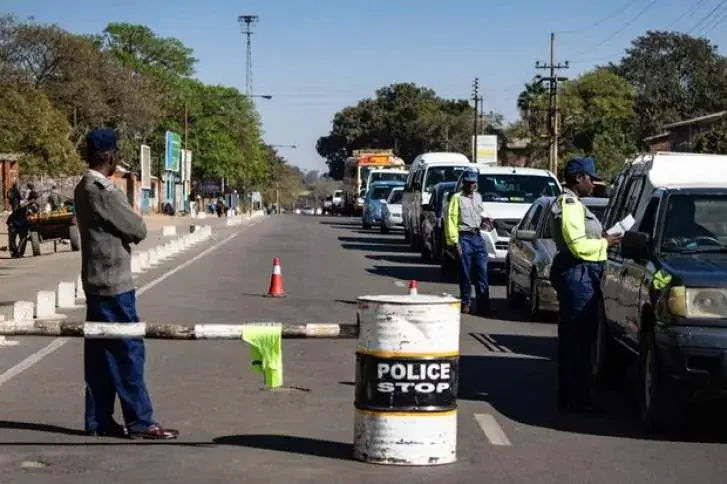
Ex-ZRP cop blows lid on police corruption — Roadblock bribes feed bosses all the way to the top
A former Zimbabwe Republic Police Assistant Inspector has exposed how roadblock corruption in Zimbabwe is not the work of a few rogue officers, but a well-organised extortion racket that feeds an entire chain of command.
Togara Fambi, now leader of the National Progressive Democrats, said in a hard-hitting statement on Saturday that the money motorists are forced to pay at roadblocks, commonly known as “poto”, does not end with the officer who collects it.
“There is a chain of distribution,” Fambi said. “The money collected at roadblocks does not necessarily end with the officer who receives it.”
Fambi compared Zimbabwe to South Africa, where he said a motorist might get away with paying a R20 bribe. In Zimbabwe, he said, officers “may not be willing to accept anything below US$5 (approximately R100), sometimes demanding even more.”
He asked: “Why is corruption so expensive in Zimbabwe?”
“First, let me make something clear: I do not condone corruption, regardless of the circumstances,” he said. “However, having served in the Zimbabwe Republic Police, I understand some of the internal dynamics that sustain this practice.”
Fambi blamed starvation wages for creating fertile ground for corruption, saying police officers “are among the many workers earning salaries that fall below the poverty datum line.”
“This economic reality creates fertile ground for corruption, although it does not justify criminal conduct,” he said.
He said as the festive season approaches, competition for roadblock duties intensifies because for some officers, deployment is “not simply another policing assignment; it is an opportunity to generate illicit income.”
But Fambi said the bigger scandal is what happens to the money after it is collected.
“Within the system I experienced, the money collected, commonly referred to as poto, is shared across different levels of the command structure,” he said.
He listed the beneficiaries: fuel for the police vehicle, the Officer-in-Charge, visiting officers who inspect roadblocks, and senior officers at district level including the District Police Officer.
“After satisfying immediate demands, the Officer-in-Charge may also have to attend to senior officers at district level, including the District Police Officer (Dispol),” he said.
“This creates a chain in which money collected at the bottom has to satisfy expectations further up the command structure,” he added.
Fambi also exposed how senior officers allegedly signal their juniors to pay up when they pass through a roadblock.
“A senior officer passing through a roadblock may telephone the district commanders and complain that officers manning a particular roadblock are not conducting themselves properly,” he said.
“But sometimes, the message is not necessarily about correcting poor policing,” he said. “It can be an indirect notification: I have seen your officers at that roadblock.”
“The implication is understood by those familiar with the internal arrangements: someone may be expected to follow up with the visiting senior officer,” he said.
“This is how corruption becomes institutionalised. It ceases to be merely an individual officer’s misconduct and becomes a network of expectations, obligations and financial demands,” Fambi said.
“Now we begin to understand why the amounts demanded from motorists can be so high,” he said. “The officer at the roadblock is not always collecting money for himself alone. He may be operating within a system where several people expect a portion of what is collected.”
Fambi warned that arresting junior officers alone will never fix the problem.
“We cannot continue arresting junior officers while pretending that corruption begins and ends with the person standing at the roadblock,” he said. “If corruption is sustained by a chain of beneficiaries, accountability must follow that chain, regardless of rank.”
“The Anti-Corruption Commission and other oversight institutions must investigate the entire structure, not simply the visible participants,” he said.
“I served in the Zimbabwe Republic Police. What I am discussing here is informed by my own experience within the institution. It is a reality that deserves an honest national conversation,” he said.
He ended with a direct challenge to the authorities: “Stop sacrificing junior officers while protecting the networks that sustain corruption.”
“We need a professional police service, adequately resourced, properly remunerated and accountable to the people,” Fambi said. “A police uniform must represent public service, not an opportunity to collect money from the public.” *_-ZimEye_*