Chris Mutsvangwa elbows VP Chiwenga’s faction as battle to succeed President Mnangagwa heats up
The political landscape in Zimbabwe is once again abuzz with whispers of succession, as President Emmerson Mnangagwa’s supporters push for an extension of his term beyond 2030. This has sparked a heated debate about the future of Zanu-PF, the ruling party, and its implications for the nation’s political stability.
The whispers of Mnangagwa’s ambition to remain in power beyond his current term, which ends in 2028, have been growing louder in recent weeks. While the President has publicly maintained his commitment to retiring at the end of his term, his supporters have been increasingly vocal about their desire to see him remain at the helm.
The “2030 VaMnangagwa Vanenge Vachipo” (Mnangagwa will remain until 2030) slogan has become a rallying cry for those loyal to the President, raising eyebrows and concerns about the potential for a power grab. This echoes the tactics employed by the late Robert Mugabe, who, despite his advanced age, clung to power for decades, refusing to name a successor and ultimately leading to his ouster in 2017.
Christopher Mutsvangwa, a former advisor to President Mnangagwa who is also the Zanu PF spokesperson, has publicly defended Mnangagwa’s leadership, urging the nation to focus on the President’s achievements rather than succumbing to “distracting tittle-tattle” about succession.
“President Mnangagwa deserves to continue his good work at the helm of the government without being sidetracked,” Mutsvangwa stated, highlighting the progress made under Mnangagwa’s administration.
However, legal experts point out that Mnangagwa, at 81 years old, would be ineligible to benefit from any constitutional amendments to remove presidential term limits. This raises questions about the legality and feasibility of extending his term beyond 2028.
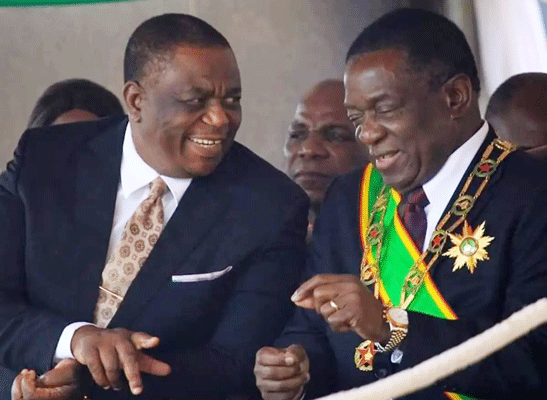
The whispers of Mnangagwa’s ambitions have exposed deep divisions within Zanu-PF, with factions vying for power and influence. Vice-President Constantino Chiwenga, widely seen as a potential successor, has reportedly been facing opposition from those loyal to Mnangagwa.
This internal strife, coupled with the President’s ambiguous stance on succession, has fuelled speculation and uncertainty about the future of Zanu-PF and Zimbabwe’s political landscape.
The party’s political commissar, Munyaradzi Machacha, has attempted to quell the controversy, asserting that succession discussions are premature and reaffirming Mnangagwa’s intention to retire in 2028. However, the continued promotion of the “2030” slogan at official events suggests that the internal power struggles are far from over.
Political analysts are concerned about the implications of this brewing conflict for Zimbabwe’s democratic future. They point to the historical suppression of opposition and internal dissent within Zanu-PF, suggesting that the party’s power dynamics may continue to favour the gerontocracy of liberation war veterans, hindering opportunities for younger generations to ascend to leadership roles.
Eldred Masunungure, a political analyst, observes that aspiring leaders within Zanu-PF are reluctant to openly declare their intentions, suggesting a secretive approach to succession planning. He doubts Mnangagwa’s commitment to fostering democratic processes within the party, predicting that the President will likely endorse a preferred successor and mobilize party support accordingly.
Professor Stephen Chan, an expert on Zimbabwean politics, expresses concerns that Zanu-PF’s succession battle may hinder opportunities for younger generations to ascend to leadership roles within the party. He critiques the party’s historical suppression of opposition and internal dissent, suggesting that power dynamics favoring the gerontocracy of liberation war veterans will continue.