
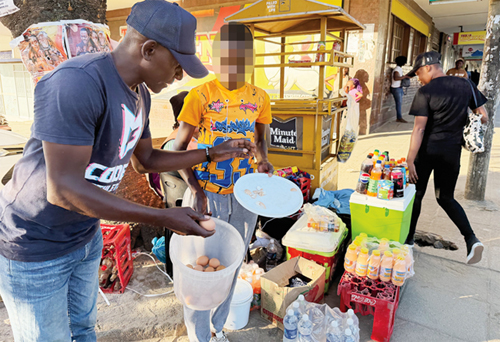
Young male vendors flood Mutare streets
A DISTURBING rise in child vendors has been observed in Mutare’s Central Business District, where boys of primary school age—many lured from rural settlements and border areas in neighbouring Mozambique—are being exploited for little more than food and shelter.
Investigations by The Manica Post over the past three weeks revealed that most of these youngsters have never enrolled in school and spend their days selling boiled eggs, airtime, and other small wares.
The situation, which bears the hallmarks of illegal human trafficking, has seen children already in Zimbabwe being used to recruit more of their peers from across the border.
Interviews conducted by this newspaper show that many of the boys are under the control of employers based in Mutare’s high-density suburbs of Chikanga, Sakubva, and Dangamvura.
One of them, Antonio Simamngo (13), said he was lured from Machipanda Village in Mozambique in August 2025 with promises of schooling alongside work. Instead, he now spends his days selling at least three 10-litre buckets of boiled eggs in Mutare’s CBD.
“I was promised that I would attend school and sell eggs during spare time. I came here in August. The woman I am staying with in Chikanga is the one who took me from Mozambique after visiting her relative,” Antonio said.
Antonio admitted that he has never attended school, either in Mozambique or Zimbabwe. His father died when he was very young, and he lived with his mother before being brought to Mutare.
“I was not attending school back home. I have never been to school in fact. I think nothing much has changed, except that I now get a decent meal in the morning and evening,” he added, speaking in a deep Sena accent.
Another boy, Kumbirai Sithole, from Mahenye Village in Chipinge South, revealed that he had been persuaded to recruit two more children from his village for employers in Mutare.
The growing presence of these child vendors highlights a troubling cycle of exploitation, where vulnerable boys are stripped of their right to education and childhood, forced instead into menial labour under harsh conditions.
“I came here with a distant relative with whom I stay in Dangamvura. I had finished Grade Seven. I am no longer attending school. I do not get paid, but they give me food and accommodation only. I also managed to get two other boys from my home area who came here to do the same job,” he said.
Herald