
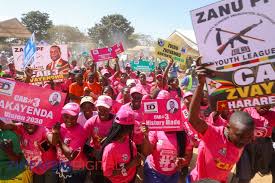
Harare Residents Reject 2030 Agenda: Critics Slam Masimirembwa’s “ED Extension” Proclamations
HARARE – Constitutional experts, civil society organizations, and
ordinary citizens have strongly condemned statements made by ZANU-PF
Harare provincial chairman Godwill Masimirembwa, accusing him of a
clear and deliberate misrepresentation of the will of Harare residents
regarding the controversial Constitutional Amendment Bill No. 3, also
known as CAB3. This follows Masimirembwa’s declaration that the
capital city fully supports extending President Emmerson Mnangagwa’s
tenure. He boldly claimed that the province still wants President
Mnangagwa to lead from 2030 to 2037 and that he must lead the party,
insisting that this is what Harare is saying. However, critics and
independent analysts have swiftly pushed back, arguing that
Masimirembwa’s statements completely ignore the true sentiments of
Harare’s population and override the democratic framework established
in the 2013 Constitution.
The reality on the ground concerning CAB3 paints a vastly different
picture from Masimirembwa’s assertions because Harare has historically
voted overwhelmingly for the opposition and remains highly critical of
attempts to manipulate the country’s supreme law. Political analysts
note that CAB3 marks a massive structural shift by replacing the
direct popular election of the President with a system where the
leader is chosen by a joint sitting of Parliament. Harare residents,
who pride themselves on direct political participation, strongly
reject being stripped of their right to vote directly for the head of
state. Furthermore, the bill extends presidential and parliamentary
terms from five to seven years, pushing the next general election from
2028 out to 2030. Legal experts argue this is a constitutional
maneuver designed specifically to bypass the two-term limit that
required Mnangagwa to step down in 2028. Under Section 328 of the
Constitution, any amendment extending term limits cannot legally
benefit the incumbent and must be put to a public referendum. The
government’s decision to bypass a referendum has caused widespread
anger across Harare’s suburbs, where residents feel their voices are
being actively suppressed.
Political commentators and legal analysts have slammed these
legislative maneuvers, stating that CAB3 dismantles the democratic
gains achieved a decade ago. Critics from various constitutional
defense forums argue that Masimirembwa cannot speak for a province
where millions are suffering from hyperinflation, unemployment, and
crumbling infrastructure. They maintain that claiming Harare residents
want an extension of this governance up to 2037 is not just a
misrepresentation but an insult to the intelligence of the voters.
Civil society groups have further noted that the ninety-day public
consultation period required before the bill’s passage was largely
treated as a formality, with ruling party elites ignoring overwhelming
public pushback. While ZANU-PF structures continue to orchestrate
loyalty pledges, independent observers maintain that the true voice of
Harare remains firmly opposed to the entrenchment of one-man rule.