Jury convicts a man of first-degree murder for the 1996 killing of rap icon Tupac Shakur
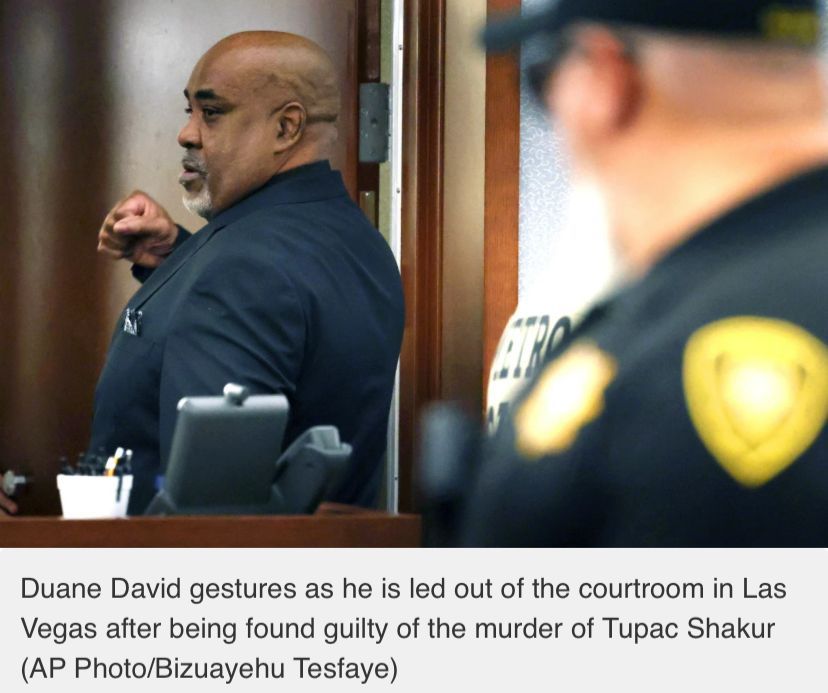
LAS VEGAS, United States — A jury found Duane “Keffe D” Davis guilty of orchestrating the 1996 killing of rap icon Tupac Shakur, finally bringing a measure of resolution to a case that had gripped hip-hop fans and lingered in the public imagination for decades.
The 63-year-old Davis was convicted Monday of a single count of murder with a deadly weapon and could be sentenced to life in prison. The jury deliberated for less than three hours after a weekslong trial in Las Vegas.
After the verdict was read, Shakur’s sister, Sekyiwa “Set” Shakur, cried and hugged the prosecutors. Davis’ son covered his face with one hand.
Chief Deputy District Attorney Binu Palal told jurors in closing arguments earlier Monday that Davis acquired a gun and “went hunting” for Shakur and Death Row Records co-founder Marion “Suge” Knight after the men had beaten up Davis’ nephew earlier that night.
“He is responsible of the murder of Tupac Shakur,” Palal said. “Tell him you hear him. Find him guilty.”
Prosecutors said that while his story had changed over the years, Davis repeatedly placed himself inside a white Cadillac from which the shots were fired. And they said that while he did not pull the trigger, evidence showed he had called for the gunfire as a powerful gang leader the younger men in the car, including his nephew, were going to listen to.
Defence attorney Michael Sanft asked jurors if there was any evidence that Davis had ever called the shots before or after the shooting.
The panel of 16 jurors, four of whom are alternates, heard testimony from 24 prosecution witnesses and three defence witnesses over nine days.
The prosecution said the state would dismiss a gang enhancement charge due to witness logistics. Prosecutors declined to comment following the verdict, and members of Shakur’s family said they were waiting until sentencing, which is scheduled for October.
The trial brought to a head a decades-old case that for years has drawn the attention of hip-hop fans and true crime experts alike. Shakur, who was considered one of the most influential rappers of all time, was in Las Vegas on September 7, 1996, and stopped at a red light when a white Cadillac pulled up beside him, and shots were fired. He died six days later from his wounds. Knight was also wounded but survived.
For years, nobody had been charged in the rapper’s death until Davis began making public statements, saying he was in the Cadillac and gave the gun to others in the backseat, calling the shooting a retaliation for the earlier beating of his nephew. Davis is the only person still alive among the four men prosecutors say were in the Cadillac.
Witnesses described the hostile rivalry between the Los Angeles gang sects Mob Piru and Davis’ Southside Compton Crips leading up to Shakur’s death and how the gangs became affiliated with Knight’s Death Row Records and Sean “Diddy” Combs’ Bad Boy Records.
Sanft, Davis’ attorney, argued there was no physical evidence connecting his client to the shooting. He said the book Davis co-authored and the public statements he made were dramatised bravado designed to make money, not to tell the truth.
Throughout the trial, Sanft poked holes in prosecutors’ narrative. He said investigators did not back up the claims made by his client, and he repeatedly pointed out a lack of physical evidence, such as phone records, that showed Davis was the shot caller.
“They have nothing in this case that says that man was here in Las Vegas on September 7, 1996,” Sanft said during his closing argument.
In a rebuttal argument, prosecutor Marc DiGiacomo pointed to a scrapbook Davis kept containing articles about Shakur.
“This guy’s scrapbooking his murder, for God’s sake,” DiGiacomo told jurors.
Palal held up Davis’ 2019 memoir, “Compton Street Legend,” and played an interview in which Davis encouraged people to buy it to get the “real truth.” Although the book contains a disclaimer saying some facts were changed, prosecutors argued the central account did not.
Sanft also turned to his client’s memoir during his closing argument. While reading an excerpt, he said the N-word aloud, prompting people watching in an overflow courtroom to recoil and shake their heads.
In multiple interviews, Davis said he handed the gun to the back seat, but in others as well as in his book, Davis wouldn’t say who pulled the trigger.
While insisting Davis’ words alone were enough to convict him, prosecutors said a gang rivalry helped explain why the shooting happened.
The shooting death of Bad Boy’s the Notorious B.I.G. six months after Shakur came up many times during the trial, with law enforcement witnesses saying Davis was briefly a suspect in that killing before being discounted. That case, which has also been an obsession of hip-hop fans, remains unsolved. – AP
*BEAM arrears soar past US$292 million but government orders schools not to send learners home*
The government has acknowledged that arrears owed under the Basic Education Assistance Module (BEAM) have risen to more than US$292 million.
However, the Ministry of Primary and Secondary Education has warned schools that learners must not be sent home for failing to pay fees.
Deputy Minister of Public Service, Labour and Social Welfare Mercy Dinha told Parliament recently that BEAM arrears had accumulated since 2023 due to limited fiscal space.
In 2023, BEAM supported 1,856,996 beneficiaries, with US$62,583,089 remaining outstanding after fees were only partially paid.
In 2024, the programme assisted 1,261,140 beneficiaries, resulting in a further US$117,766,325.08 in arrears.
In 2025, 950,192 beneficiaries were supported, leaving US$112,142,942 outstanding in fees, levies and examination fees.
This brought the cumulative arrears to US$292,492,316.46.
Dinha said Treasury had released ZiG84,876,800 in 2026, which was used to partially clear arrears owed to some mainstream and special schools. A further ZiG10 million was allocated towards examination fee arrears with the Zimbabwe School Examinations Council (ZIMSEC).
She said Treasury had committed to releasing additional funds to clear the outstanding balance.
The issue came under further scrutiny after MPs raised concerns about the impact of unpaid BEAM funds on learners.
ZANU PF Chief Whip and Gutu South MP Pupurai Togarepi told Parliament that some schools in his constituency were sending home between 70 and 80 per cent of learners receiving BEAM support.
He questioned why learners should bear the consequences of the government’s failure to pay schools, particularly when the schools were government institutions.
The matter was referred to Primary and Secondary Education Minister Torerayi Moyo.
Moyo said government policy did not allow schools to exclude learners because of unpaid fees, adding that sending learners home violated their fundamental right to education.
He acknowledged that some schools had been turning learners away and said the government had taken action against those responsible.
Moyo said he intended to issue another statement before the start of the third term to reinforce the directive that learners must not be sent home over unpaid fees.
The parliamentary debate also highlighted a distinction between mainstream schools and special schools for learners with disabilities.
MP Angeline Gata told Parliament that special schools had been fully paid for 2023, 2024 and 2025, while arrears dating back to 2023 remained outstanding for mainstream schools.
She added that the number of learners benefiting from BEAM had grown to around five million, placing additional pressure on the programme.
The government says it expects Treasury funding to become available to clear the outstanding arrears before the end of the year.