
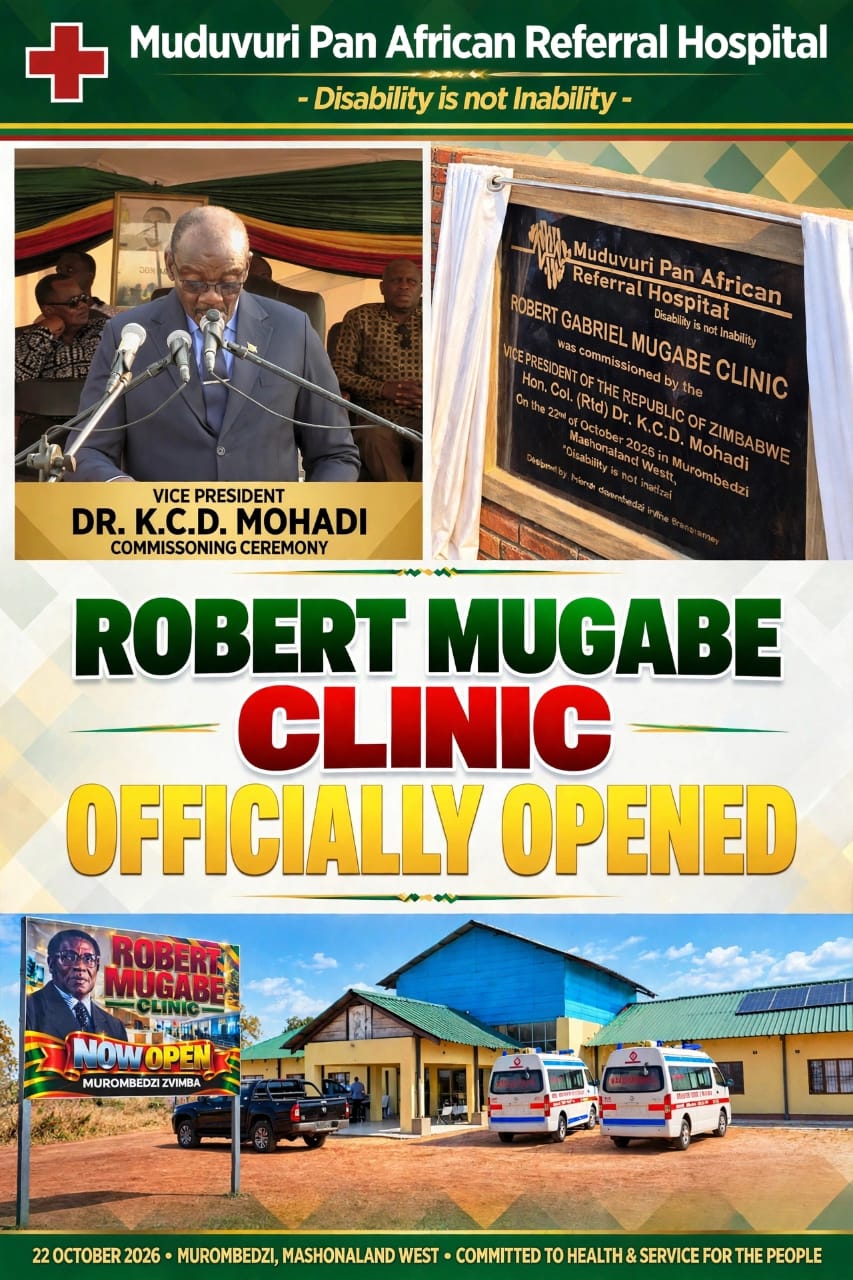
A Quiet Earthquake in Zvimba: How Muduvuriism Delivered a 24-Hour Clinic to 5,000 People—and a Benchmark for Rural Africa
VP Mohadi commissions Robert Gabriel Mugabe Clinic at Murombedzi Growth Point, the 44th health facility in Zvimba District, as private philanthropy meets public need
_By Chiyedzo Josiah Dimbo, Ambassador of Hope_
_Murombedzi, Zvimba — 22 October 2026_
The earthshaking thing about the Robert Gabriel Mugabe Clinic is not the ribbon. It is the distance it erases.
For years, the road to healthcare for thousands of villagers in Mhako and surrounding areas was measured in hours, long queues and the quiet arithmetic of pain. Yesterday, it was measured in minutes.
Vice President Rtd Col Dr K.C.D Mohadi officially commissioned the state-of-the-art clinic at Murombedzi Growth Point in Zvimba, placing Muduvuriism — the practical philosophy of building Zimbabwe through service, empathy and inclusive development — at its peak.
The facility was built by businessman and ZANU PF National Consultative Assembly member Cde Dr Jimayi Muduvuri, proprietor of the Muduvuri Pan-African Referral Hospital, National Chairperson of People With Disabilities 4ED and Ambassador of Disability Empowerment and Humanitarian Service.
It is the 44th health facility in Zvimba District and will serve a catchment of *more than 5,000 people* in Mhako and surrounding villages. It is equipped with maternity services, male and female wards, and will introduce specialist services including cancer and renal care through partnerships with private medical practitioners. It will operate around the clock.
VP MOHADI: “A MILESTONE IN HEALTHCARE”
“The timely construction of the Robert Gabriel Mugabe Clinic will go a long way towards serving the people of Zvimba, Murombedzi, and Zimbabwe at large. As the country strives towards universal health coverage, this facility will further reduce the distances travelled by our people to access healthcare in this province, especially for women and children,” said VP Mohadi.
“Cde Robert Gabriel Mugabe dedicated his life to the liberation, unity and development of this country. Naming this clinic in his honour reflects our commitment to preserving his legacy while serving the people,” added VP Mohadi.
FROM QUEUES TO JOBS: VOICES FROM MHAKO
“I am super happy about this development. This is employment creation at its best. I am looking forward to work at the clinic as a nurse aid. I have honed the experience at Chitungwiza General Hospital,” said Joyce Jonasi.
“This clinic will ease congestion and bring healthcare closer to people with disabilities and the community at large,” said Mr Peter Paradza, a disabled resident of Mashonaland West.
“This is a fitting tribute to the late former President and a great relief to the people of Zvimba,” said Chief Zvimba, Mr Stanley Mhondoro.
CDE MUDUVURI: PRESERVING A LEGACY
“Cde Robert Gabriel Mugabe dedicated his life to the liberation and development of Zimbabwe. Building this clinic in his home area is a way of ensuring that his legacy continues to positively impact communities through improved healthcare,” said Muduvuri.
He added that more clinics will be commissioned in honour of Zanu chairman Cde Herbert Chitepo, Cde Josiah Magama Tongogara and Cde Simon Muzenda early next year.
“We should all respond to calls by President Mnangagwa for Zimbabweans to help build their nation,” added Muduvuri.
THE BENCHMARKS: WHY THIS IS MORE THAN A RIBBON
Against regional and international yardsticks, the Zvimba clinic is not a silver bullet. It is a revealing data point.
– Primary healthcare is the engine of universal health coverage. The World Health Organization has long argued that strong primary healthcare is the most efficient way to achieve universal health coverage. A clinic within walking distance, open 24 hours, with maternity services, is exactly the kind of frontline facility that global health policy says countries need.
– The distance benchmark. Across rural Africa, distance is still one of the biggest barriers to care. A facility serving 5,000+ people in Mhako and surrounding villages reduces the tyranny of travel — especially for women in labour, children and people with disabilities. That is a measurable development gain, not a slogan.
– The Abuja Declaration test. The 2001 Abuja Declaration committed African governments to allocate at least 15% of national budgets to health. Most countries, including Zimbabwe, have struggled to meet that target. Private philanthropy like the Muduvuri model cannot replace public financing — but it can complement it, plug gaps and pressure systems to perform.
– Disability inclusion is a global standard. The UN Convention on the Rights of Persons with Disabilities demands equal access to health services. The presence of a disabled resident’s voice at the centre of this story — and the promise of local employment — matters. Inclusion is not a footnote; it is a benchmark.
– Public-private partnership is the new development arithmetic. From Rwanda’s community health posts to India’s PPP hospitals, countries are testing models where private capital and public need meet. Zimbabwe’s Second Republic has clearly opened that door. The question is whether the Muduvuri model can be replicated at scale — and whether it strengthens, rather than substitutes for, the public system.
WHY IT MATTERS
– Access: More than 5,000 people gain a closer, 24-hour health facility.
– Decongestion: Murombedzi Hospital and surrounding clinics will feel less pressure.
– Jobs: Local youths, including nurse aides, groundsmen and general hands, stand to earn from the facility.
– Inclusion: A disabled resident’s experience is central, not peripheral.
– Legacy with delivery: Naming the clinic after Robert Gabriel Mugabe is political memory. Keeping it open at night is service.
– A replicable model: If 35 primary healthcare centres by 2030 become real, Zimbabwe will have a working example of citizen-led development.
The Robert Gabriel Mugabe Clinic will not shake the ground. It will do something quieter and more important: it will shift what people expect from the State, from private citizens and from themselves.