Chief Mutasa orders man to “marry” dead woman after DNA bombshell at funeral
Chief Mutasa has ruled that a man who proved through DNA that he was the biological father of a Dangamvura man must first marry the deceased’s late mother and compensate the family that raised him before he can be recognised as a father-in-law.
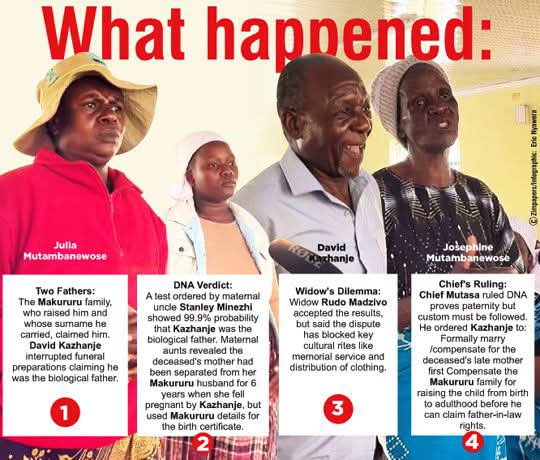
The chief said David Kazhanje, who was found to be biologically related to the deceased with a 99.9 per cent probability, must observe customary procedures despite the DNA outcome.
“You need to go and marry your late son’s mother first before you go to your son’s widow and introduce yourself as her father-in-law, as you have done,” Chief Mutasa told him.
“Kazhanje should begin the traditional processes required of him, including compensating the Makururus, who looked after his child from birth until his death this year.
“He had already become a grown man with his own family. Kazhanje should also marry the deceased’s late mother.”
The ruling followed a bitter burial dispute that exposed a decades-old family secret. The deceased, who died in a road accident near Rusape on 26 July, had been known all his life as a Makururu and was universally recognised as part of the Makururu family.
The row erupted the following day as relatives gathered to prepare for the funeral, when Kazhanje arrived and declared that the man was his biological son. The claim stunned mourners and triggered a dispute over identity, lineage and final resting place.
Tensions intensified when the Makururu family questioned plans to bury him in Mutare.
The matter was reported by the deceased’s maternal aunt, Josephine Mutambanewose.
“After the death, when we went to collect the body from the mortuary, the Makururu family wanted to know why we intended to bury him in Mutare because they said the child belonged to them,” she said.
“They were the fathers that we knew, but the child grew up within my family. I told them that while he was alive they never acknowledged him, yet they now wanted to claim him in death.”
The funeral at the deceased’s home in Dangamvura became the centre of a standoff, with relatives splitting into opposing camps.
To settle the matter, the families agreed to DNA testing. Stanley Minezhi, Mutambanewose’s brother, said he ordered the tests.
“I am the one who instructed them to do a DNA test so that we could know the truth. It was only Kazhanje who underwent the tests, and the deceased was found to be his son,” he said.
Minezhi said the deceased had been raised under the Makururu surname after members of that family paid roora for his mother.
Another maternal aunt, Julia Matambanewose, said her late sister had been married into the Makururu family and had two children before the marriage ended.
“After they had been separated for six years, she became pregnant by Kazhanje,” she said.
She alleged that her sister later used her former husband’s details to obtain a birth certificate, resulting in the child carrying the Makururu surname.
“The truth is that the deceased was not Makururu’s child, and both parents went to the grave with that secret,” she said.
Kazhanje denied abandoning his son.
“They knew that I was the father. His late mother should have told her relatives that I was the deceased’s real father, but she never did. I spent my entire son’s life as an outsider, and sadly he never got the opportunity to know me before his death,” he said.
The deceased’s widow, Rudo Madzivo, said she had accepted the outcome despite the turmoil, but said the uncertainty had complicated cultural processes that can only be overseen by the rightful paternal family, including a memorial service and the traditional distribution of his clothing.
Further confusion arose from DNA tests involving two of the deceased’s children, which reportedly produced differing outcomes – one showing a 63.9 per cent probability with insufficient evidence to conclusively prove or refute a biological link, and another showing a 99.9 per cent probability. *_-Manica Post_*