Southern Africa Faces Severe Drought, Record Heat, and Water Scarcity as Super El Nino Looms
By Lloyd Mwale
Meteorological authorities and climate risk experts have issued urgent warnings across Southern Africa as a powerful Super El Niño takes hold, threatening the region with a punishing wave of extreme heat and severe drought conditions.
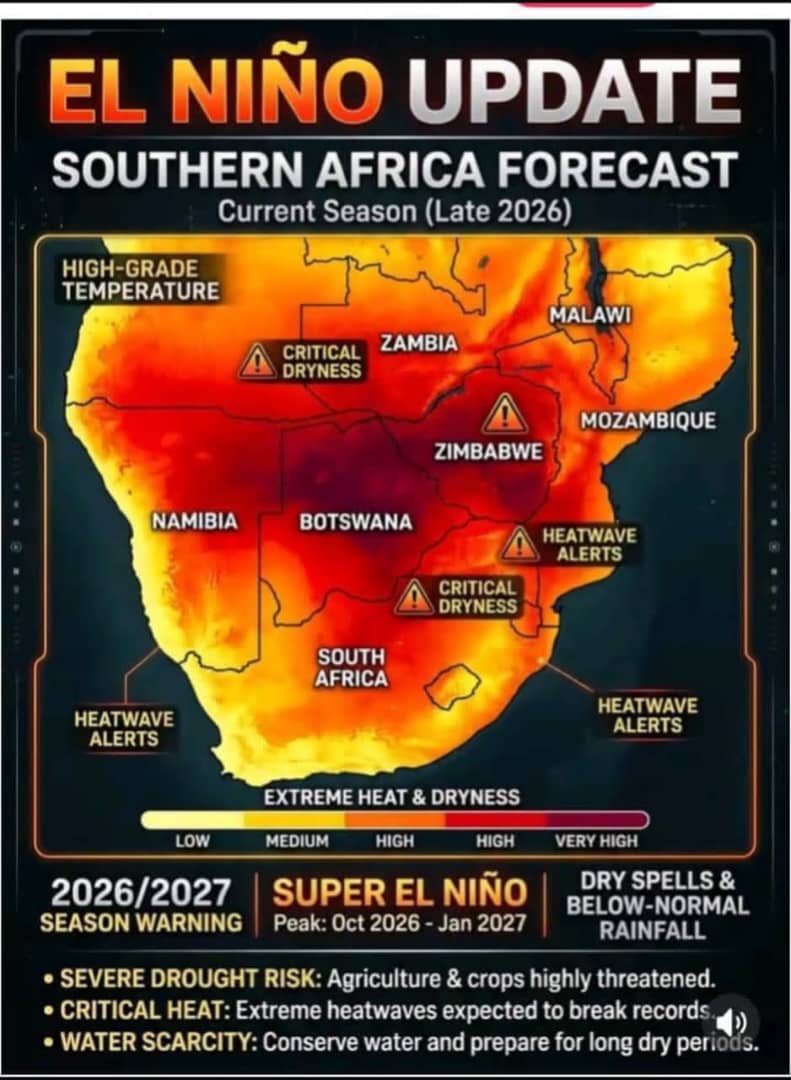
Forecast maps tracking the ongoing season highlight severe vulnerabilities across wide swaths of the continent. Countries spanning from Zimbabwe and Zambia to Botswana, Namibia, and large parts of South Africa are blanketed under high-risk zones, facing critical dryness and persistent heat wave alerts.
With the climate phenomenon peaking between October 2026 and January 2027, international organizations and regional bodies have raised alarm bells over the compounding threats to human security.
Rain-fed agricultural sectors, which form the backbone of rural economies, face critical threats as prolonged dry spells stunt crop yields and threaten staple maize production.
According to a leading global organisation, Famine Early Warning System Network (FEWS NET) report for Southern Africa 2026-2027 El Nino Special Report released on 6 October 2026 and Food Security Outlook June 2026-Jan 2027, the organization predicted a gloomy future.
“The food impact will be highest in Southern Africa especially in parts of East Africa and Southern Africa where El Nino is expected to contribute to widespread drought, with Angola, Lesotho, Madagascar, Malawi , Mozambique Zambia and Zimbabwe with the countries in need of food assistance to rise from November 2027 to March 2028.There will be widespread crisis expected across Southern Angola, Southern and Central Malawi, Southern Mozambique and Grand Suds of Madagascar,”
FEWS NET also predicted a price shock to come later.
“The worst hunger is not now but will be affected by a lean season from November 2027-March 2028, after the poor 2026/27 season harvest therefore South Africa white maize price is expected to rise from April 2027 to early 2028.”
Welthungerhilfe, a German non-denominational and politically independent non-profit and Non-governmental aid agency in its report on the effects of Climate Change induced El Nino to affect SADC countries said Southern Africa had entered a critical crop establishment era with the Super El Nino possibly the strongest since 1950.
“Bulk of SADC countries will likely to have below -normal rainfall from October 2026 up to March 2027 with high confidence dry zones in Angola, Southern Zambia, Zimbabwe, Southern Malawi, Central and Southern Mozambique, Namibia, Botswana, most of South Africa, Eswathini and Lesotho while a glimpse of hope will be in Democratic Republic of Congo, Northwestern Angola, Northern Zambia, Northern Malawi and Northern Mozambique where some areas will be wetter. Late start and prolonged dry will affect electricity generation in Zambia and Zimbabwe with the highest risk of load shedding, power imports and putting pressure on power generation.
High-grade temperature alerts are in effect as meteorologists project record-breaking heat waves that will accelerate moisture loss, stress livestock, and drain vital soil moisture.
Municipalities and rural communities alike are urged to implement immediate water-conservation measures as river flows drop and reservoirs come under severe strain.
Experts emphasize that while the meteorological drivers originate thousands of kilometres away in the Pacific Ocean, the local consequences require immediate and grassroots adaptation.
Governments, agricultural extension workers, and humanitarian agencies are calling for coordinated response plans—including the early marketing of livestock, the reinforcement of community water harvesting systems, and the prepositioning of drought relief—to protect vulnerable populations from deepening food and water insecurity.
As the region navigates this high-stakes climate anomaly, authorities stress that early preparedness will make the critical difference between localized hardship and widespread humanitarian crisis.