Wicknell Chivayo’s Final Flight: The Missing Black Box, the CIO Warning & A Death Shrouded in Questions
By Gabriel Manyati
On the afternoon of September 30, 2026, two helicopters departed Gandami Village in Chikomba District at roughly 4:20 pm, flying in formation toward Marondera in Mashonaland East.
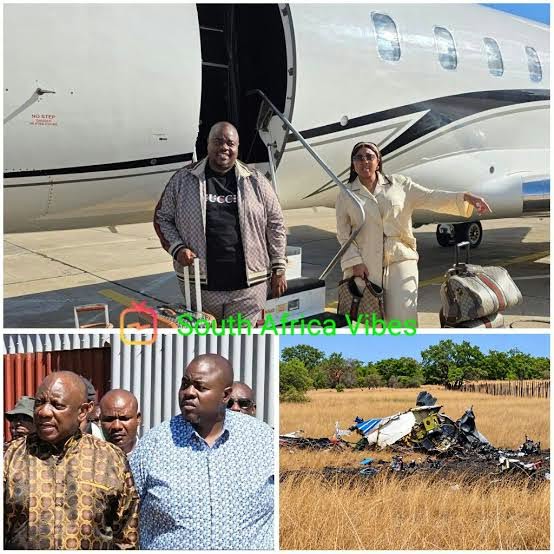
Inside the twin-engine Bell 430, bearing registration Z-PED, sat Wicknell Chivayo, Zimbabwe’s most flamboyant and politically entangled businessman, alongside his wife Lucy Muteke, security officer and aide Sanelisiwe Magagula, pilot-in-command Captain Kelvin Tafirei Soda, and co-pilot Courage Mutavirwa.
Roughly 10 minutes into the journey, low cloud and thickening mist rolled in from the east. Operating under visual flight rules, which require pilots to maintain clear sight of the ground, the accompanying Bell 407 banked west to evade the worsening weather.
Chivayo’s Bell 430 turned northeast instead, with the crew reporting over the radio that the route ahead was clear. Moments later, in its final radio transmission, the crew reported entering another layer of cloud without emerging from it.
Witnesses on the ground near Waddilove heard the rotorcraft circling overhead in heavy fog and drizzle for approximately 10 minutes before a deafening impact shattered the afternoon.
The Bell 430 struck Kudenga Farm, about 22km southwest of Marondera, scattering wreckage across a 170-by-75-metre debris field and killing all five occupants instantly.
The Crash Report and the Vanishing Black Box
What initially appeared to be an aviation tragedy caused by severe weather rapidly evolved into one of Zimbabwe’s most volatile political and security controversies.
On November 16, 2026, six-and-a-half weeks after the crash and well past the standard 30-day reporting window, the Ministry of Transport and Infrastructural Development’s Air Accidents and Incidents Investigation Department released a 14-page preliminary investigation report.
The document ruled out an in-flight breakup or mid-air explosion, noting that the debris pattern indicated the aircraft was intact upon impact.
Civil Aviation Authority of Zimbabwe director-general George Mashababe at the scene of the helicopter crash that killed businessman Wicknell Chivayo and his wife Lucy Muteke
Civil Aviation Authority of Zimbabwe director-general George Mashababe at the scene of the helicopter crash that killed businessman Wicknell Chivayo and his wife Lucy Muteke
Investigators highlighted that the Meteorological Services Department had issued severe weather advisories for thunderstorms, lightning, and strong gusts between September 29 and October 1.
Furthermore, the report confirmed that Captain Soda, aged 44, was an experienced aviator holding a commercial helicopter licence with 2756 total flying hours, including 614 hours on the Bell 430, and that no mechanical defects had been identified from the copies of the latest maintenance records obtained so far.
While stopping short of declaring a final probable cause, the preliminary findings pointed squarely toward controlled flight into terrain following inadvertent entry into instrument meteorological conditions.
Yet the credibility of the official narrative collapsed almost immediately over a single, glaring contradiction regarding the helicopter’s black box. Less than 24 hours after the crash, state authorities and a family spokesperson confirmed via state broadcasters, including the Zimbabwe Broadcasting Corporation and The Herald, that the flight recorder had been recovered intact from the scene and taken into custody for analysis.
Six weeks later, the Ministry of Transport’s written report reversed that account entirely, stating bluntly: “The aircraft was fitted with a Cockpit Voice Recorder (CVR). However, the CVR was not recovered among the wreckage and is presumed to have been destroyed.”
That assertion defies fundamental aviation engineering standards. Modern cockpit voice recorders are housed inside crash-survivable memory units constructed from reinforced titanium and stainless steel, specifically engineered to withstand impact forces up to 3400 Gs and intense jet-fuel fires exceeding 1100 degrees Celsius.
Even in catastrophic, non-survivable impacts where airframes disintegrate and burn, the hardened memory module almost invariably survives. For a certified CVR to vanish without leaving a trace of its armoured casing is virtually unprecedented in modern aviation history.
State security personnel cordoned off Kudenga Farm immediately after the impact, controlling access to the wreckage and evidence collection, while independent international aviation specialists were given no unfettered access to examine the recovered components.
Without the CVR audio, investigators and the public are deprived of the final cockpit conversations, warning alarms, and crew responses that would definitively establish whether flight Z-PED was brought down solely by fog or by external intervention.
Inside the CIO Elimination Plot
Two days after the transport ministry released its report, the investigative outlet The NewsHawks published a four-part dossier that transformed public scepticism into explosive alarm. Citing veteran intelligence sources, The NewsHawks revealed that Chivayo had been formally designated a national security threat by Zimbabwe’s Central Intelligence Organisation (CIO) in March 2024, and that senior operatives had tabled a plan to permanently eliminate him through an engineered road accident if he failed to curb his reckless breaches of presidential security.
According to the intelligence sources, Chivayo’s habitual disregard for close-protection protocols around President Emmerson Mnangagwa had turned him into an acute operational liability. He routinely bypassed perimeter vetting, broadcast real-time locations from secure zones, and published unvetted photographs taken inside State House, the President’s Office, and Mnangagwa’s private Precabe Farm in Kwekwe.
A senior intelligence official explained the institutional stakes to The NewsHawks in stark terms: “Breaching state security protocols around a head of state compromises executive safety, national stability, and institutional credibility. When protective measures fail, the immediate physical risk to a leader triggers broader systemic consequences for a country’s governance and defence apparatus.”
The official added: “A lapse in perimeter control, intelligence vetting, or close protection exposes the head of state to assassination, kidnapping, or coercion. This creates an immediate risk of a sudden leadership vacuum and constitutional or governance crisis. That is why the Chivayo issue was treated seriously and considered a security threat. Whether it was an accident or he was eliminated, that is entirely another issue.”
Despite repeated warnings and internal intelligence briefs, Chivayo acted as though his immense wealth and proximity to Mnangagwa rendered him untouchable.
A veteran CIO operative with more than two decades in state security had warned The NewsHawks in 2024: “He thinks the rules of gravity don’t apply to him anymore. Look at the background of this photo (showing Chivayo with Mnangagwa). That isn’t just flexing. That’s a breach of state security protocols.” When pressed on why Chivayo appeared to enjoy unrestricted clearance alongside heads of state, the officer replied: “Clearance is a leash, not a crown.”
He elaborated on how Chivayo had crossed from useful political financier into dangerous territory: “There are strict protocols regarding operational security, movement schedules, and proximity to the president. When you start openly interfering with close security protocols, broadcasting real-time locations, posting unvetted images from secure zones, and bragging about sensitive procurement channels on public platforms, you stop being an asset. You become a liability. That is what Chivayo has become.”
The operative further revealed that senior figures within the security establishment had lost all patience with Chivayo’s exhibitionism: “I saw a brief circulated last week. The old guard in the security apparatus is furious. They tolerate wealth, and they tolerate noise, as long as it stays inside the perimeter. Once a civilian starts compromising state security protocols to feed his own ego, the system corrects itself. Mark my words: ‘if he doesn’t quiet down, he’s in danger of elimination’. Not from access to the President’s Office or State House. Permanently.”
At the time, editors held back on publishing the intelligence warnings, viewing the prospect of an assassination plot against one of Mnangagwa’s most visible allies as implausible. Yet Chivayo continued to test the patience of the security establishment. Although CIO officials successfully lobbied to have him temporarily banned from State House in 2024, Chivayo repeatedly wormed his way back into Mnangagwa’s inner circle through lavish gifts, including a herd of cattle, and political utility.
On April 27, 2024, during Kenyan President William Ruto’s state visit to open the 64th edition of the Zimbabwe International Trade Fair in Bulawayo, Chivayo barged into Mnangagwa’s motorcade and forced his way into a private pre-meeting room with Ruto to take photographs. Furious CIO officers filed an urgent report warning that Chivayo had crossed a red line, with one official declaring: “He has now crossed the red line. This is unacceptable and he must be stopped. Otherwise, we will be reduced to a Banana Republic or a circus.”
The final straw for the presidential close-security apparatus occurred in November 2025, when Chivayo attempted to storm into State House in Harare to gatecrash a high-level investment meeting between Mnangagwa and Nigerian billionaire Aliko Dangote, attended by senior cabinet ministers and business executives.
Only the physical intervention of Sean Mnangagwa, the president’s son and head of the close-security unit, stopped Chivayo at the door. As a CIO source later told The NewsHawks: “When such sort of things happen, intelligence services in states like Zimbabwe use various tactics to deal with situations like this depending on whether the goal is quiet removal or public deterrence. They remove real or perceived threats, including those posed by members of the president’s inner circle if they have enough evidence to take action.”
Patronage, Procurement and the Road to Power
To understand how a convicted fraudster came to wield enough leverage to breach presidential perimeters across Africa, one must trace Chivayo’s extraordinary reinvention after the November 2017 military coup that brought Mnangagwa to power.
Initially shunned by the new administration, Chivayo was the explicit target of Mnangagwa’s June 11, 2018 warning that “Chikurubi is not full” over stalled state energy tenders, most notably the controversial Gwanda solar project under his company Intratrek Zimbabwe.
Chivayo had served a prison sentence in the mid-2000s for fraud before emerging to secure lucrative state contracts, surviving subsequent corruption and money-laundering prosecutions through a string of court acquittals. His path back into the seat of power was unlocked by gold dealer and Zanu PF legislator Pedzisayi “Scott” Sakupwanya, who introduced Chivayo directly to Mnangagwa.
Chivayo cemented his indispensability during Zimbabwe’s August 2023 harmonised elections. Seeking to neutralise potential sabotage from military factions aligned with Vice President Constantino Chiwenga, Mnangagwa sidelined the army from election management and handed operational control to the CIO-linked affiliate Forever Associates Zimbabwe (FAZ).
Chivayo became a central financial conduit for that political machinery after securing a massive windfall from a controversial US$100 million Zimbabwe Electoral Commission (ZEC) procurement tender for election materials, executed in partnership with South African printing firm Ren-Form CC.
While South Africa’s Directorate for Priority Crime Investigation, the Hawks, later stated in July 2026 that Chivayo was not under active criminal investigation in South Africa, and the Zimbabwe Anti-Corruption Commission cleared the procurement process, leaked audio recordings and investigative reports by civil society watchdogs like Open Secrets exposed the vast sums flowing through his network.
Flush with procurement capital, Chivayo turned Harare’s car dealerships into a daily spectacle of political patronage, gifting luxury Mercedes-Benz sedans, Toyota Hilux pickups, and hundreds of thousands of dollars in cash to musicians, religious leaders, ZANU PF loyalists, and state media figures. Days before his death, Chivayo boasted publicly that he had spent more than US$100 million on cars, cash handouts, and donations.
His sense of total impunity was captured in his viral Shona declaration in a leaked audio in June 2024, “ndakachibata kuti dzvi,” meaning he held the presidency in an unbreakable grip.
Even when his May 2024 bid to secure an exclusive local partnership for Elon Musk’s Starlink through his firm IMC Communications collapsed after SpaceX refused to endorse the arrangement despite Mnangagwa’s premature announcement, Chivayo simply pivoted outward toward the broader continent.
Continental Reach and Presidential Circles
Using his Bulawayo encounter with William Ruto in April 2024 as a springboard, Chivayo built an astonishing diplomatic and commercial network across eastern and southern Africa, travelling as though he possessed sovereign status.
In May 2024, he met Ugandan President Yoweri Museveni at State House in Kampala to pitch multi-million-dollar investments in telecommunications and 5G infrastructure, alongside parallel outreach to Tanzanian President Samia Suluhu Hassan. While his Ugandan pitches failed to materialise into contracts, Chivayo established lucrative commercial footholds in Tanzania and Kenya.
His relationship with Ruto grew extraordinarily close, sparking intense political backlash in Nairobi. Chivayo met Ruto repeatedly at State House in Nairobi and at Sagana State Lodge in Nyeri County alongside Deputy President Kithure Kindiki, and joined the Kenyan president at Wajir State Lodge during Madaraka Day celebrations in June 2026.
In February 2026, Kenyan human rights activist Boniface Mwangi publicly revealed that Chivayo had been issued a Kenyan diplomatic passport, prompting opposition lawmakers to demand answers over how a foreign businessman with a criminal fraud conviction had been granted diplomatic immunity.
Undeterred, Chivayo and his wife attended the traditional engagement ceremony of Ruto’s daughter, Charlene, at Intona Heritage Farm in Kilgoris in August 2026, where Ruto was filmed personally driving the couple to their helicopter. On September 8 and 9, 2026, just three weeks before his death, Ruto hosted Chivayo for a three-hour private dinner at State House in Nairobi to discuss a proposed US$200 million Kenyan infrastructure investment.
When news of the Marondera crash broke, Ruto was the first foreign leader to mourn Chivayo as a “dear friend,” while Tanzanian President Samia Suluhu Hassan personally travelled to Zimbabwe for his funeral.
Across the region, Chivayo had also secured direct audiences with South African President Cyril Ramaphosa, Nigerian President Bola Ahmed Tinubu, Zambian President Hakainde Hichilema, Malawian leaders Lazarus Chakwera and Peter Mutharika, Mozambican President Daniel Chapo, and Eswatini’s King Mswati III, with talks underway to meet Zulu King Misuzulu at the time of his death.
Unfinished Contracts and the Questions Zimbabwe Must Answer
Chivayo’s sudden demise has left an intricate web of public contracts, offshore accounts, corporate entities, and political debts suspended in mid-air. From the uncompleted Gwanda solar project and the disputed ZEC election supply chain to pending energy and telecommunications ventures in East Africa, vast sums of public and private capital remain unaccounted for.
As anti-corruption investigators have emphasised, the death of a central figure neither erases bank ledgers nor extinguishes the legal accountability of surviving corporate directors, state officials, and political beneficiaries who facilitated his deals.
Ultimately, the tragedy at Kudenga Farm confronts the Zimbabwean state with a profound test of institutional integrity. Authorities cannot expect citizens or regional partners to accept a preliminary aviation report at face value when the central piece of forensic evidence, a crash-hardened cockpit voice recorder initially reported as recovered intact, vanishes without explanation.
Zimbabwe must answer where the CVR went, who took custody of it at the crash site, and why official narratives shifted over six weeks. Equally, the state cannot ignore the documented reality that its own intelligence apparatus viewed Chivayo as a severe threat to presidential security and actively debated his permanent removal.
Until an independent, transparent forensic investigation accounts for the missing black box and opens the books on the public contracts that financed his empire, the circumstances of Wicknell Chivayo’s death will remain an enduring indictment of unaccountable power in Zimbabwe. *nehandaradio*