
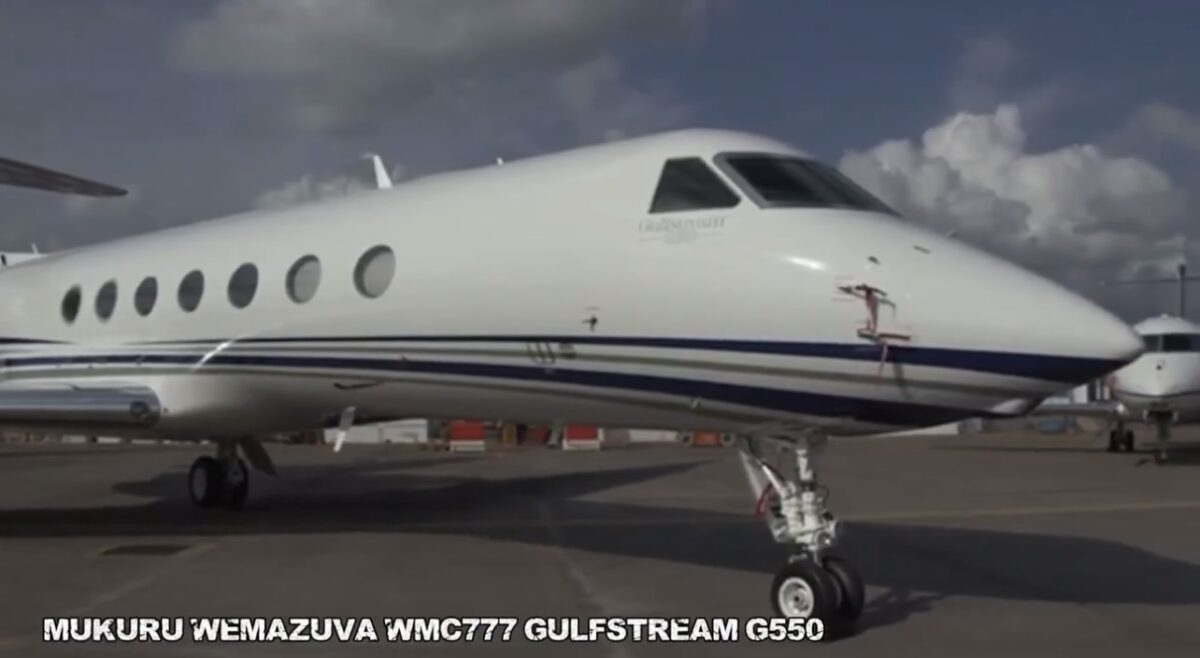
Wicknell Chivayo’s US$34 Million Gulfstream G550 Lands in Zimbabwe
Businessman Sir Wicknell Chivayo’s brand-new Gulfstream G550 private jet has touched down at Robert Gabriel Mugabe International Airport in Harare.
The luxury aircraft, reportedly valued at US$34 million, is regarded as one of the world’s premier long-range business jets. The Gulfstream G550 can fly at an altitude of up to 51,000 feet and reach speeds of Mach 0.885.
Designed to carry up to 19 passengers, the jet features a handcrafted interior and state-of-the-art amenities, including a boardroom-style cabin for business meetings while in flight.
The aircraft is capable of flying non-stop from Harare to major global destinations such as London, Paris, Milan and Singapore.
The Gulfstream G550 is also used by several high-profile figures, including entrepreneur Elon Musk, media personality Oprah Winfrey and African business magnate Aliko Dangote. *_-Afrogazette_*
1. Baby Found Mutilated After Abduction In Chitungwiza
A baby who was stolen from his mother’s home was reportedly found dumped at the family gate with both legs severed and multiple cuts across the body.
Details surrounding the circumstances of the alleged abduction remain unclear, but the gruesome discovery has sparked outrage and calls for swift action from law enforcement authorities.
Witnesses and community members expressed horror at the incident, describing it as one of the most disturbing cases they have encountered.
Authorities are reportedly investigating the matter to establish what happened and identify those responsible.
“This is a heartbreaking and horrifying incident. We hope the police will leave no stone unturned in bringing the perpetrators to justice,” said a concerned resident.
Police are yet to release an official statement on the case as investigations continue.*_-Afrogazette_*
1. Father sues ZIMSEC, minister over 9-subject O’ Level cap
A Harare father has filed a High Court application challenging a government directive that caps the number of Ordinary Level subjects a pupil can register for at nine, after his academically gifted son was forced to drop three subjects he had already paid for at Mutare Boys High School.
Walter Mutowo, acting in his personal capacity and as the natural guardian of his minor son Anesu Mutowo, filed the application on Wednesday.
The application, prepared by Lenon Rwizi of Hamunakwadi & Nyandoro Law Chambers, names ZIMSEC, the minister of primary and secondary education, and Mutare Boys High School as respondents.
Mutowo, in his founding affidavit, says he registered his son for 12 O’ Level subjects and paid the full examination fees on March 16, 2026.
Eight days later, the school’s head informed him that a new policy directive required Anesu to reduce his subjects to nine. The directive, he was told, was drawn from a policy document titled the “Heritage Based Curriculum Framework,” jointly issued and enforced by ZIMSEC and the ministry of primary and secondary education.
“To my utter shock, on March 24, 2026, I was advised by the head of Mutare Boys High that, pursuant to a new policy directive, they are forced to reduce his registered subjects from 12 to nine,” Mutowo says in the affidavit.
The circular underpinning the directive, Secretary’s Circular No. 10 of 2024 signed by ministry secretary Moses Mhike, states that the recommended maximum number of learning areas for study per pupil is nine at O’ Level and three at A’ Level.
Mutowo argues that neither the Zimbabwe School Examinations Council Act nor the Education Act empowers ZIMSEC or the minister to place such a cap on the number of subjects a learner may sit for, making the directive beyond their powers and therefore unlawful.
Mutowo also argues the cap violates Section 75 of the constitution, which guarantees the right to education, and Section 68, which enshrines the right to administrative justice. He further contends the sudden implementation of the directive after his son had already registered, prepared for, and paid for 12 subjects constitutes a violation of the boy’s legitimate expectation.
He further argues that capping subjects at nine is “profoundly unreasonable” and “actively harms academically gifted candidates.”
“It stifles intellectual curiosity and forces high-achieving learners to abandon disciplines that could shape their future professional endeavours. The State is effectively legislating a ceiling on intellectual excellence,” Mutowo says.
Mutowo also points to what he describes as a financial conundrum: ZIMSEC accepted his payment for 12 subjects on March 16, only to enforce the cap eight days later, leaving him forced to either apply for a partial refund for the three excluded subjects or withdraw his son entirely and re-enrol him at a centre that permits more than nine subjects.
The draft order filed with the application asks the court to set aside Clause 3.3 of the Heritage Based Curriculum Framework, direct that Anesu be allowed to register and sit for all 12 subjects he paid for in March, and order ZIMSEC and the minister to pay costs jointly and severally.
Zimbabwe’s education system has historically allowed O’ Level and A’ Level candidates to sit for an uncapped number of subjects. The Heritage Based Curriculum Framework 2024–2030, introduced under Secretary’s Circular No. 10 of 2024, replaced the previous Competence Based Curriculum and, among other changes, set the subject ceiling for lower secondary pupils.
The tension between the cap and high-achieving students has surfaced before. In November last year, a student from Pamushana High School in Masvingo sat for 12 A’ Level subjects and scored 56 points.