
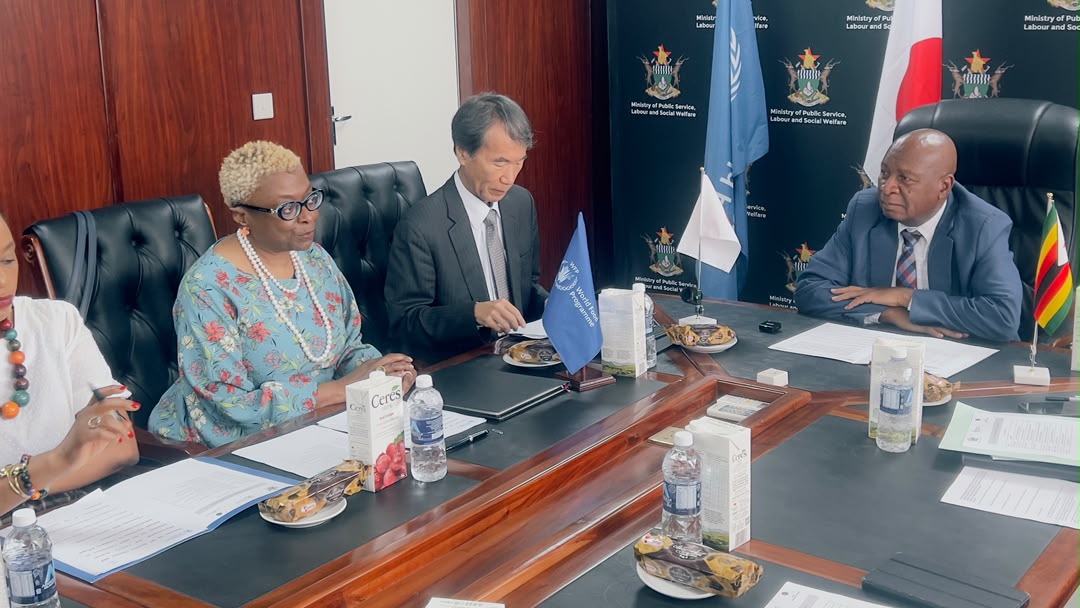
Japan and WFP Partners Public Service Ministry to Provide Life-Saving Food Aid to 11,000 Refugees in Zimbabwe
By Staff Writer
The Government of Japan has committed approximately US$1.3 million to provide urgent food and nutrition assistance to over 11,300 vulnerable refugees at the Tongogara Refugee Settlement.
The grant was formalized on Monday, September 7, 2026, through the signing of an Exchange of Notes between the Ambassador of Japan to Zimbabwe, H.E. Mr. MAEKAWA Nobutaka, and the World Food Programme (WFP).
The project, titled “Strengthening Food and Nutrition Security for Refugees in Tongogara Refugee Settlement through General Food Assistance and Targeted Nutrition Support,” aims to alleviate severe food access challenges during the 2025/2026 lean season.
Under the initiative, the most vulnerable households will receive food baskets consisting of essential cereals—including maize, millet, and sorghum — as well as vegetable oil and pulses.
Speaking at the signing ceremony, Ambassador Maekawa emphasized Japan’s solidarity with Zimbabwe as the region braces for the potential impact of a “super El Niño,” which threatens to disrupt livelihoods and deepen food insecurity.
“Zimbabwe may once again experience serious challenges in food security and livelihoods, particularly among vulnerable communities,” Ambassador Maekawa said.
“Today’s assistance responds to the growing food insecurity… driven by a combination of factors, including climate change and rising food prices linked to global crises.”
The Ambassador noted that these challenges have placed a “significant burden” on displaced populations and that Japan is pleased to contribute to efforts that support those in the most desperate need.
This latest contribution is part of a sustained humanitarian partnership. Over the past seven years, Japan has provided US$12.7 million in food assistance through the WFP, benefiting an estimated 227,300 people across the country.
In addition to direct food aid, Ambassador Maekawa highlighted Japan’s broader support for Zimbabwe’s agricultural resilience. This includes the 2024 provision of 6,000 metric tonnes of fertilizer to 100,000 small-scale farmers and an ongoing US$5 million project aimed at empowering smallholder farmers to survive climate-related shocks.
“Japan stands in solidarity with Zimbabwe,” the Ambassador added. “Through this partnership, we hope to alleviate immediate needs while contributing to long-term food security.”
The Tongogara Refugee Settlement, located in the Manicaland Province, remains home to thousands of refugees from across the region who rely heavily on international aid for their daily survival.
Public Service Minister Edgar Moyo commended the milestone in collective efforts to ensure food and nutrition security for the most vulnerable refugee community residing at Tongogara Refugee Settlement.
He extended profound gratitude to the Government and people of Japan for their generous contribution of JPY 200 million towards food and nutrition support for refugees in Tongogara.
“This support comes at a critical time and reflects the enduring spirit of global solidarity that binds our nations together. As we look ahead, the spectre of a potential El Niño induced drought looms over the 2026/27 agricultural season,” he said.
“In anticipation, the Government has already unveiled a comprehensive six point strategy to safeguard national food security. Your donation comes at a pivotal moment, complementing Government efforts to strengthen the Strategic Grain Reserve and ensure that no one succumbs to hunger in the event of a drought.”
These intersecting challenges; climatic shocks, structural pressures, and global supply chain disruptions reminds the nation that the fight against food insecurity requires sustained partnership and unwavering commitment.
Zimbabwe currently hosts approximately 12,532 refugees and asylum seekers, with more than 90% residing at Tongogara Refugee Settlement in Chipinge.
The settlement is vibrant with livelihood activities, including crop production of chilli, sugar beans and maize, as well as livestock ventures such as poultry, piggery and fisheries.
These initiatives have not only benefited the refugee population but also extended positive impacts to surrounding communities. The Government remains committed to building resilience, strengthening market linkages, and promoting value addition to local produce. These livelihood interventions have been instrumental in improving food and nutrition security, increasing household income, creating assets, reducing negative coping strategies, and fostering strong social cohesion.
This resonates profoundly with His Excellency, the President’s mantra of “leaving no one and no place behind”.
On behalf of the Government of Zimbabwe, Minister Moyo reaffirmed sincere gratitude to the Government of Japan for their invaluable generosity, and to the World Food Programme for their steadfast commitment in championing this noble cause.