
Former HSBC, KPMG and PwC executives join Bard Santner Bank board
Harare – After its launch last week amid a blaze of publicity, Bard Santner Microfinance Bank, which has ambitions of becoming the first diaspora-focused financial institution of its kind in the country to tap into the deep multi-billion-dollar remittance market, has unveiled a multidisciplinary
board of directors, who have held senior roles at some of the world’s best known banks, audit firms and financial regulators.
The board aims to provide robust corporate governance oversight and secure depositors’ funds in a market where people have lost hundreds of millions of dollars due to mismanagement, corporate governance failures and devastating cycles of economic meltdown and hyperinflation.
Strong corporate governance and strict protection of depositors’ funds are vital in the Zimbabwean financial market against a backdrop of a checkered history of systemic banking crises, owner-manager abuses, and a fragile macroeconomic environment affecting different institutions, big, medium or small.
Size and scale of the institution no longer matter the most.
Agility, utility, and profitability are the true north stars of modern fintech — shifting the focus entirely away from traditional banking’s reliance on sheer size and scale.
While legacy banks historically won by having the largest balance sheets and the most physical branches, the digital era has levelled the playing field.
Survival and dominance now belong to the nimble, not behemoths.
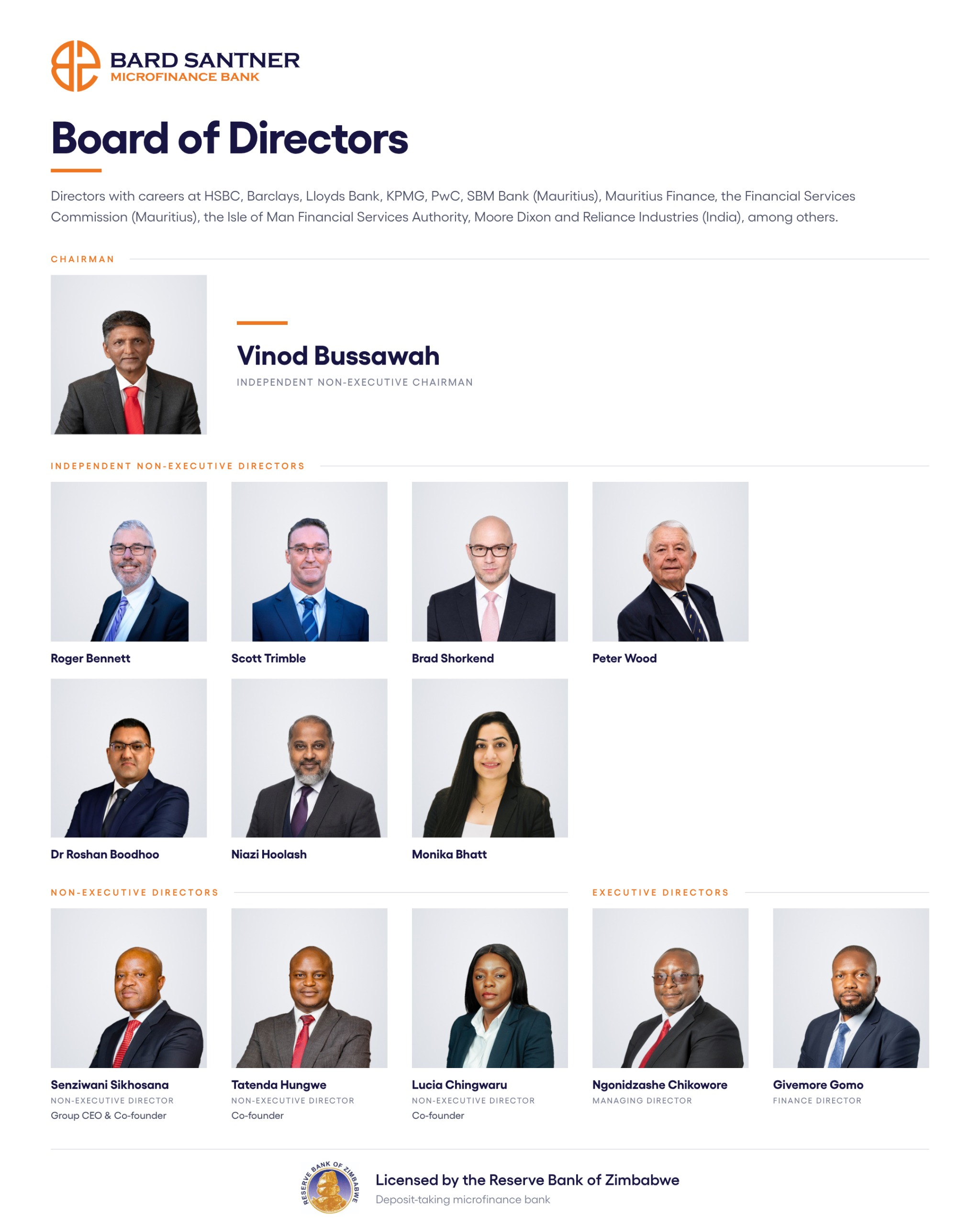
The 13-member board, which includes executive, non-executive and independent directors, is drawn from five different countries in the region and overseas, Zimbabwe, South Africa, Mauritius, India and the United Kingdom.
It includes Vinod Bussawah (chairman) and independent directors: Roger Bennett, Scott Trimble, Brad Shorkend, Peter Wood, Dr Roshan Boodhoo, Niazi Hoolash, and Monika Bhatt.
Its non-executive directors are Senziwani Sikhosana, Tatenda Hungwe, Lucia Chingwaru, whilw executive directors entail Ngonidzashe Chikowore (Managing Director) and Givemore Gomo (Finance Director).
The board has financial heavyweights on it, experienced directors and regulators with great track records.
Bussawah, a Fellow of the Association of Chartered Certified Accountants with more than 30 years in finance and governance, chairs the board.
He already presides over audit committees of two listed companies.
There is Boodhoo, former chief executive of the Financial Services Commission of Mauritius and former deputy CEO of SBM Group, one of the largest banking groups on the Island nation.
He sits on the board of a NASDAQ-listed company.
Scott Trimble, 30 years in senior and board-level roles at HSBC, HBOS, Grant Thornton, Moore Global and the Isle of Man financial regulator, brings a wealth of experience and leadership.
He was named UK Anti-Money Laundering Advisor of the Year in 2022 and 2023.
Forty years in banking and trust services, including Lloyds Bank, Canada Trust and CIBC, and founder of Fortress Management Services in the Isle of Man, Roger Bennett is is also a top-notch professional.
Former Associate Director at KPMG and Senior Manager at PwC Niazi Hoolash has led central bank mandated restructurings of commercial banks and is a key member.
Brad Shorkend is an adjunct faculty member at the Gordon Institute of Business Science and Duke Corporate Education, and adviser to leadership teams across Europe, the United States, Asia, the Middle East and Africa, Monika Bhatt is Company Secretary in practice, specialising in corporate law and governance.
These world-class directors sit alongside Zimbabwean bankers with decades of experience in the local market, including Peter Wood, former Chairman of BancABC Zimbabwe.
Founding Bard Santner Inc. pioneers Sikhosana, Hungwe and Chingwaru, who are non-executive directors, will steer the ship as custodians of the vision and strategy, while Chikowore and Gomo provide management skills and ensure profitability.
Sikhosana, who has long experience in the local banking and financial services sector, is the captain of the ship as chief executive of the group.
Recently, he was honoured as the 2026 Director of the Year by the Institute of Directors Zimbabwe.
Bussawah said: “Our job as a board is simple: to protect depositors’ money and to make sure the bank is run to international standards.”
Chikowore noted: “Zimbabweans deserve a new fintech institution they can trust. That is why we brought together experts with great track records, locally, regionally and internationally, alongside people who know this market well, to build a new diaspora-focused institution from sracth.
“We want to lay a strong foundation, ensure corporate governance and protect depositors’ funds from the word go.”
Sikhosana said trust and confidence in banking are the bedrock; everything.
“Banks are founded on trust.
Trust in banking is gradually earned through customer-centred, efficient and consistent service, security, and transparency.
Trust and the interplay of confidence and accountability become the nerve-centre of banking.
This entails a deep responsibility to protect both depositors’ funds, confidentiality and data.
When customers choose a bank, they are not just choosing a name or brand; they are entering a confidential relationship built on the legitimate expectation of safety of their funds, confidentiality of their information and ethical behaviour.”
The appointment of this multi-disciplinary board comes at a critical evolutionary junction for the banking sector, which is changing irrevocably due to the digital revolution.
Historically, microfinance and remittance-driven digital platforms have been viewed as informal alternatives to traditional commercial banks, often suffering from weaker governance frameworks.
By constructing a board strong on local and international regulatory compliance, corporate governance and legal structure, as well as professional and technical expertise, Bard Santner is positioning itself to shift this perception entirely.
This structure directly addresses the complexities of cross-border financial connection.
Because the bank aims to operate as a digital-first conduit linking the Zimbabwean and wider African diaspora, primarily in markets like South Africa, the United Kingdom, and the United States, with local small-to-medium enterprises and investment funds, its exposure to compliance risk is high.
The presence of an independent, internationally certified governance specialists at the helm ensures that anti-money laundering controls and know-your-customer frameworks match standard international banking requirements.
This baseline of compliance is crucial for maintaining relationships with foreign correspondent banks.
Furthermore, the board’s emphasis on separating executive functions from independent oversight addresses a historic weakness in emerging fintech startups, where rapid scaling often bypasses internal auditing.
By staffing its board with recognised champions of corporate integrity and international asset law, the bank has laid down a solid framework of trust.
As the institution begins mobilising parts of the continent’s multi-billion-dollar remittance pool into structured investment vehicles, its corporate governance model will serve as a digital-era vital blueprint.
It demonstrates that for a financial intermidiary to truly succeed, it must be built on a foundation of capital, customer care, and compliance.


