
Zimbabwe’s recycling paradox: Can waste become a source of wealth?
As Zimbabwe embraces the circular economy and promotes recycling as a source of employment and investment, the country continues to grapple with uncollected rubbish, illegal dumpsites and plastic pollution. The question is whether the emerging green economy can turn the country’s waste crisis into an economic opportunity.
By Kudzai Jakachira
MUTARE: Zimbabwe is sitting on an economic opportunity that is quite literally being thrown away.
From discarded plastic bottles and packaging materials to food waste, scrap metal and used paper, the country’s growing waste problem presents opportunities for businesses, employment creation and environmental protection.
Yet, in many urban communities, the sight of uncollected rubbish, overflowing skips and illegal dumpsites remains a familiar feature of everyday life.
For urban residents dwelling near these expanding refuse mountains, the crisis is an immediate daily confrontation with toxic pollution and infectious disease hazards.
“We live encircled by mountains of decomposing garbage that catch fire during the dry season, filling our homes with toxic smoke that chokes our children and leaves us constantly ill,” said Tambudzai Mtero, a community health activist from the densely populated Sakubva township.
“Municipal trucks have not serviced our sector in months, forcing people to dump waste in dry riverbeds and vacant lots. When the heavy rains come, the runoff washes this filth right back into our yards and shallow wells, turning our daily survival into a desperate battle against disease.”
This breakdown of municipal services has simultaneously fostered a vast network of vulnerable informal waste pickers who comb through hazardous refuse sites without protective gear or economic security.
“We spend our days exposed to sharp medical waste, rotting food, and chemical fumes just to salvage plastic bottles and scrap metal that we can sell for a few coins to feed our families,” said Tinashe Moyo, an informal material recovery worker operating at a municipal dumpsite.
“We are the ones keeping the city from drowning in its own plastic, yet the authorities treat us as nuisances rather than essential workers. Without formal recognition, proper gear, and fair pricing structures, our labor remains a trap of poverty and chronic sickness.”
While government has increasingly promoted recycling and the circular economy as part of its broader sustainable development agenda, the country’s waste management system continues to face serious structural challenges.
This presents a paradox: Zimbabwe is beginning to recognise waste as an economic resource, but has yet to establish a sufficiently effective system to collect, process and commercialise it on a meaningful national scale.
The country’s experience raises an important question: Is waste management and recycling emerging as a Zimbabwean success story, or is the country still struggling to translate environmental ambition into economic reality?
There are encouraging developments.
Across the country, community organisations, entrepreneurs and recycling companies are increasingly participating in the collection, sorting and processing of recyclable materials.
In some communities, waste collection has become a source of income, particularly for women and young people who have established small businesses around plastic recovery, paper collection and other recyclable materials.
Local Government and Public Works Permanent Secretary Engineer Tafadzwa Muguti said the proposed declaration would enable authorities to take decisive action to address the country’s waste management challenges, with the Geo Pomona Waste Management model providing a blueprint for the nationwide rollout.
Speaking during a familiarisation tour of the Geo Pomona facility by representatives from all 92 local authorities, Eng Muguti said President Mnangagwa had approved the Presidential Household Waste Management Programme, under which every household would receive a metal bin to improve refuse collection.
“What that means is that, as Government, we are moving to ensure that every local authority has a state-of-the-art facility,” he said.
“We have gone beyond the point of debate. When the President declares something a national project, we roll it out.
“I am happy to say that this is the beginning of the rollout of the Geo Pomona waste management project to the remaining 91 local authorities.”
Eng Muguti said the programme was part of broader efforts to restore orderly waste management practices while creating opportunities for recycling and energy generation.
He said the household bin initiative would help the country reclaim the high standards of refuse collection and disposal it maintained in the past.
Community-based initiatives in places such as Harare and Bulawayo demonstrate that recycling can provide livelihoods while helping to reduce the volume of waste entering the environment.
The United Nations Development Programme has also documented initiatives in Zimbabwe that demonstrate the economic potential of converting organic waste into useful products.
One such Harare initiative processed 105 tonnes of food waste, trained 125 people and created eight green jobs.
These interventions illustrate how waste, when properly managed, can become an input into productive economic activity rather than an environmental liability.
The growing involvement of private companies and cooperatives is another indication that the sector has potential.
Recycling creates opportunities in plastic processing, compost production, paper recovery, scrap metal trading and the manufacture of products using recycled materials.
However, the existence of these initiatives does not necessarily mean Zimbabwe has established an effective recycling economy.
The scale of the challenge remains considerable.
Zimbabwe’s 2024 Biennial Transparency Report estimated that recycling rates in 2022 stood at just 0.1 percent in urban areas and 0.2 percent in rural areas.
Although these figures do not necessarily capture all informal waste recovery activities, they underline the limited scale of formal recycling reflected in the country’s reporting.
The problem is compounded by weaknesses in municipal waste collection.
Local authorities, particularly in major urban centres, have struggled with inadequate refuse collection equipment, financial constraints, ageing vehicle fleets and inconsistent collection schedules.
In high-density communities, residents often resort to disposing of rubbish in undesignated areas, open spaces and drainage systems.
The consequences extend beyond the appearance of towns and cities.
Poor waste management contributes to blocked drainage systems, environmental degradation and the contamination of water sources.
Accumulated waste can also provide breeding grounds for disease-carrying pests.
Plastic pollution is particularly concerning because much of the material discarded into the environment takes a long time to break down.
Zimbabwe’s recycling ambitions therefore face a fundamental obstacle: the country cannot build a thriving recycling industry without first establishing reliable systems for collecting and separating waste.
The economics of recycling
The economic argument for recycling is compelling.
Rather than relying entirely on imported raw materials, manufacturers can potentially use recovered materials to produce new goods.
This could create domestic value chains, reduce pressure on natural resources and generate employment.
For entrepreneurs, waste collection and processing also offer opportunities to establish businesses with relatively modest initial investments, although industrial-scale recycling requires substantial capital.
But recycling is not automatically profitable.
Companies require reliable supplies of recyclable materials, processing equipment, electricity, transport, storage facilities and access to markets.
The quality of recovered materials also matters. Waste that is mixed with organic matter or contaminated by other substances can become difficult and expensive to process.
This is one reason why waste separation at household and commercial level is important.
Without proper separation, valuable materials are lost or become unsuitable for recycling.
There is also the question of investment.
Zimbabwe needs greater investment in modern recycling facilities, collection infrastructure and technologies capable of processing different categories of waste.
Government incentives could help attract businesses into the sector, particularly where recycling projects contribute to employment creation and environmental protection.
However, investors will also need predictable policies, reliable infrastructure and commercially viable markets for recycled products.
The forgotten workforce
Behind Zimbabwe’s recycling economy is an often-overlooked workforce of informal waste pickers.
These men and women collect plastics, bottles, cardboard, scrap metal and other materials that can be sold to recycling businesses.
Their contribution to waste recovery is significant, yet many operate under difficult conditions.
They often lack protective clothing, proper storage facilities, access to reliable markets and adequate social protection.
As Zimbabwe develops its circular economy, integrating informal waste collectors into formal recycling value chains should become a priority.
Recognising their contribution could improve their working conditions while strengthening the country’s overall waste recovery system.
Cooperatives, organised collection centres and partnerships between local authorities and recycling companies could provide a more structured way of involving these workers.
Government’s ambitions versus realities on the ground
Government has increasingly highlighted recycling as part of its environmental sustainability and green economic development agenda.
Environment Minister Evelyn Ndlovu said recycling hubs had been established in all 10 provinces and that more than 3,000 green jobs had been generated through circular economy initiatives.
These figures point to the scale of the government’s ambitions. However, the critical question is how many of these facilities are fully operational, how much waste they process and whether the jobs created are permanent and sustainable.
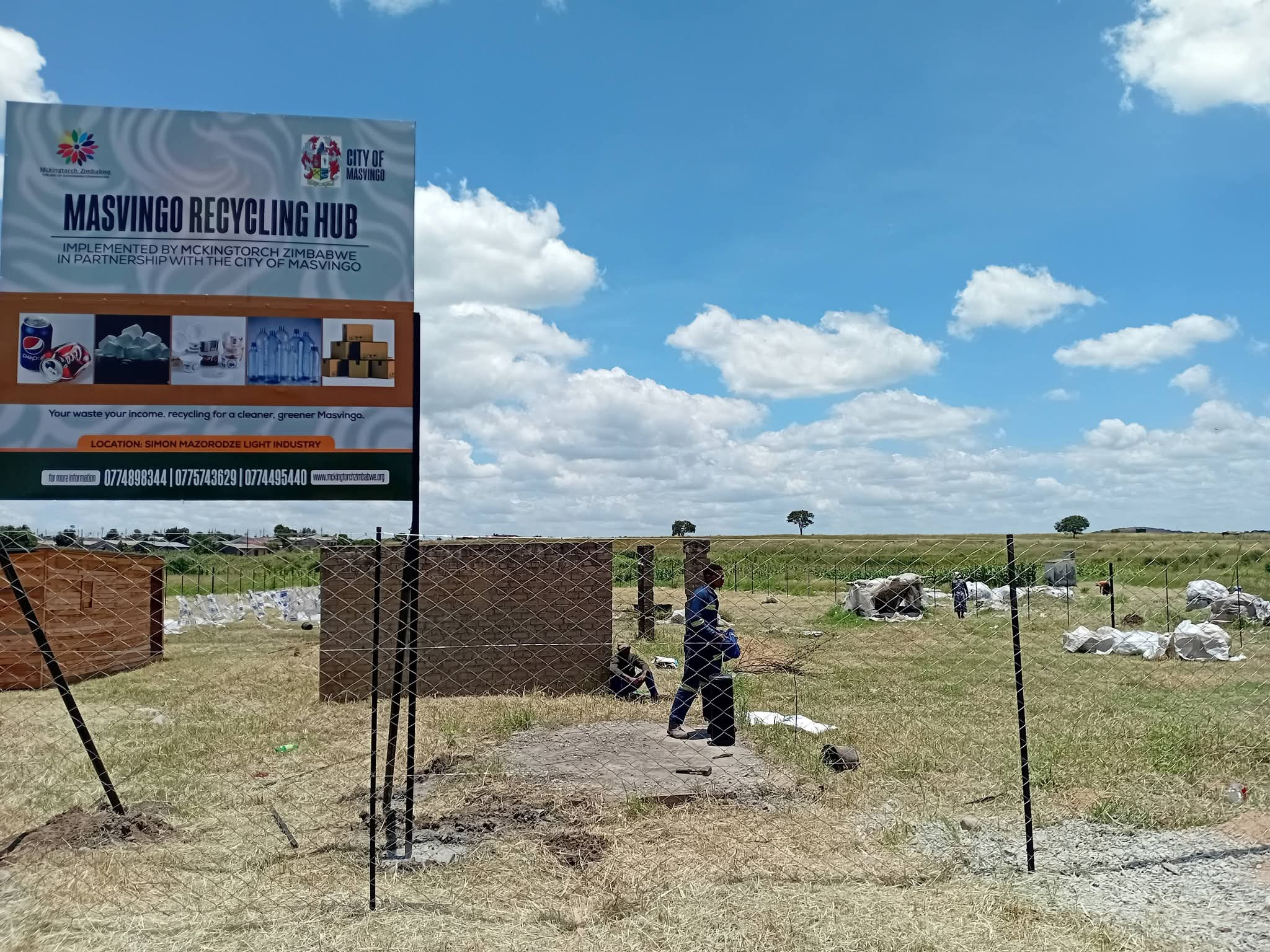
City of Masvingo in partnership with Mckingtorch Zimbabwe has introduced Masvingo Recycling Hub, an initiative aimed at strengthening sustainable waste management and promoting a circular economy.
This initiative aims to promote waste separation at source, strengthen recycling systems, create green jobs, and empower communities to actively participate in environmental stewardship.
This program was built on strong partnerships and recognised the critical role of residents, the private sector, informal waste collectors, educational institutions, and development partners in ensuring its success.
Howevee, the success of recycling programmes cannot be measured simply by the number of initiatives launched or facilities established.
It should also be measured through the volume of waste recovered, the proportion of materials successfully recycled, the reduction in illegal dumping and the number of people earning sustainable incomes from the industry.
Independent verification of reported achievements will therefore be important in assessing the sector’s actual progress.
Can Zimbabwe turn the tide?
Zimbabwe’s waste management challenges are not insurmountable.
A more coordinated approach involving government, local authorities, businesses, communities and environmental organisations could help transform the sector.
First, municipalities need to improve waste collection and establish reliable systems for separating waste at source.
Second, government should create an enabling environment for private investment in recycling infrastructure.
Third, communities need greater awareness of the economic and environmental benefits of separating recyclable materials.
Fourth, informal waste collectors should be integrated into formal recycling programmes.
Finally, manufacturers should be encouraged to take greater responsibility for the packaging and materials they introduce into the market.
Extended producer responsibility, which places greater responsibility on manufacturers for the post-consumer management of their products, could also help strengthen recycling systems.
Ultimately, Zimbabwe’s recycling sector stands at an important crossroads.
There are businesses creating opportunities, communities finding value in discarded materials and government initiatives seeking to promote a circular economy.
But these developments exist alongside a persistent waste management crisis that continues to affect communities across the country.
For Zimbabwe, the challenge is no longer simply about encouraging people to recycle. It is about building an economic and institutional system that makes recycling viable, accessible and sustainable.
Until that happens, the country will continue to throw away an opportunity that could create jobs, support industry and protect the environment.
The real measure of success will be whether Zimbabwe can move from treating waste as something to be discarded to recognising it as a resource capable of generating wealth.