
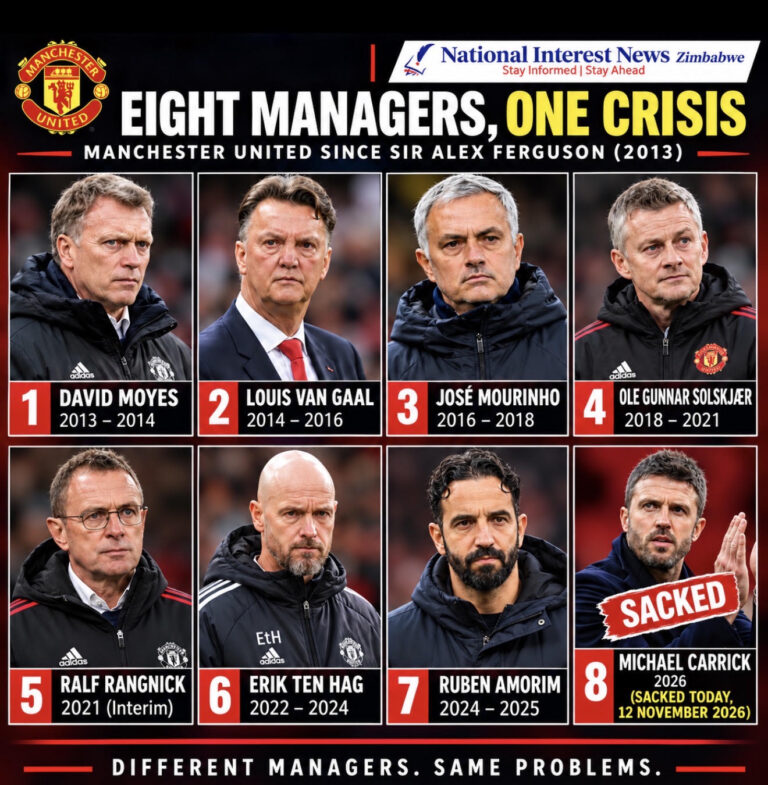
8 managers, one crisis: Is Manchester United’s real problem in the boardroom?
Eight managers, different football philosophies, hundreds of millions of pounds spent on players and one recurring outcome: failure to restore Manchester United to the summit of English football.
The dismissal of Michael Carrick on Thursday has once again exposed the instability gripping Old Trafford, raising an increasingly uncomfortable question: Are Manchester United’s managers failing the club, or is the club’s leadership repeatedly failing its managers?
Carrick becomes the latest casualty of a managerial revolving door that has defined United’s decline since Sir Alex Ferguson retired in 2013.
From David Moyes and Louis van Gaal to José Mourinho, Ole Gunnar Solskjær, Ralf Rangnick, Erik ten Hag and Ruben Amorim, successive managers have arrived promising revival, only to depart amid disappointing results, mounting pressure and questions over the club’s direction.
Carrick’s departure is particularly remarkable.
Just six months ago, the former United midfielder was being celebrated for rescuing a struggling team after replacing Amorim in January.
He won 12 of his 17 Premier League matches, secured a third-place finish and restored Champions League football to Old Trafford.
Those achievements earned him a contract until 2028.
But ten league matches into the new season, United have managed just one victory, collecting eight points and slipping into the relegation zone.
A humiliating 3-0 home defeat to Bournemouth, followed by a 2-0 loss at Chelsea and a chaotic 4-4 draw against Aston Villa, ultimately sealed his fate.
Announcing his departure, the club said:
“After a disappointing start to the season, the club has come to the extremely difficult conclusion that a change is necessary in order to achieve our ambitions.”
But beyond the familiar language of managerial dismissals lies a deeper problem.
Why does Manchester United continue to change managers without achieving lasting change?
The evidence points towards an institution struggling with leadership continuity, recruitment strategy and a clearly defined football identity.
Moyes lasted less than a season after inheriting Ferguson’s formidable legacy.
Van Gaal delivered the FA Cup but lost his job.
Mourinho won the Europa League and League Cup and finished second in the Premier League, yet his tenure collapsed amid tensions and declining performances.
Solskjær restored optimism and secured consecutive top-three finishes but failed to deliver major silverware.
Rangnick’s interim appointment exposed further concerns about the club’s structure, while Ten Hag’s domestic cup successes failed to translate into sustained league improvement.
Amorim arrived with an ambitious tactical philosophy but departed after 14 months.
Now Carrick has suffered the same fate.
These managers differed significantly in experience, personality and tactical approach. Some were proven winners, others promising coaches or former United players who understood the club’s traditions.
Yet none succeeded in delivering sustained Premier League success.
That pattern demands scrutiny beyond the technical area.
United have repeatedly recruited players for different tactical systems, changed senior football executives and altered their long-term strategies.
The result has been a squad assembled across several managerial eras, often leaving incoming coaches attempting to impose new ideas on players recruited for entirely different approaches.
Carrick inherited many of those challenges.
Despite substantial investment during the summer transfer window, questions remained over the balance of the squad, defensive reliability and whether recruitment had adequately addressed the team’s weaknesses.
The additional demands of Champions League football exposed those vulnerabilities.
United’s defensive problems became particularly evident in the extraordinary 4-4 draw against Aston Villa, when Carrick’s side twice recovered from two-goal deficits but again failed to demonstrate the stability expected of a club with championship ambitions.
Off-field tensions further complicated his position.
Captain Bruno Fernandes publicly challenged aspects of the team’s approach following a Champions League defeat to Como, while defender Lisandro Martínez criticised the club’s recruitment decisions and leadership.
Such developments suggested that Carrick was managing more than poor performances. He was also confronting questions about squad unity and the relationship between players, coaches and senior executives.
Nevertheless, Carrick cannot be absolved of responsibility.
One victory in ten Premier League matches represents an unacceptable return for a club of United’s stature.
His inability to maintain last season’s momentum, improve defensive organisation and establish consistency provided legitimate grounds for questioning his suitability.
But accountability should not end with the manager.
According to British media reports, director of football Jason Wilcox and chief executive Omar Berrada recommended Carrick’s dismissal following discussions with minority owner Sir Jim Ratcliffe.
The decision raises important questions about the executives responsible for shaping United’s football strategy.
If recruitment, managerial appointments and long-term planning fall under their authority, should they not also face scrutiny when those decisions repeatedly fail to deliver?
A manager can be dismissed for poor results. But who takes responsibility when the same institutional problems survive successive dismissals?
Former United defender Gary Neville has been among the most outspoken critics of the club’s recurring managerial changes.
Speaking to NBC, as reported by Sky Sports, Neville warned that replacing coaches without fixing the organisation would merely reproduce the same failures.
“You can keep changing the manager and thinking that’s going to be the answer. But this has been proven now over 12 years, that’s not the answer.”
He also questioned the quality and alignment of leadership throughout the club, arguing that weak recruitment and ineffective football structures would undermine even highly capable managers.
His assessment goes to the heart of United’s predicament.
The club has repeatedly treated managerial dismissals as the starting point for rebuilding, without demonstrating that the wider football operation has achieved the stability necessary to support lasting success.
The contrast with Ferguson’s era remains striking.
During his 26 years at Old Trafford, Ferguson established a culture built around authority, accountability, recruitment planning and continuity.
Managers elsewhere came and went, but United maintained a recognisable identity and consistently challenged for major honours.
Since his retirement, the club has struggled to reproduce that structure.
Despite enormous commercial resources and repeated investment in the playing squad, United have not won the Premier League since 2013.
The problem is therefore bigger than one unsuccessful season or one underperforming manager.
It is a prolonged failure to convert financial strength into sustained sporting success.
Mauricio Pochettino, currently managing the United States national team, is now widely expected to replace Carrick.
The Argentine possesses extensive Premier League experience, having previously managed Southampton, Tottenham Hotspur and Chelsea.
But his potential appointment will inevitably raise the same questions that surrounded his predecessors.
Will he inherit a squad suited to his philosophy?
Will the recruitment department deliver players who address genuine tactical weaknesses?
Will senior executives provide the stability required for a long-term rebuilding project?
And will he be given sufficient time when results inevitably fluctuate?
Without convincing answers, United risk repeating the familiar cycle: a celebrated appointment, an encouraging honeymoon period, growing frustration and another expensive dismissal.
Carrick’s departure may prove justified by the results. Few managers could expect to survive such a disastrous opening to a Premier League campaign.
But the bigger issue is whether United’s hierarchy understands why so many managers have struggled at the same institution.
The club has changed coaches, players, executives and tactical systems, yet the underlying instability has persisted.
That does not prove every manager was blameless, nor does it establish that every recruitment decision was wrong.
It does, however, raise serious questions about the consistency and effectiveness of the leadership overseeing those decisions.
After more than a decade of managerial upheaval, Manchester United can no longer afford to treat every dismissal as a fresh solution to an old problem.
The next manager may improve results. He may even deliver trophies.
But unless the club establishes a coherent football strategy, strengthens recruitment accountability and creates stability beyond the dugout, another managerial appointment could become little more than another temporary reset.
For supporters who remember Ferguson’s era of dominance, the most troubling question is no longer who should manage Manchester United.
It is whether the people running the club have the vision, competence and accountability required to restore its former greatness.
Eight managers have come and gone. The problems remain.
Perhaps it is time Manchester United stopped asking why its managers keep failing — and started asking why the institution keeps producing the same failures.


