
Chipinge man’s conflicting details of 2 murder cases attract public attention…Court records set the record straight
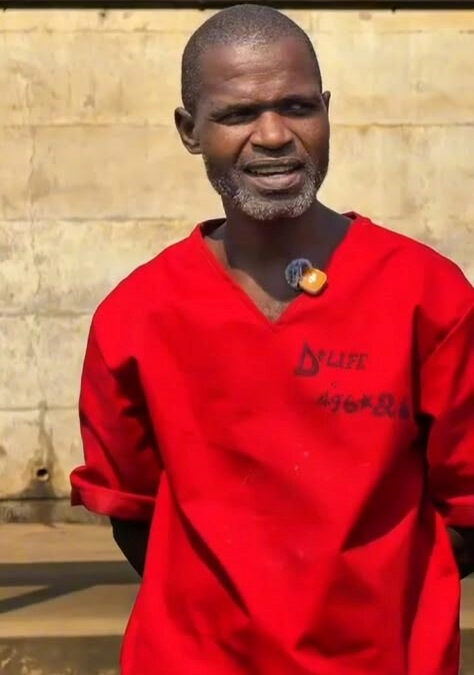
FELIX Siyathunya, a Chipinge man serving two life sentences for murdering two women in separate incidents, has attracted public sympathy after a social media interview in which he presented a different account of the circumstances surrounding his imprisonment.
However, court records show that Siyathunya (37), was convicted of two separate murders, one involving a 16-year-old girl, following incidents in Chipinge in 2023 and 2025 respectively.
The convictions followed cases heard at Mutare High Court, where judges, Justice Isaac Muzenda and Justice Sijabuliso Siziba sentenced him to life imprisonment on May 26 and June 2, respectively.
In the first case, which occurred on September 26, 2023 in Checheche, Siyathunya unlawfully caused the death of Florence Mutuvi.
Court findings established that he struck Mutuvi on the head, back and legs with an unidentified weapon before slamming her against a wall. He acted intending to kill her or realising that his conduct created a real risk or possibility of death.
In the second case, which occurred on December 17, 2025 in Usanga Location, Chipinge, Siyathunya unlawfully caused the death of Charity Mbaimbai.
He assaulted her with open hands, struck her repeatedly with a log and stabbed her three times with a metal file, hitting her on the head, beside the left eye and on the left thigh.
In both cases, the prosecution secured murder convictions under Section 47(1)(a) or (b) of the Criminal Law (Codification and Reform) Act [Chapter 9:23].
Principal public prosecutor, Mr Malvina Musarurwa and Mrs Jane-Rose Matsikidze prosecuted the two cases, respectively.
Siyathunya is now serving his sentences at Chikurubi Maximum Prison.
The account that went viral
Despite the court findings, Siyathunya recently attracted widespread attention after appearing in a social media broadcast titled Behind the Walls.
The interview, which other social media platforms subsequently circulated, presented his version of the events leading to his imprisonment. Wearing a red D LIFE prison uniform bearing inmate number 496*26, Siyathunya introduced himself and described what he claimed happened when he returned home and found his wife with another man.
“My name is Felix Siyathunya. I come from Mutare. The crime that I committed is murder which happened in Chipinge. Before I go on to explain the case being my imprisonment, I want to thank Bridge FM and our ZPCS Officers who gave me this opportunity to tell my story.
“My case started when I found my wife in the company of a boyfriend at my house and this was after I had gone out for work. I left home and returned after 40 minutes after I had forgetten something. When I reached home, I found someone coming out. The person attacked me. He used a plank to hit me.
“I managed to push him into the house, asking him who exactly was he at my house. My wife managed to slip out as I wrestled that person. My wife started calling out neighbours for assistance since I was now literally fighting the boyfriend. I had sustained injuries, but I managed to overpower him. I left him crying after dragging him outside since my neighbours had already gathered outside.
“I left the scene. At first I wanted to look for medical help for the intruder, since I had observed that he was badly injured, but I later thought of fleeing to avoid arrest. I was later arrested and given life in prison sentence.
The painful thing about my experience is that I was the one who was being attacked in my own house by my wife’s boyfriend and I ended up being the one getting a sentence like this. I just told myself that some of these things need patience and the trust in Lord Almighty because this is not easy,” he said.
Siyathunya’s account prompted widespread reactions, with some social media users questioning the severity of the sentence and criticising the country’s judicial system.
However, the court records establish that Siyathunya’s imprisonment followed two separate murder convictions involving Florence Mutuvi and Charity Mbaimbai.
His social media account focused on an alleged confrontation with his wife’s boyfriend, but did not address the circumstances of the two cases, in which he was convicted.
Misinformation, disinformation and verification
The episode highlights the dangers of circulating unverified claims, particularly when social media audiences form opinions about criminal cases without examining court records.
Misinformation refers to false, inaccurate or misleading information shared without necessarily intending to deceive. Disinformation, by contrast, involves deliberately creating or circulating false information to mislead audiences.
The distinction is important when assessing both the person making a claim and the platform publishing it. Establishing deliberate deception requires evidence of intent, while establishing whether a claim is inaccurate requires verification against reliable records.
In Siyathunya’s case, the court findings provide an essential reference point for assessing the circumstances surrounding his convictions.
In an era when information spreads rapidly across digital platforms, journalists must verify claims before publishing or amplifying them.
The growing influence of social media has also increased the need for journalists and content creators to distinguish between personal accounts, allegations and established facts.
Media practitioner, Ms Jane Mudukuti, said fact-checking and verification are fundamental to responsible journalism.
“Fact-checking and verification are foundational to journalism, described by media scholars and the Society of Professional Journalists Code of Ethics as a “discipline of verification” that separates credible reporting from unverified communication.
“Core values and benefits include preserving Public Trust. Consistent, rigorous vetting builds long-term institutional credibility, ensuring audiences treat reporting as reliable rather than manipulated or biased. Cross-referencing multiple sources, consulting subject-matter experts, and authenticating digital media (photos, video, and audio) prevent false narratives from spreading rapidly online.”


