SHOCKING UPDATE: Human skull and another body part found at Toyota Quantum accident scene… some victims still missing
ESIGODINI – The already harrowing narrative surrounding the catastrophic Toyota Quantum explosion on the Bulawayo–Beitbridge Road has taken an even more grim turn with the discovery of a human skull and another body part at the crash site. This chilling find, made days after the initial inferno, has intensified fears that the death toll from the 16 April 2026 tragedy could be significantly higher than the 18 previously reported, leaving families in an agonising wait for closure.
The accident, which occurred on a notorious stretch of highway known locally as “Much Binding,” has unravelled into a complex investigation, revealing a dangerous nexus of cross-border explosives smuggling. What began as a journey of mourning for a group of funeral-goers returning from Nkayi to Johannesburg tragically culminated in a fireball that obliterated the kombi and its occupants, scattering human remains over a wide radius.
The Unfolding Horror: A Grim Discovery
Search teams, aided by a family desperately seeking their missing aunt, made the latest macabre discovery on Sunday, days after the initial blast. Mr Nathan Nkomo, the Director-General of the Zimbabwe Civil Protection Unit (CPU), confirmed the find, stating, “The teams at the crash site discovered a skull and another body part on Sunday. This was after a family still missing its relative requested to join in the search, so this means that the figure can actually be higher than the reported 12.” This statement, initially referencing 12 reported deaths, underscores the fluctuating and uncertain nature of the casualty count in the immediate aftermath of such a devastating event.
Authorities are now faced with the arduous task of identifying these newly found remains. Mr Nkomo indicated that forensic processes, including DNA testing, would be employed. “We are liaising with the National University of Science and Technology (NUST), whom we understand have the necessary equipment to carry out the tests, and the costs will be met in full by the Government through the CPU,” he explained. This crucial step is also being extended to three other bodies that were burnt beyond recognition in the initial explosion, highlighting the extreme violence of the incident and the challenges in providing definitive identification for the victims.
A Scene of Unimaginable Devastation
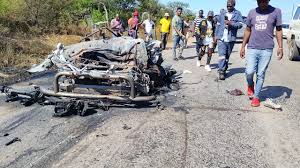
The explosion, which occurred between 13:00 and 14:00 on Thursday, 16 April 2026, transformed the Toyota Quantum commuter omnibus into an inferno near the Chipangali Wildlife Orphanage, approximately 25 kilometres east of Bulawayo. The intensity of the blast was so severe that it defied the typical physics of a road traffic accident. Debris was scattered for hundreds of metres across the dry Matabeleland bush. One body was discovered nearly 100 metres from the charred shell of the vehicle, while another was found lodged atop a four-metre-high tree, a testament to the raw power of the detonation. An overhead communication cable was severed by flying fragments, cutting off communication lines in the immediate vicinity as the vehicle was reduced to an unrecognisable skeletal frame.
Eyewitnesses described a scene of utter horror. Andrew Ncube, a local resident who arrived minutes after the explosion, recounted a landscape of unimaginable carnage. “When I arrived, there were bodies thrown all over the place,” he said, his voice trembling as he recalled the sight. “Some were on the sides of the road, whilst others were lying in the middle of the road.” In a particularly heart-wrenching detail, Mr Ncube described encountering two victims—a man and a woman—who were still clinging to life amidst the wreckage. “The lady was asking for water. We were told help was coming, but she passed on before the ambulance arrived, about five minutes later,” he recounted, painting a vivid picture of the desperate final moments.
Emergency services, including the Bulawayo Fire Brigade, police, and military personnel, swiftly responded to the disaster. However, by the time they arrived, the kombi was already engulfed in flames, rapidly reducing it to a skeletal frame. Authorities promptly cordoned off the area, deploying a drone to assist in the grim search for bodies and remains scattered across the surrounding bushland.
The Explosives Theory: A Dark Undercurrent of Illicit Trade
Preliminary investigations by the Zimbabwe Republic Police (ZRP) and other security apparatus have increasingly pointed towards a sinister cause: the detonation of explosive material within the vehicle. Reports from the scene indicate that fragments suspected to be explosive material were discovered a few metres from the wreckage, lending credence to the theory that the kombi was transporting dangerous cargo. While officials have yet to officially confirm the presence of explosives, the evidence gathered so far strongly suggests this illicit trade was at the heart of the tragedy.
One anonymous miner from Filabusi told ZimLive that he recognised remnants of what appeared to be industrial explosives among the debris. This observation has fuelled suspicions that the driver was engaged in the perilous act of smuggling explosives into South Africa. Such materials are highly sought after by criminal syndicates involved in illegal mining operations, often referred to as ‘zama zamas’, and cash-in-transit (CIT) heists, which plague South Africa.
This incident is not an isolated case of bad luck; it is a symptom of a burgeoning illicit trade. The Bulawayo–Beitbridge highway is a known conduit for various illicit goods, and the smuggling of explosives has become a significant concern for authorities in both nations. South African officials have repeatedly highlighted how these illegally trafficked materials are directly contributing to a surge in violent crimes, particularly armed robberies and unregulated mining activities.
Zimbabwe has stringent regulations governing explosives under its Explosives Act and accompanying statutory instruments, such as S.I. 72 of 1989. These laws meticulously control the manufacture, possession, storage, transport, and use of all explosive materials. Obtaining a permit for such materials is mandatory. However, the proliferation of unregulated mining across Zimbabwe has inadvertently created a thriving black market for cheap explosives. A significant portion of these illicit materials is then smuggled into South Africa, where demand, driven by illegal mining and criminal enterprises, remains exceptionally high.
A Broader Crisis: Recent Interceptions and the Human Cost
The economics of this trade are lucrative and deadly. Recent seizures have uncovered explosives worth between R770,000 and R1,000,000 being moved across the border in single shipments. For a “malaicha” (informal transporter) or a kombi driver, the promise of a high payout for carrying a small, unassuming parcel can outweigh the perceived risks—until the unthinkable happens.
Just four days prior to this explosion, on 14 April 2026, South African authorities at the Beitbridge Border Post intercepted a truck carrying a massive haul of Zimbabwean explosives. The driver, Edgar Maroto, aged 42, was arrested for attempting to smuggle explosives valued at nearly R770,000. Reports indicated that Maroto’s truck was equipped with a concealed compartment specifically designed to hide the contraband. Furthermore, only three days before the kombi explosion, on 13 April 2026, a suspect in South Africa was severely injured when the explosives he was setting up for a CIT robbery in Kranskop detonated prematurely. The Border Management Authority (BMA) also successfully intercepted another significant consignment of explosives, valued at R1 million, at the Beitbridge border post on 14 April 2026. These repeated seizures highlight the persistent efforts by criminal networks to transport dangerous materials across the border, often with devastating consequences.
Munesu Munodawafa, the Managing Director of the Traffic Safety Council of Zimbabwe (TSCZ), issued a stern warning to the motoring public to avoid carrying items with the potential to explode, noting that preliminary findings in the Esigodini disaster strongly suggest such materials were present.
The Victims: Names, Ages, and Lingering Questions
President Emmerson Mnangagwa swiftly declared the accident a “State of Disaster,” a move that authorises the mobilisation of state resources to assist the bereaved families. Local Government Minister Daniel Garwe confirmed the declaration under Section 27(1) of the Civil Protection Act (Chapter 10:06). “His Excellency, the President of the Republic of Zimbabwe, Cde E.D. Mnangagwa, has declared a State of Disaster following the tragic accident that claimed sixteen lives near Esigodini along the Bulawayo–Beitbridge Road,” Garwe stated. He later clarified that the toll had risen, noting, “The accident claimed sixteen lives. Some of the bodies were burnt beyond recognition, while others were severely dismembered. This will necessitate DNA testing in order to positively identify the victims.”
Transport and Infrastructural Development Minister Felix Mhona, who visited the site alongside Civil Protection Unit (CPU) Director-General Nathan Nkomo, pleaded for a return to road safety and a respect for the deceased. “We need to respect the dead, but we are seeing that as soon as an accident happens, videos begin circulating. Please let us refrain from that,” Mhona said, expressing concern that relatives might learn of their loved ones’ deaths through graphic social media clips. “I humbly plead again with the people of Zimbabwe that as we partake on our journey, let us take cognisant of the fact that life is so precious and we must uphold road safety.”
Despite the declaration of a State of Disaster, the path ahead for the survivors and the families of the deceased remains fraught with difficulty. Nathan Nkomo explained that while the state will cover burial and medical costs, the current Civil Protection Act lacks provisions for long-term compensation. “The only assistance we can give to the families is through the provision of resources for burial and medical expenses for those injured,” he clarified.
The investigation has also waded into a murky dispute over the vehicle’s ownership. While Minister Garwe initially stated the vehicle belonged to “Best Care Funeral Services of South Africa,” the company’s director, Mr Thembani Ndlovu, has vehemently denied this. “That vehicle is not ours. We didn’t have any funeral for Zimbabwe. We have previously hired the vehicle yes, but it’s not ours. Instead of removing our sticker, they kept it there,” Ndlovu said. This discrepancy highlights the often-unregulated nature of cross-border transport, where vehicles are frequently sub-contracted or “outsourced” with little oversight, creating a fertile ground for illicit activities.
The Perilous Stretch: ‘Much Binding’ and its Deadly History
The accident occurred on a stretch of the Bulawayo–Beitbridge Road notoriously known as “Much Binding,” a name that has become synonymous with tragedy for locals. This particular section, situated between Chipangali and the Gwanda tollgate, has long held a grim reputation as a treacherous vein of asphalt. Its perilous nature is attributed to a combination of factors, including potholes, the presence of wild animals from the nearby Chipangali Wildlife Orphanage, and the high volume of heavy haulage trucks that traverse this critical regional link.
Indeed, the history of this road segment is marred by numerous fatal incidents. As recently as 16 November 2023, more than 20 individuals lost their lives in an accident within the same vicinity. The community’s concern over this hazardous stretch is not new; in November 2016, residents and local churches in Esigodini even organised prayer meetings specifically to address these “black spots,” highlighting a long-standing plea for improved road safety and maintenance. The continued degradation of the Bulawayo–Beitbridge highway, despite its vital role in regional transport, has made it a high-risk route for both passenger and commercial traffic, fostering an environment where such catastrophic events are tragically not uncommon.
A Call for Accountability and Lasting Solutions
The Toyota Quantum explosion has laid bare not only the devastating human cost of illicit trade but also the systemic vulnerabilities in cross-border transport and road safety. While the declaration of a State of Disaster by President Mnangagwa provides immediate relief for burial and medical expenses, it does not address the long-term suffering of the affected families, as the current Civil Protection Act lacks provisions for comprehensive compensation.
The incident serves as a stark reminder of the urgent need for enhanced vigilance and stricter enforcement against the smuggling of dangerous goods. The porous borders and the economic desperation that drives individuals to engage in such perilous activities demand a multi-faceted approach, involving not only law enforcement but also socio-economic interventions. The dispute over the vehicle’s ownership further complicates accountability, underscoring the need for greater regulation and oversight in the informal cross-border transport sector.
As forensic teams work tirelessly to identify the newly discovered remains and bring a semblance of closure to the grieving families, the echoes of the Esigodini explosion resonate far beyond the charred wreckage. It is a powerful and tragic testament to the hidden dangers lurking beneath the surface of seemingly ordinary journeys, and a poignant call for collective action to prevent such preventable horrors from ever happening again.