
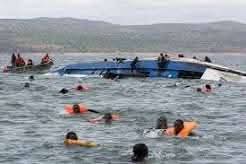
Kariba ferry disaster death toll rises to 73
The death toll from the Lake Kariba ferry disaster has risen to 73 after 27 more bodies were recovered yesterday, as preliminary investigations began pointing to a navigational error, possible overloading and failure to heed adverse weather warnings as factors that may have contributed to the tragedy.
The latest recovery brings the number of bodies retrieved from the lake to 73, five days after the passenger vessel capsized last Tuesday, with rescue teams continuing to search for more victims.
The disaster, which occurred when the overloaded vessel was hit by a strong wave and overturned, has been declared a National Disaster by President Mnangagwa.
A technical report on the accident is expected to be presented to Cabinet on Tuesday, as investigators race to establish the circumstances that led to one of the worst maritime disasters on Lake Kariba.
Lieutenant-Colonel Joseph Muchechesi, who is involved in the recovery operation, said by yesterday afternoon teams had recovered 22 bodies.
“So far today (yesterday afternoon) we have managed to retrieve 22 bodies and the rescue operation is still going on,” he said.
“Yes, this is the fifth day since the tragedy happened, but if you check the milestone that we have reached, it means we are confident that we will manage to retrieve all the bodies.”
By evening yesterday, five more bodies were recovered to move the day’s tally to 27.
Lt-Col Muchechesi said the cold conditions on the lake were affecting the rate at which bodies were surfacing.
“Normally, in hot weather, it takes the bodies about three days to float and ascend to the surface, but now that it is very cold it takes a bit longer,” he said.
“We are expecting that by the seventh day all the bodies will be floating on the surface. We are confident and I assure you that we will get all the bodies so that they can be accorded decent burials.”
While the recovery operation continues, investigators are piecing together evidence from the vessel, the weather conditions and communications between the captain and the Lake Navigation Centre.
Local Government and Public Works Minister Daniel Garwe told Government officials in Kariba last week that President Mnangagwa wanted a technical report ready for Tuesday’s Cabinet meeting.
Preliminary findings suggest that the vessel’s physical condition may not have been the cause of the accident.
*Mother floored as family fights over ngozi cattle*
A MAKONI family has been plunged into bitter wrangles over the distribution of eight cattle paid as compensation for the avenging spirit (ngozi) of a murdered aunt, with the dispute ending up before Chief Makoni’s community court.
At the centre of the family feud are brothers, Enford and Kenneth Chinembiri, who are battling over who had the authority to oversee the sharing of the beasts.
Enford accused his younger brother of unlawfully presiding over the distribution of the cattle while he was away, arguing that as the eldest son and custodian of the family’s traditional heirlooms, tsvimbo dzemusha (ancestral knobkerries), he alone had the authority to sanction such a process.
“Kenneth and I are blood brothers. Our father died in 1997, and I inherited two family knobkerries, one belonging to my father and the other to our late grandfather who died in 1988,” said Enford.
He explained that the cattle in dispute were paid by the Bangure family as compensation after their son-in-law allegedly murdered his aunt, Sinoria Chinembiri.
“During proceedings before this court in 2022 over Tete Sinoria’s ngozi, the Bangure family was ordered to compensate us. To my surprise, Kenneth moved ahead and distributed the cattle in my absence despite knowing that I am the custodian of our grandfather’s knobkerrie, which culturally makes me responsible for matters concerning the family,” he said.
However, Kenneth dismissed the allegations, instead accusing his elder brother of using his traditional status to intimidate relatives and frustrate family decisions.
“We lived peacefully as a family for years, but things changed after Enford retired and returned to the village. Since then, there has been no peace.
“Whenever anyone disagrees with him, he reminds them that he is the eldest son and the holder of the family knobkerries. He believes that gives him authority over everyone else,” he said.
Kenneth said it was, in fact, Enford who had initially called family members together to discuss distribution of the cattle.
According to Kenneth, the meeting failed when Enford sought to link the issue to unrelated family grievances, including demands for land and proposals for the allocation of responsibility over certain aunts within the extended family.
“He wanted a piece of land, wanted us three brothers to formally share responsibility for our aunts, and also wanted the ngozi cattle distributed. When family members rejected some of his demands, he refused to proceed and attempted to block the distribution exercise,” Kenneth said.
He claimed family members later resolved to proceed with the process.
“At the next meeting, he became angry, shouted at relatives and even disrespected Sekuru Chinembiri, who is 94 years old, as well as an elderly aunt from Mutoko who is over 80,” he said.
Kenneth further alleged that the confrontation turned physical when their mother attempted to calm Enford down.
“Our mother tried to restrain him, but he pushed her to the ground. She broke down crying. Family elders wanted to abandon the meeting because of his behaviour, but I persuaded them to stay so the matter could be concluded,” he told the court.
The eight cattle were subsequently distributed among eligible family members, with Enford also receiving a share despite his absence, Kenneth said.
Veteran family elder, Sekuru Chinembiri, backed Kenneth’s version of events, accusing Enford of disregarding elders and making unilateral decisions.
“Enford no longer respects his father’s brothers. He bypasses us and makes decisions on his own,” he said.
“The murdered aunt died when Enford was only six years old. I am the one who handled the ngozi process and the spiritual consultations relating to her demands. Yet when compensation cattle arrived, he stopped working with us.”
Sekuru Chinembiri further claimed that Enford had previously taken one beast and given it to another family without consulting relatives, while slaughtering another without informing other beneficiaries.
Enford denied acting unilaterally.
He argued that one beast was slaughtered following a family resolution after the death of his wife, while another was given to the Chikumbirike family, his late aunt’s maternal relatives, with the blessing of family members.
“I wanted the cattle to be distributed only after consulting the spirit of our late aunt so that she could guide us on how she wanted the beasts shared.
“I also wanted long-standing family issues, including land allocation, to be dealt with at the same time,” said Enford.
The family’s elderly matriarch delivered the most emotional testimony of the hearing, accusing her eldest son of becoming arrogant because of his possession of the traditional paraphernalia.
“Enford has become wayward because he holds the family’s traditional symbols of authority.
“He does not buy vaccines for the cattle, does not help care for them and has not even visited the kraal despite living in the village for two years,” she said.
She said she was heartbroken when her son allegedly pushed her during the dispute.
“That day I cried just as I cried when my husband died. Culturally, my eldest son is supposed to protect me, but instead he pushed me to the ground. He should remove his cattle from my kraal. Kenneth and his brothers help me care for the animals, while he does nothing. Tsvimbo ne hubaba hazvirime! (Knobkerries and seniority do not till the land),” she said.
After hearing submissions from both sides, Chief Makoni dismissed Enford’s complaint, ruling that Kenneth had not personally distributed the cattle and that the exercise had been carried out collectively by family members.
The chief, however, found Enford at fault for assaulting his mother.
“It is clear that the cattle were distributed by the family, not by Kenneth,” ruled Chief Makoni.
“As the eldest son, Enford must lead by example, humble himself and work with other family members. Leadership is about uniting people, not dividing them.”
The chief ordered Enford to give his mother a goat as an apology for the assault and urged him to use his position within the family to promote unity rather than conflict. _*ManicaPost*_
*Back from SA, found co-wife in bed*
A PENHALONGA woman claims that she was left homeless and struggling to support her children after her husband allegedly transferred ownership of their jointly acquired residential stand into his sole name while she was working in South Africa to help provide for the family.
Dorothy Gondo brought her complaint before Chief Mutasa’s community court last Saturday, alleging that her husband, Joseph Chikunguru, unlawfully removed her name from council records and took sole ownership of their stand in Tsvingwe.
Gondo said the stand was purchased in 2003 during their marriage, and was initially registered in her name.
“We bought our stand together in Tsvingwe, but along the way my husband started assaulting me. Whenever this happened, I would flee to my relatives for shelter,” she said.
She recounted that during one of her returns home, she found another woman living at the property.
“On one occasion when I returned, I found another woman there. My husband introduced her as his aunt and I accepted it. Later, I came back again and found Anesu Sarumhungwe sitting on our bed.
“I asked my husband whether she was his lover and he became violent. He heavily assaulted me and I had to be taken to South Africa for medical treatment,” said Gondo.
Gondo said her move to South Africa was not only prompted by the need for medical treatment, but also by a desire to earn money to contribute towards the construction of their family home.
She said after returning with building materials, she asked Chikunguru to collect them from Mutare. Instead, she said, he informed her that their relationship was over.
“He simply told me that he was done with me,” she said.
Following the breakdown of their relationship, Gondo said she visited the Mutasa Rural District Council offices to verify ownership of the stand and was shocked by what she discovered.
“When we bought the stand, my name was on the council records. But when I went to council to make inquiries, I discovered it was no longer there, and the stand had been registered in his name.
“He did not give me any divorce token or indication that our marriage had been dissolved. He just told me he was done with me.
“Now I am struggling with my children. We do not have a home and survive by selling produce on the streets, while he is developing the stand we jointly acquired together with his new mistress,” she said.
However, Chikunguru disputed Gondo’s account, maintaining that although the stand was acquired during their marriage, he was the one who financed the purchase.
“Although we jointly acquired the stand during our marriage, I am the one who provided the money. Her name was initially used when the stand was acquired, but the money belonged to me,” he told the court.
Chikunguru further claimed that Gondo left for South Africa in 2008 against his wishes, despite his objections that she should remain with her family in Zimbabwe.
“I told her I did not agree because we were married and she had a family here, but she insisted and eventually left,” he said.
According to Chikunguru, Gondo later returned and found him in a relationship with Sarumhungwe before leaving again.
“She stayed away for a long time and only came back with these claims in 2026, after I had already developed the stand and built the house to window level. This is a person who left in 2008,” he said.
Chikunguru also argued that the stand had been repossessed by Mutasa Rural District Council after it remained undeveloped beyond the stipulated period.
He claimed he subsequently repurchased the property and formalised ownership through a notarial deed registered in his name.
Sarumhungwe, now Chikunguru’s wife, denied allegations that she had broken up the couple’s marriage.
She said: “When I met this man, she had already left him. I did not chase her away from her home or snatch him from her. I married Chikunguru in 2008 after Gondo had already left.”
Chief Mutasa said his court was unable to make a definitive ruling on the ownership dispute without clarification from Mutasa Rural District Council regarding the property’s registration history.
He instructed Gondo to formally engage the local authority and obtain records detailing the original allocation of the stand, the alleged repossession process and the subsequent transfer of ownership.
“The council has the records and must explain what happened to this stand.
“Gondo should make a formal follow-up with the local authority so that the ownership history can be established clearly,” said Chief Mutasa. _*ManicaPost*_