Can Africa turn its huge solar potential into reliable electricity?
By Desire Tshuma
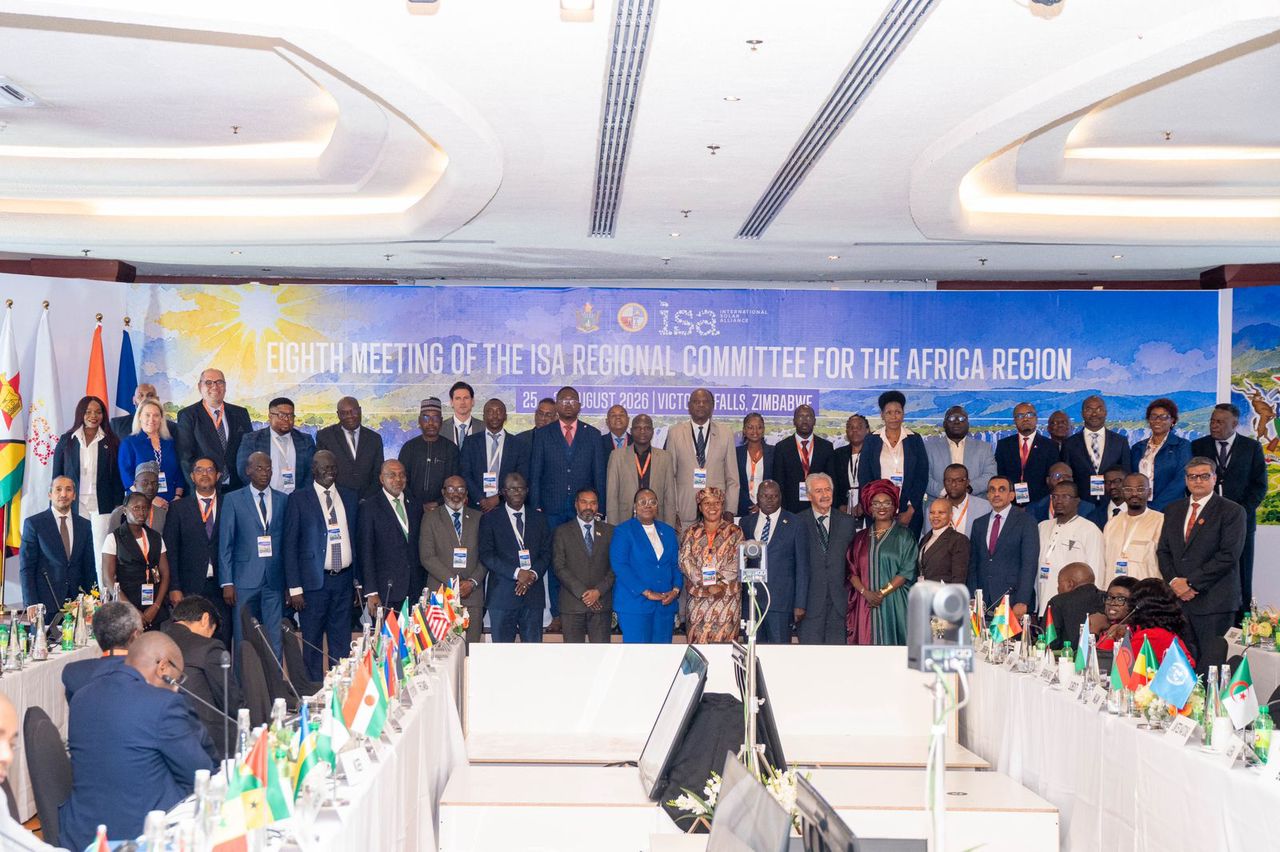
VICTORIA FALLS – Africa has some of the world’s richest solar resources. But turning that natural advantage into reliable electricity remains a major challenge. That was the message from political leaders and energy officials meeting in Victoria Falls, Zimbabwe, for the eighth Regional Committee Meeting for Africa of the International Solar Alliance.
Zimbabwean President Emmerson Mnangagwa opened the meeting by calling for Africa to move from discussion to action.
He said solar energy should be used not only to increase electricity access but also to support industry, agriculture, jobs and economic growth.
“Africa possesses some of the world’s richest natural endowments,” Mnangagwa said.
He said solar resources should help African countries industrialise and modernise. But building more solar plants will not be enough. Countries also need stronger electricity grids, energy storage and ways of moving power across borders.
African Union Commissioner for Infrastructure and Energy Lerato Dorothy Mataboge said energy was at the heart of the continent’s development plans.
“Africa does not need one solar model,” she said.
She called for a mix of large solar plants, mini-grids, stand-alone systems and distributed power for businesses and industry. She also highlighted a major obstacle, the cost of finance.
“Our greatest constraint remains finance, and particularly the cost of capital,” Mataboge said.
She said many African energy projects are technically viable but struggle because financing is too expensive. Development finance and concessional funding, she argued, should be used to reduce risks and attract private investors.
The International Solar Alliance says it is trying to help address that problem. At the meeting, it launched an Africa Solar Facility designed to operationalise a $200 million fund for distributed renewable-energy projects.
The facility will focus on projects serving rural communities, farmers, small and medium-sized businesses and other energy users. The alliance also launched a new strategy called Solarising Africa.
It sets out a pathway for expanding solar capacity across the continent from about 20-22 gigawatts today to as much as 150-200 gigawatts by 2030. The target rises to 500 gigawatts by 2040 and 1 terawatt by 2050.
The strategy focuses on four areas, which are distributed renewable energy, solar-powered agriculture, electric mobility and large-scale solar linked to stronger electricity grids. Agriculture is emerging as a major part of the strategy.
The ISA launched a Community of Practice on the solarisation of agriculture in Africa during the meeting. It will allow countries to share experience on solar irrigation and agrivoltaics, which combine agriculture with solar generation.
Six countries, Uganda, Zimbabwe, The Gambia, Ghana, Senegal and Rwanda endorsed the Zimbabwe Declaration on solar water pumps and agrivoltaic solutions. A solar-water-pumping e-learning programme was also launched to help farmers access practical information about the technology.
The ISA says these programmes could help farmers improve access to water and electricity while supporting food production. India’s ambassador to Zimbabwe, Bramha Kumar, said India’s experience showed what sustained investment and collective action could achieve.
He said India remained committed to sharing its experience with African countries through the International Solar Alliance.
Seychelles Environment, Climate, Energy and Natural Resources Minister Marie-May Jeremie said Africa’s solar deployment remains far below its potential. She said solar, storage and stronger electricity networks could help countries improve energy security and reduce dependence on imported fuels.
“Africa’s energy transition is gaining momentum, but deployment remains far below the continent’s immense potential,” Jeremie said.
ISA Director General Ashish Khanna said Africa was ready to move from megawatts to gigawatts of solar.
He pointed to stronger political support and falling costs for solar and storage. The alliance is also linking its solar plans with Mission 300, the wider effort to connect 300 million Africans to electricity by 2030.