
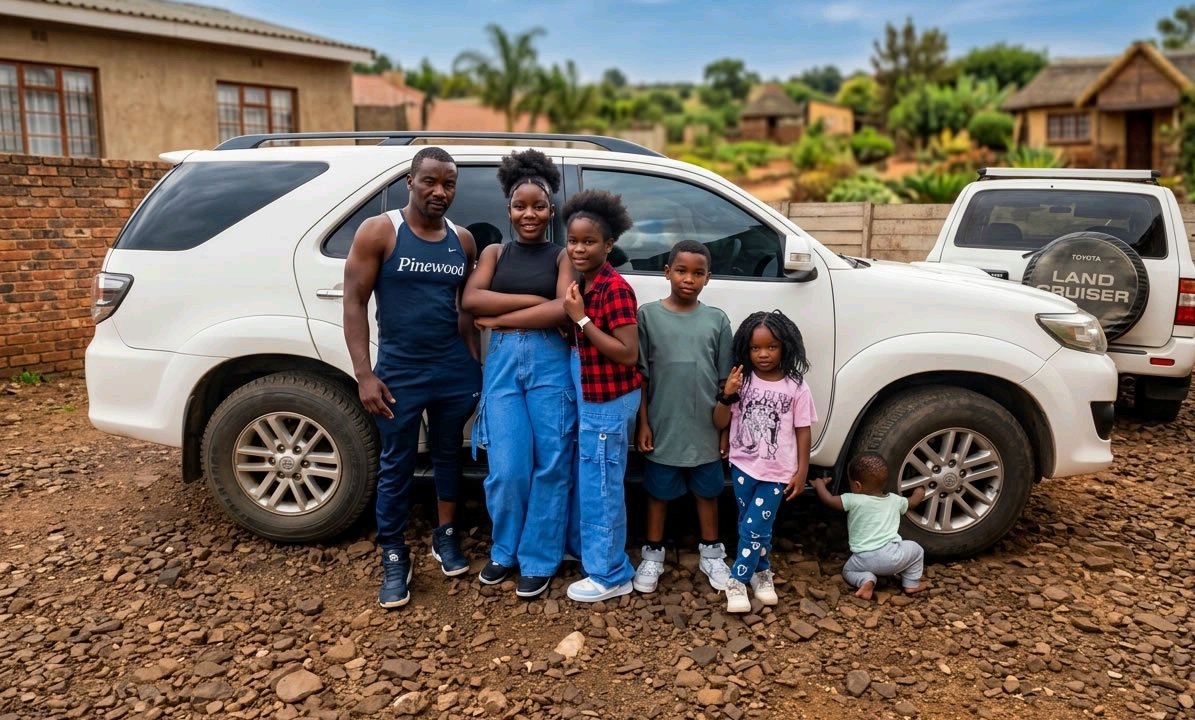
Wicknell Chivhayo donates Fortuner, US$50 000 as chema to Ronald Mujuru
HARARE – The silence that now pervades the Mujuru residence in Tynwald North is not merely the absence of sound; it is a heavy, suffocating shroud that speaks of a life abruptly and violently extinguished. For Ronald ‘General’ Mujuru, a man once known for his vibrant presence in the music industry and his unwavering devotion to Dynamos Football Club, the world as he knew it ceased to exist at approximately 09:50 AM on Thursday, 2 April 2026. In a single, horrific moment at the 246-kilometre peg along the Harare-Masvingo Highway, an entire lineage was wiped out.
The scale of the loss is almost impossible to comprehend. Mr Mujuru did not merely lose a relative; he lost his wife, Lilian Maranda Mujuru, 40, and all five of their children: Nokutenda, 15; Makanaka, 13; Ronald Junior, 11; Rufaro Shalom, 7; and the youngest, Kayden, just 3 years old. They were travelling in a Toyota Corolla, headed towards Zvishavane for a church conference of the Latterrain Saints Church, a journey of faith that ended in a mangled heap of metal near the Chatsworth turn-off.
The Ominous Silence of a Thursday Afternoon
For Precious Mukondo, the family’s maid, the tragedy began with a phone call that would haunt her forever. She had been a constant presence in the Mujuru household, more a family member than an employee. She had been invited to join the family on their trip to the church conference, as she often did, but on this occasion, a simple decision to stay behind saved her life.
“Mom (Lillian) and the kids were going to a Church Conference. I used to go with them but this time I said I wasn’t going,” she recounted, her voice breaking as she wiped away tears. “She just said goodbye as she always does when she was leaving. I didn’t know that was the last she could physically say to me.”
The call came in the afternoon from a police officer using Lilian’s mobile phone. The officer’s questions about her address and her relationship to the owner of the phone sent a chill through her. Confused and terrified, she passed the officer’s number to Mr Mujuru. The reality that followed was a nightmare from which there is no waking.
The Mujuru residence, once filled with the chaotic energy of five growing children, is now a place of haunting stillness. The toys that were left behind, the schoolbooks that will never be opened again, and the silence where laughter used to be, serve as a constant, brutal reminder of what was lost. The youngest, Kayden, only three years old, was the baby of the house, a child whose life was only just beginning. Nokutenda, at fifteen, was entering the threshold of adulthood, her future bright with possibility. In an instant, these futures were erased, leaving behind a void that no amount of community support can ever truly fill.
The Mujuru family was not just a statistic; they were a vibrant part of their community. In the days following the accident, the Tynwald North community rallied together, holding a multi-denominational prayer meeting that saw representatives from Christ Ministries, the Baptist Church, the Salvation Army, and many others. Under the light showers of a sombre evening, the community knelt in intercession. The diversity of the churches represented—from the United Methodist Church to Celebration Church and ZAOGA—underscored the broad impact this family had on those around them.
“We are not expecting any human voice other than that of the creator,” one church leader remarked during the service. The message to Ronald was clear and poignant: “Among all to be protected, guard your heart jealously.” The community’s collective grief was palpable, a shared burden in the face of a loss that felt too heavy for any one man to bear. The praise and worship team, drawn from various denominations, led the gathering in spiritual hymns that provided a temporary sanctuary of sound against the crushing silence of the Mujuru home.
A Nation in Mourning: From the First Lady to the ‘Glamour Boys’
The tragedy has resonated far beyond the suburbs of Harare, reaching the highest offices in the land. On Tuesday, 8 April 2026, the First Lady, Dr Auxillia Mnangagwa, visited the Mujuru home to personally convey her condolences. Her presence was seen by many as a powerful gesture of national solidarity.
“As a mother and grandmother, I am still deeply pained by this unimaginable loss, and I continue to stand with Mr Mujuru and the entire family, relatives and friends in this moment of profound grief,” the First Lady shared in a tribute. “May the Almighty God continue to grant them strength, comfort and peace, and may our nation unite in prayer and compassion. May the departed dear souls rest in eternal peace.”
For Mr Mujuru, a lifelong supporter of Dynamos FC—affectionately known as DeMbare—solace also came from the football pitch. The club’s executive, led by CEO Desmond Bvute and Secretary General Divine Sena, visited the grieving father, bringing with them a VVIP season ticket and a significant condolence token. This visit was more than just a formal gesture; it was a meeting of hearts between a fan and his heroes.
His mother, Shelly Mujeri, watched in surprise as her son, who had been catatonic with grief for nearly a week, managed a weak smile as he joined the team in song. “I am shocked that he was able to really get to jump and smile with the Dynamos players,” she said. “I am really struggling to think this is real. I was very close to my daughter-in-law and my grandchildren.”
Mr Mujuru himself admitted that the visit provided a momentary reprieve from the crushing weight of his sorrow. “I feel like a huge lump on my chest has been removed,” he said. “You know when you see a team, very close to your heart, a team that is your second home coming to your first home to say sorry, it just means everything.” The “Glamour Boys” had demonstrated that they were more than just a football club; they were a family that looked after its own.
The Chivhu Connection and a Controversial Gift
The family was laid to rest side-by-side on Sunday at the family farm in Wilshire, Chivhu. The burial took place just a day before Easter Monday, the day they were supposed to return to Harare. The sight of six caskets, arranged in a row, was a visual testament to the absolute annihilation of a family unit. The location of the burial holds deep significance for prominent businessman Wicknell Chivayo, who also hails from the Chivhu area.
Chivayo, moved by the tragedy and the shared connection to his home district, announced a massive donation to Mr Mujuru: US$50,000 in cash and a brand-new 2026 Toyota Fortuner valued at US$80,000. In a lengthy Facebook post, Chivayo expressed his horror at the event, writing with a raw emotion that transcended his usual public persona.
“At a time when the CHRISTIAN community in Zimbabwe and across the world was celebrating the EASTER HOLIDAYS, I learnt with DEEP SHOCK the HEARTBREAKING news of a road traffic accident in which SIX LIVES were lost in the most painful and UNIMAGINABLE way. Those precious and YOUNG lives lost were all from the MUJURU FAMILY. I was out of the Country when this TRAGEDY happened, and I am even more SADDENED that our dear brother RONALD MUJURU, lost his beloved WIFE and all FIVE of his CHILDREN in this gruesome accident. May their dear souls rest in ETERNAL PEACE. 🕊️
It is the most difficult and UNIMAGINABLE thing for any parent to bury a CHILD, but to bury FIVE CHILDREN and at the same time, bury your WIFE is the MOST HORRENDOUS thing that no human heart should ever be asked to endure. My brother Ronald, NO WORDS can ever console you, nor can they restore what has been taken, and no one can imagine waking up to such a CRUEL REALITY. The loss of an entire family dims the very PURPOSE of waking up each day and WORKING HARD for those we LOVE the most. I share this grief as a Zimbabwean and as your own HOMEBOY from Zabe in Chivhu, which is so close to our Wiltshire Commercial Farms in Gandami where I was born and raised.”
Chivayo’s gesture, while generous, comes amid a broader national conversation about the safety of Zimbabwe’s roads and the systemic issues that contribute to such carnage. Some have questioned the timing of such high-profile donations, but for Mr Mujuru, the support—both emotional and financial—is a lifeline in his darkest hour.
Investigation: The ‘Death Trap’ Highway and Systemic Failures
The Harare-Masvingo Highway, a 585-kilometre artery vital to the nation’s economy, has long been dubbed a ‘death trap’ by those who traverse it regularly. While the government has made significant strides in its rehabilitation—with only 72 kilometres reportedly left to complete as of late 2025—the Mvuma stretch remains notoriously dangerous. The ongoing dualisation project, while a welcome development, has been criticised for its slow pace, leaving vast sections of the highway vulnerable to the very conditions that contributed to the Mujuru family’s tragedy.
The accident involved a head-on collision between the Mujuru’s Toyota Corolla and a Mercedes Benz haulage truck driven by 59-year-old Proof Mative, a resident of Cowdray Park. Initial police reports suggested that Lilian Mujuru lost control of her vehicle and veered into the path of the oncoming truck. However, investigative journalists and local motorists point to a more complex narrative that involves systemic infrastructure failures.
The highway is plagued by what locals call ‘phantom’ potholes—sudden, deep craters that appear overnight and are often obscured by the road’s uneven surface. On undivided sections of the road, swerving to avoid such a hazard can be fatal. The Mvuma area, in particular, has gained a grim reputation as a ‘black spot’ – a section of road where accidents are disproportionately frequent. Local residents and frequent travellers report that despite numerous appeals to authorities, these dangerous stretches, characterised by sudden dips, sharp curves, and uneven surfaces, have largely been ignored.
Furthermore, the presence of heavy-duty haulage trucks, some of which are allegedly operating with illicitly obtained ‘fitness certificates’, creates a perilous environment for smaller family cars. There are persistent whispers that ‘fitness certificates’ are sometimes illicitly obtained for unroadworthy trucks, allowing them to operate on the nation’s roads and pose a significant threat. This alleged corruption within the vehicle inspection system directly compromises public safety. The driver of the Mercedes Benz truck involved in the Mvuma accident, Proof Mative, was hospitalised in Bulawayo following the collision, highlighting the severe impact of the crash even on the operators of heavy vehicles.
Corruption within the Zimbabwe National Roads Administration (ZINARA) has been a recurring theme in parliamentary audits and forensic investigations. Allegations of financial irregularities, inflated contracts, and a general lack of accountability have plagued the organisation for years. These issues contribute to the deteriorating state of roads, creating conditions ripe for such devastating accidents. When funds meant for road repairs and upgrades are diverted for illicit gains, the human cost is measured in the lives of people like Lilian Mujuru and her children.
The Mvuma accident also brought into sharp focus the adequacy of emergency response services in rural areas. Reports indicated that the Mujuru family waited in the wreckage for an extended period, with bystanders attempting to assist without professional equipment. The lack of immediate professional medical and rescue services in the immediate aftermath of the crash is a deeply troubling aspect of this tragedy. Eyewitness accounts suggest that ordinary citizens, with no formal training or appropriate tools, were the first responders, bravely attempting to free the trapped victims. This reliance on untrained civilians underscores a critical gap in Zimbabwe’s emergency infrastructure, where the absence of readily available ambulances and specialised rescue equipment can mean the difference between life and death.
The Broader Context: Easter Holiday Carnage
The Mujuru tragedy occurred during a particularly bloody Easter holiday on Zimbabwe’s roads. According to the Zimbabwe Republic Police (ZRP) and the Traffic Safety Council of Zimbabwe (TSCU), the 2026 Easter period saw a disturbing rise in fatalities.
Metric
2025 Easter Period
2026 Easter Period
Change
Total Road Accidents
312
337
+8%
Fatal Accidents
21
22
+4.7%
Total Deaths
28
30
+7.1%
Number of Injuries
178
104
-41.5%
While the number of injuries saw a significant drop, the lethality of the accidents increased. The ZRP continues to cite ‘human error’—including speeding, overtaking errors, and fatigue—as the primary cause of 90% of these accidents. Yet, this official narrative often overlooks the role of crumbling infrastructure and the lack of dualisation on major highways. The TSCU has repeatedly called for stricter enforcement of traffic laws and better education for drivers, but without a parallel investment in the physical state of the roads, these measures are likely to have limited impact.
The Human Cost of a Crumbling Infrastructure
The tragedy of the Mujuru family is not just a personal loss for one man; it is a national indictment. It highlights the urgent need for the completion of the Harare-Masvingo-Beitbridge dualisation project and a more rigorous approach to vehicle roadworthiness and road maintenance. The fact that an entire family can be wiped out on a major national highway is a sign of a system that is failing its citizens.
As the nation moves on from the 2026 Easter holiday, the image of six graves side-by-side in Chivhu remains a haunting symbol of the cost of highway carnage. For Ronald Mujuru, the brand-new Toyota Fortuner and the cash donation from Wicknell Chivayo may provide some material support, but they cannot fill the void left by a wife and five children who will never come home. The memories of his children—Nokutenda’s dreams, Makanaka’s laughter, Ronald Junior’s energy, Rufaro Shalom’s smiles, and little Kayden’s innocence—are now all that remain.
The question remains: how many more families must be ‘annihilated’ before the ‘death trap’ highways of Zimbabwe are truly made safe? The investigation into the Mvuma accident may eventually close its files, but for the people of Zimbabwe, the road to safety remains long and fraught with peril. The government’s promises of “modernisation” and “rehabilitation” ring hollow as long as families continue to be decimated on the nation’s most vital transport routes.