
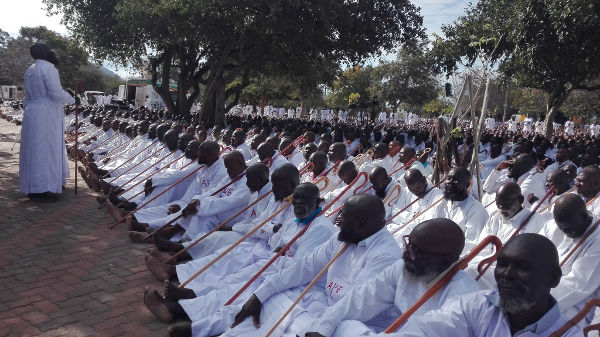
“They Are Chivhayo’s Proxies With a Hidden Agenda”: Critics Blast Vapostori “Development” Talks With Harare Council as a Smokescreen Sent to Seize Land, Build an Urban Support Base for the President, and Muffle CAB3 Protests
HARARE – In an unexpected shift in municipal relations,
representatives from the Johane Masowe apostolic sect—widely
identified by observers as disciples of the high-profile,
ZANU-PF-aligned tycoon Wicknell Chivhayo—have entered into direct
talks with the Harare City Council over collaborative urban
development initiatives. Historically, interactions between Town House
and the ‘Vapostori’ have been purely regulatory, confined to public
health enforcement regarding open-air worship, a lack of sanitation,
and informal settlements in suburbs like Budiriro and Highfield.
However, this sudden turn toward structured “development projects” has
ignited a fierce political debate, with critics, civil society groups,
and political analysts questioning the true motive behind the sudden
partnership. Some detractors have gone so far as to describe the
faction as “sheep in wolves’ clothing,” alleging that the guise of
civic development masks a calculated plot to expand ruling-party
influence, exploit congregants, and systematically neutralize internal
dissent.
Skeptics argue that the proposed “development projects” serve as a
convenient smokescreen. Independent commentators suggest that by
engaging the local authority under the banner of civic progress,
Chivhayo’s influential religious faction aims to fast-track the
formalization and allocation of prime municipal land. The ultimate
goal, critics allege, is to establish permanent apostolic shrines and
churches across every corner of Harare. By embedding these religious
structures across a traditionally opposition-leaning metropolitan
area, observers contend the faction can aggressively expand its
territorial footprint. In Zimbabwe’s highly charged political
landscape, analysts point out that an allocated church site is rarely
just a place of worship; critics view it as a highly mobilized,
self-sustaining community hub capable of shifting local geopolitical
dynamics.
The political subtext of this alliance, according to critics, points
directly toward bolstering support for President Emmerson Dambudzo
(ED) Mnangagwa. Wicknell Chivhayo’s unwavering backing of the
President and ZANU-PF is heavily documented, punctuated by
high-profile donations of luxury vehicles to church leaders and
influencers. Political analysts assert that the *Vapostori* are being
strategically positioned to act as a formidable urban support base for
the President. Critics argue that through structured council
partnerships, the sect gains institutional legitimacy, which they can
leverage to recruit and retain thousands of followers. Civil society
watchdogs claim this institutional capture is designed to command a
disciplined block of voters in the heart of Zimbabwe’s capital,
chipping away at the opposition’s traditional metropolitan
strongholds.
Perhaps the most critical angle raised by opponents is how this
structure could be weaponized to diffuse the growing public friction
surrounding the controversial Constitutional Amendment Bill No. 3
(CAB3). Insiders and political opponents allege that by utilizing the
strict, hierarchical command structure of Chivhayo’s *Vapostori*,
handlers can easily manipulate massive numbers of congregants. Because
doctrine within these sects demands absolute obedience to leadership,
critics argue that the political narrative can be tightly controlled
from the pulpit. Commentators contend that this partnership could
systematically neutralize internal dissent, framing any questioning of
state policy or the CAB3 controversy as spiritual rebellion. According
to this viewpoint, the strategy aims to pacify a huge demographic and
ensure that any growing public dissatisfaction is quietly managed
before it translates into civic protest. As Town House continues to
engage with Chivhayo’s disciples, Harare residents and political
watchdogs remain deeply divided over whether these “development
projects” represent genuine civic cooperation or a highly
sophisticated strategy for political engineering.
*Harare Residents Reject 2030 Agenda: Critics Slam Masimirembwa’s “ED Extension” Proclamations*
HARARE – Constitutional experts, civil society organizations, and
ordinary citizens have strongly condemned statements made by ZANU-PF
Harare provincial chairman Godwill Masimirembwa, accusing him of a
clear and deliberate misrepresentation of the will of Harare residents
regarding the controversial Constitutional Amendment Bill No. 3, also
known as CAB3. This follows Masimirembwa’s declaration that the
capital city fully supports extending President Emmerson Mnangagwa’s
tenure. He boldly claimed that the province still wants President
Mnangagwa to lead from 2030 to 2037 and that he must lead the party,
insisting that this is what Harare is saying. However, critics and
independent analysts have swiftly pushed back, arguing that
Masimirembwa’s statements completely ignore the true sentiments of
Harare’s population and override the democratic framework established
in the 2013 Constitution.
The reality on the ground concerning CAB3 paints a vastly different
picture from Masimirembwa’s assertions because Harare has historically
voted overwhelmingly for the opposition and remains highly critical of
attempts to manipulate the country’s supreme law. Political analysts
note that CAB3 marks a massive structural shift by replacing the
direct popular election of the President with a system where the
leader is chosen by a joint sitting of Parliament. Harare residents,
who pride themselves on direct political participation, strongly
reject being stripped of their right to vote directly for the head of
state. Furthermore, the bill extends presidential and parliamentary
terms from five to seven years, pushing the next general election from
2028 out to 2030. Legal experts argue this is a constitutional
maneuver designed specifically to bypass the two-term limit that
required Mnangagwa to step down in 2028. Under Section 328 of the
Constitution, any amendment extending term limits cannot legally
benefit the incumbent and must be put to a public referendum. The
government’s decision to bypass a referendum has caused widespread
anger across Harare’s suburbs, where residents feel their voices are
being actively suppressed.
Political commentators and legal analysts have slammed these
legislative maneuvers, stating that CAB3 dismantles the democratic
gains achieved a decade ago. Critics from various constitutional
defense forums argue that Masimirembwa cannot speak for a province
where millions are suffering from hyperinflation, unemployment, and
crumbling infrastructure. They maintain that claiming Harare residents
want an extension of this governance up to 2037 is not just a
misrepresentation but an insult to the intelligence of the voters.
Civil society groups have further noted that the ninety-day public
consultation period required before the bill’s passage was largely
treated as a formality, with ruling party elites ignoring overwhelming
public pushback. While ZANU-PF structures continue to orchestrate
loyalty pledges, independent observers maintain that the true voice of
Harare remains firmly opposed to the entrenchment of one-man rule.
HARARE – In an unexpected shift in municipal relations,
representatives from the Johane Masowe apostolic sect—widely
identified by observers as disciples of the high-profile,
ZANU-PF-aligned tycoon Wicknell Chivhayo—have entered into direct
talks with the Harare City Council over collaborative urban
development initiatives. Historically, interactions between Town House
and the ‘Vapostori’ have been purely regulatory, confined to public
health enforcement regarding open-air worship, a lack of sanitation,
and informal settlements in suburbs like Budiriro and Highfield.
However, this sudden turn toward structured “development projects” has
ignited a fierce political debate, with critics, civil society groups,
and political analysts questioning the true motive behind the sudden
partnership. Some detractors have gone so far as to describe the
faction as “sheep in wolves’ clothing,” alleging that the guise of
civic development masks a calculated plot to expand ruling-party
influence, exploit congregants, and systematically neutralize internal
dissent.
Skeptics argue that the proposed “development projects” serve as a
convenient smokescreen. Independent commentators suggest that by
engaging the local authority under the banner of civic progress,
Chivhayo’s influential religious faction aims to fast-track the
formalization and allocation of prime municipal land. The ultimate
goal, critics allege, is to establish permanent apostolic shrines and
churches across every corner of Harare. By embedding these religious
structures across a traditionally opposition-leaning metropolitan
area, observers contend the faction can aggressively expand its
territorial footprint. In Zimbabwe’s highly charged political
landscape, analysts point out that an allocated church site is rarely
just a place of worship; critics view it as a highly mobilized,
self-sustaining community hub capable of shifting local geopolitical
dynamics.
The political subtext of this alliance, according to critics, points
directly toward bolstering support for President Emmerson Dambudzo
(ED) Mnangagwa. Wicknell Chivhayo’s unwavering backing of the
President and ZANU-PF is heavily documented, punctuated by
high-profile donations of luxury vehicles to church leaders and
influencers. Political analysts assert that the *Vapostori* are being
strategically positioned to act as a formidable urban support base for
the President. Critics argue that through structured council
partnerships, the sect gains institutional legitimacy, which they can
leverage to recruit and retain thousands of followers. Civil society
watchdogs claim this institutional capture is designed to command a
disciplined block of voters in the heart of Zimbabwe’s capital,
chipping away at the opposition’s traditional metropolitan
strongholds.
Perhaps the most critical angle raised by opponents is how this
structure could be weaponized to diffuse the growing public friction
surrounding the controversial Constitutional Amendment Bill No. 3
(CAB3). Insiders and political opponents allege that by utilizing the
strict, hierarchical command structure of Chivhayo’s *Vapostori*,
handlers can easily manipulate massive numbers of congregants. Because
doctrine within these sects demands absolute obedience to leadership,
critics argue that the political narrative can be tightly controlled
from the pulpit. Commentators contend that this partnership could
systematically neutralize internal dissent, framing any questioning of
state policy or the CAB3 controversy as spiritual rebellion. According
to this viewpoint, the strategy aims to pacify a huge demographic and
ensure that any growing public dissatisfaction is quietly managed
before it translates into civic protest. As Town House continues to
engage with Chivhayo’s disciples, Harare residents and political
watchdogs remain deeply divided over whether these “development
projects” represent genuine civic cooperation or a highly
sophisticated strategy for political engineering.