
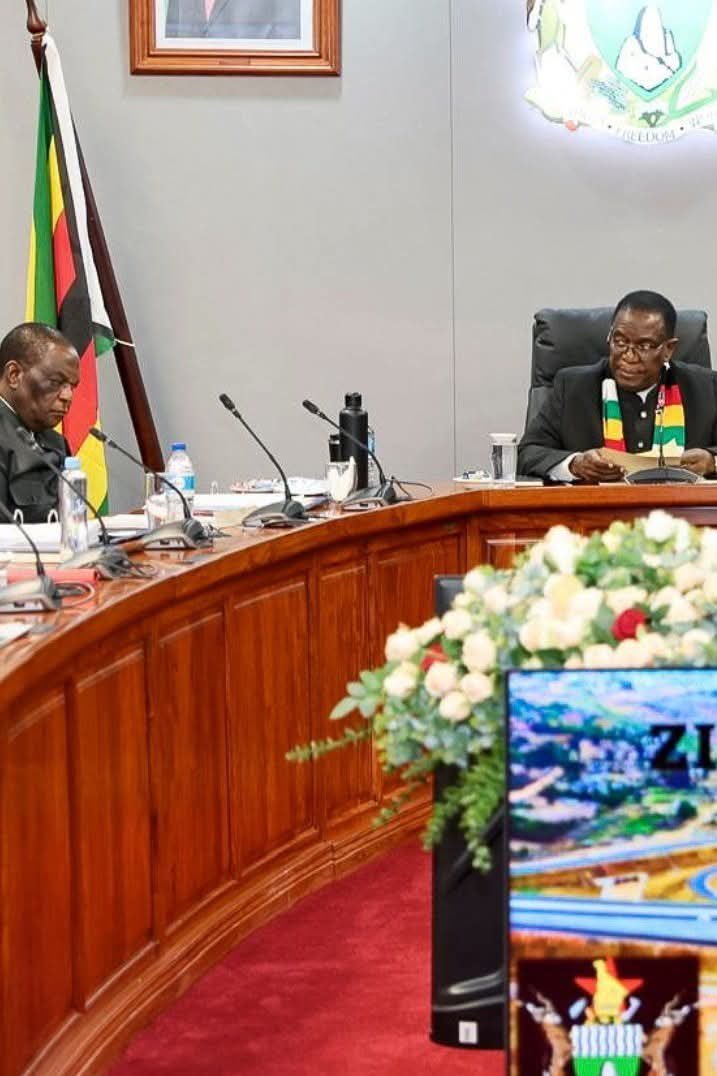
Strategic Enclosure; The Decoupling of the “Restorer” from the Presidency
Staff Writter
The current political landscape in Zimbabwe has undergone a seismic shift, evolving from the fragile military-civilian diarchy of 2017 into a consolidated Doctrine of Executive Primacy.
The recent move by the ZANU-PF cabinet to back a Constitutional Amendment Bill extending the presidential term to 2030, alongside the strategic neutralization of Vice President Constantino Chiwenga, represents a masterstroke of institutional enclosure.
For Chiwenga, the architect of the 2017 transition, these developments do not merely represent a delay, they constitute a structural “scuttling” of his presidential aspirations through a sophisticated application of political lawfare and administrative insulation.
The core of Chiwenga’s political strategy rested on the “gentleman’s agreement” of a single or two-term limit for President Emmerson Mnangagwa, theoretically opening a window for succession in 2028.
By advancing a bill to extend the term limit to seven years—effectively pushing the horizon to 2030—the incumbent has unilaterally shredded this timeline.
This move serves a dual purpose, temporal displacement,as it pushes Chiwenga’s opportunity further into a future where his primary currency,military influence continues to depreciate.
While constitutional experts note that such amendments typically requires a national referendum and cannot benefit the incumbent (Section 328 of the Constitution), the administration’s control over the Zimbabwe Electoral Commission (ZEC) and the judiciary suggests a confidence in “legalizing” the extension.
For Chiwenga, challenging this in the courts or the streets becomes a high-risk endeavor that borders on the “treasonous” labels already being circulated by Mnangagwa’s loyalists.
The analysis of recent stories reveals a systematic “hollowing out” of Chiwenga’s domestic support.
Historically, Chiwenga’s power was anchored in a “securitocracy”,a state where military elites held a veto over civilian politics.
Mnangagwa has dismantled this through Strategic Reassignment.
By moving military commanders loyal to the 2017 intervention into diplomatic posts abroad, the President has effectively “exiled” Chiwenga’s internal enforcement mechanism.
Furthermore, the introduction of parallel party structures such as the “Heritage” and “Empowerment” wings has redirected the patronage network.
In Zimbabwean politics, loyalty follows the treasury.
As Mnangagwa centralizes economic developmental narratives under “Vision 2030,” the grassroots and the business elite , have realigned with the presidency, leaving Chiwenga as a Vice President with an impressive title but no functional “bloc” in the Central Committee to trigger a leadership challenge.
Perhaps the most damaging blow to Chiwenga’s aspirations is the shift in the mode of governance.
The 2017 transition was a military solution to a political problem; the 2026 maneuvers are a legalistic solution to a military threat.
By moving the election of the President from a popular vote to a Parliamentary vote, the administration ensures that the party’s whipping system,controlled by Mnangagwa’s fixers,acts as a final gatekeeper.
”For Chiwenga, the move is more than a policy shift,it is a structural exclusion. The ‘crocodile’ has effectively drained the swamp, leaving the ‘general’ on high ground but without an army to command in the theater of civilian politics.”
The political trajectory for Constantino Chiwenga has narrowed into a corridor of diminishing returns.
The “Vision 2030” narrative has effectively overwritten the “Restorer” ethos of the 2017 intervention.
As the President’s camp consolidates control over the legal and legislative apparatus, the “automaticity” of succession that Chiwenga once relied upon has evaporated.
He remains trapped in a state of institutional entrapment, holding office while the very stairs he intended to climb are being dismantled beneath him.
.