
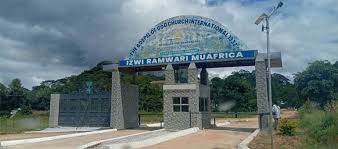
The Severed Conduit:When Soil Becomes Soul, The Untold Story of The Gandanzara Shrine.
In the cosmology of the Gospel of God Church International, the
Gandanzara Shrine is not merely a cemetery; it is a celestial portal.
The recent judicial mandates threatening to uproot the remains of
Johanne Masowe are viewed by the faithful as an act of “spiritual
vandalism.” To the congregation, the Prophet’s physical presence in
the earth of Gandanzara acts as a divine anchor. His remains are the
“battery” from which the church’s altars draw their potency.
The proposed relocation to a private farm in Marondera is viewed as a
metaphysical amputation. Church elders argue that by severing the
Prophet from his chosen resting place, the “anointing” of the church
will be extinguished. If the High Court allows the exhumation, the
devotees believe they will be left with hollowed ground—a religion
stripped of its spirit, leaving thousands of seekers wandering without
a spiritual compass.
________________________________
Option 2: The Political & Power Perspective
Focus: The struggle for succession, legitimacy, and the
“privatization” of a global icon.
The Throne and the Tomb: A Battle for Religious Hegemony
The legal battle over the Gandanzara Shrine masks a more cynical
struggle for institutional control. The move by Magaga Masedza to
relocate his father’s remains is seen by critics as a strategic coup
d’état. By physically controlling the Prophet’s remains on his private
property, Magaga effectively attempts to privatize a global
pilgrimage.
This is a monopolization of the sacred. If the remains are moved, the
thousands of international pilgrims who traditionally flock to
Gandanzara will be forced onto Magaga’s private estate, thereby
granting him an unearned mandate as the “New Throne.” The court’s
focus on the Cemeteries Act—a cold, statutory framework—fails to
account for the geopolitical shift this would cause within the
church’s hierarchy, potentially transforming a communal faith into a
family-owned enterprise.
________________________________
Option 3: The Humanitarian Perspective
Focus: The exploitation of the widows and the betrayal of the guardians.
The Betrayal of the Guardians: A Crisis of Ethics and Age
Beyond the legal jargon and the theological debates lies a
heart-wrenching human tragedy: the marginalization of the Masowe
widows. These elderly matriarchs have spent their lives as the vestal
guardians of the shrine, preserving the legacy of their late husband
with monastic devotion. Now, in the winter of their lives, they face a
calculated dispossession.
Magaga Masedza is accused of weaponizing his biological lineage to
bypass the spiritual authority of these women. By seeking to move the
grave, he is not just moving a body; he is evicting the widows from
their spiritual and physical home. This represents a cruel
intersection of elder abuse and patriarchal overreach, where the
intimacy of family ties is used as a tool to strip the church’s
“mothers” of their dignity and their standing as the protectors of the
faith.
________________________________