
70% VS 5%: THE LAND MIRROR SOUTH AFRICA CANNOT AFFORD TO IGNORE
_By Chiyedzo Josiah Dimbo — Ambassador of Hope_
_“You Cannot Build a Nation on Borrowed Soil.”_
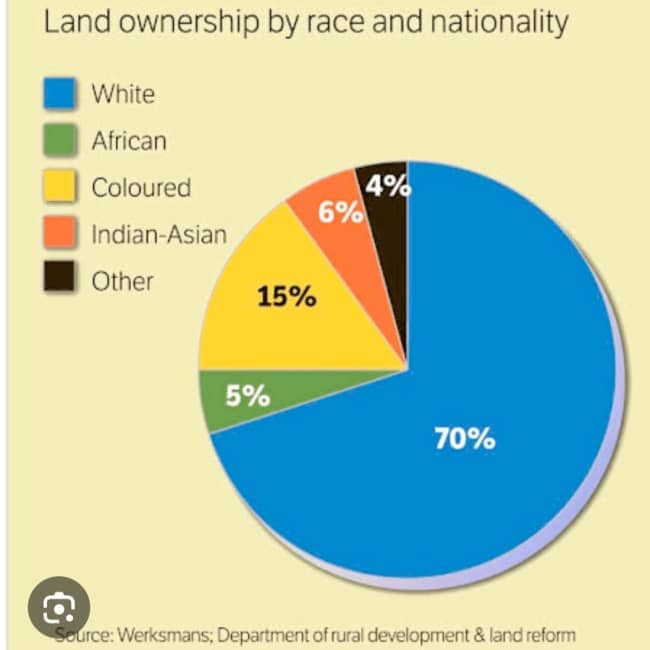
_JOHANNESBURG_ — A simple pie chart is breaking the internet again.
– *White: 70%*
– *African: 5%*
– *Coloured: 15%*
– *Indian-Asian: 6%*
– *Other: 4%*
_Source: Werksmans; Department of Rural Development & Land Reform_
One picture. 30 million conversations. One wound that has not healed in 30 years.
This is not about hate. This is not about revenge.
This is about _dignity, food, and the future_.
*THE MATH THAT DOESN’T MATH*
South Africa’s population is roughly 80% African. Yet according to this chart, Africans own _5%_ of the land being measured.
That is the pinch point — the moment laughter turns into anger. Because land is not just soil.
Land is a title deed. Land is collateral for a bank loan.
Land is food for your children. Land is a legacy for your grandchildren.
When 70% of productive land sits with 9% of the population, you don’t have a free market.
You have _a market built on a foundation of dispossession_.
_Key statistic:_ According to the 2022 Land Audit, white South Africans — 7.8% of the population — control 72% of total farmland. Meanwhile, black South Africans (81.4% of the population) hold just 4% of agricultural land. That’s a ratio of 18:1 in ownership per capita.
*WHERE THIS COMES FROM*
We cannot debate the present without naming the past.
The _1913 Natives Land Act_ restricted African ownership to 7% of South Africa. Apartheid expanded the theft — forced removals uprooted 3.5 million people between 1960 and 1980.
1994 brought political freedom. But the land question remained frozen.
Thirty years later — thirty harvests, thirty budgets, thirty land summits — the pie chart _still_ looks like this. And that is why the debate is so hot. Because _without land ownership, you have only half independence_. 80% of South Africans have realised flag independence minus economic independence. Land is the economy; the economy is land.
*ZIMBABWE’S LESSON: THE GOOD, THE BAD, THE UGLY*
As Zimbabweans, we know this pain intimately.
In 2000, we said “enough is enough” and began Land Reform Program.
– _The Good:_ Over 300,000 black Zimbabwean families received land. The white minority share of commercial farmland dropped from over 90% to roughly 10%. Dignity was restored for millions.
– _The Bad:_ Production collapsed — maize output fell from 2 million tonnes in 2000 to just 500,000 tonnes in 2008. The main reason: land was given without capital, inputs, irrigation, or training.
– _The Ugly:_ Hyperinflation hit 89.7 sextillion percent (November 2008). Illegal Sanctions followed. Food shortages became chronic. By 2016, 4 million Zimbabweans needed food aid.
We are still recovering. But one thing is clear: _land without support is just a plot_. Zimbabwe’s experience teaches that speed without strategy is collapse.
*THE AFRICAN CONTINENT’S LAND MIRROR*
South Africa is not alone in this struggle. Across the continent, the same wound bleeds:
– _Namibia:_ 70% of agricultural land is owned by white farmers, who make up less than 6% of the population. In 2023, the government launched a “willing-buyer-willing-seller” programme that has transferred only 5% of commercial land in 30 years.
– _Kenya:_ 0.1% of the population — 3,500 mostly white and Asian families — control 40% of arable land. Land clashes in the Rift Valley have killed over 1,500 people since 1991.
– _Zambia:_ The 1975 land reform nationalised all land, but corruption and lack of title have left 80% of rural farmers without formal ownership. They work plots averaging less than 2 hectares — impossible to escape subsistence poverty.
– _South Sudan:_ Land is abundant but governance is absent. Over 60% of land disputes are resolved by violence, not law.
The pattern is clear: wherever land is concentrated, conflict and poverty multiply. Where land is equitably distributed and titled, development accelerates.
*SOUTH AFRICA’S CROSSROADS*
SA is trying a different path:
– _Legislative_ — Expropriation Bill (2018, still not fully enacted). Willing-buyer-willing-seller has transferred only 1.2 million hectares in 25 years — less than 2% of agricultural land.
– _Judicial_ — Court processes to test constitutionality. The Constitutional Court has ruled that expropriation without compensation is permissible in specific cases, but the legal pipeline remains slow.
– _Market_ — Land redistribution grants. Since 1994, government has spent R12 billion on land acquisition, yet the 70% vs 5% ratio has barely moved.
But the pie chart in 2026 still looks like the pie chart in 2017.
That slowness is what makes young people say: _“We are tired of waiting.”_ A 2023 Afrobarometer survey found 68% of South Africans aged 18–35 believe land reform is moving _too slowly_.
*THE REAL PROBLEM ISN’T JUST OWNERSHIP. IT’S PRODUCTIVITY.*
Imagine if tomorrow we flipped the chart to 70% African ownership.
If those new farmers have no tractors, no irrigation, no cold rooms, no markets —
We will have more land owners, but less food. And hungry people don’t care who owns the farm.
Zimbabwe’s lesson again: after land reform, average maize yield per hectare dropped from 1.5 tonnes (pre-2000) to 0.7 tonnes (2005–2010). The issue wasn’t ownership — it was _productive capacity_.
That is why the debate must move from _“Who owns?”_ to _“Who produces?”_
_Statistic to answer that question:_ South Africa’s commercial farms — still majority white-owned — produce over 95% of the country’s food. Any land transfer without a parallel investment in black farming productivity risks a national food crisis. The ratio of white-owned to black-owned commercial farms is approximately 20:1.
*AMBASSADOR OF HOPE PROPOSAL: THE 3 PILLARS*
If we want justice _without_ collapse, we need:
– _LAND_ — Accelerate transfer, but with clear title. Communal, freehold, and leasehold options. Target: transfer 30% of agricultural land to black ownership by 2035, with measurable title security.
– _CAPITAL_ — A Land Bank that funds black farmers the same way commercial banks funded white farmers for 100 years. Current: black farmers receive less than 2% of total agricultural credit. Target: 30% by 2030.
– _MARKETS + SKILLS_ — Cold rooms, logistics, training. Link new farmers to Shoprite, Pick n Pay, and export. No more “produce and pray.” In 2023, black farmers produced an estimated R5 billion worth of crops but only 10% reached formal retail — the rest was lost, wasted, or sold at half price.
*AMBASSADOR OF HOPE CONCLUSION*
South Africa, Zimbabwe, Namibia, Kenya, Zambia, South Sudan, Mozambique — we all share one truth:
_You cannot build a nation on borrowed soil._
The 70% vs 5% chart is not an accusation. It is a _diagnosis_.
The cure cannot be chaos. The cure cannot be delay.
The cure must be _Justice + Production + Dignity_.
To our brothers and sisters in SA: Learn from our mistakes. Don’t repeat them.
Move fast, but move smart. Transfer land, but transfer capacity with it.
Because in the end, the goal is not to change the color on the pie chart.
_The goal is to make sure every child, black or white, goes to bed with a full stomach._
That is true freedom.
That is true ownership.